Dark Academia Display

In a move that was very much less what-do-I think-my-students-will-enjoy in favour of what-do-I-want-to-make-a-display-about, I decided to create a Dark Academia display for my school library.

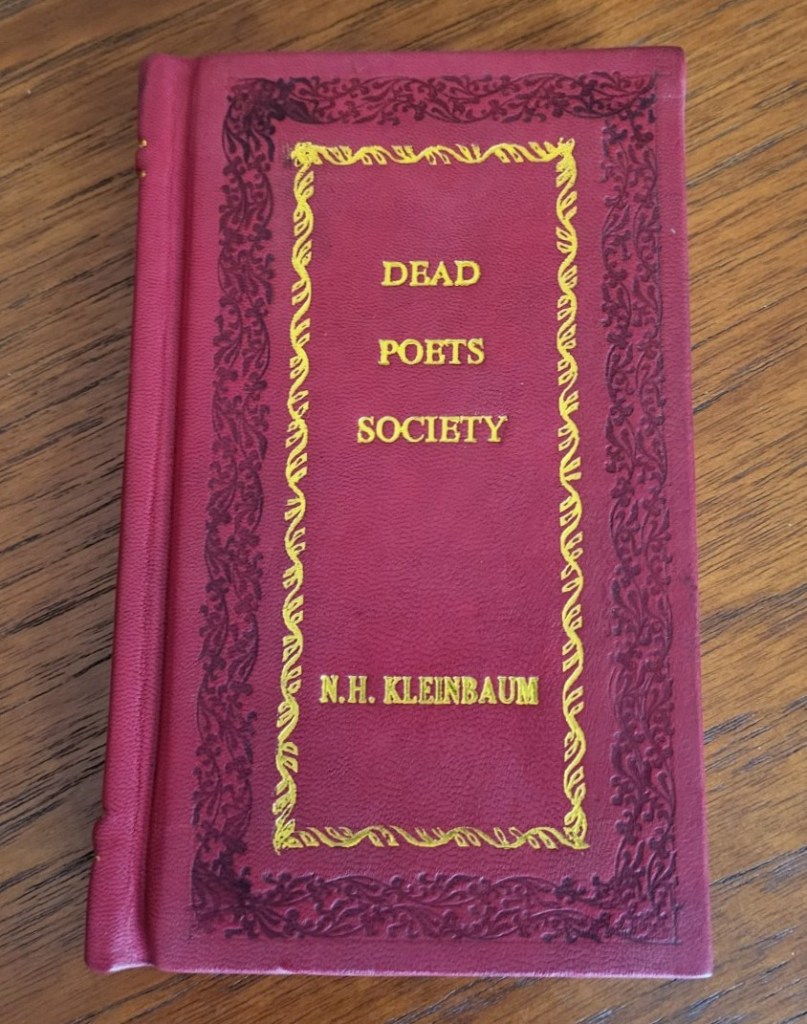
My fancy custom bound copy of
Dead Poets Society
(because I did not want to just have Robin William’s face on my bookshelf).

Ever since I read Donna Tartt’s The Secret History back in April, I have been on what can only be described as something of a Dark Academia fixation. I purchased a series of lectures from Signum University about Dark Academia, which I am still working (gloriously playing?) my way through, and I have been subjecting my poor, beleaguered Calum to every Dark Academia (and Dark Academia-adjacent) movie I could find. Some more enjoyable for him than others.

Bookwise, I’ve been dipping into various Dark Academia titles (If We Were Villains, Babel, the Atlas trilogy) only to stop partway through and move onto the next because I didn’t want any of them to end! I did read Hangsaman by Shirley Jackson and the ridiculous novelisation of The Dead Poets Society by N. H. Kleinbaum in their entireties – but then, I also gave each only two stars on Goodreads, so that maybe tells you something about my reading habits?

Anyway, on the pleasingly symmetrical date of 25/09/25, I finally completed the Dark Academia display I’d been working on since the school returned from the summer holidays. And I am proud enough of it to want to write about it.

Selecting the Books

I started by looking through our collection for existing Dark Academia titles. We already had a few young adult options: Ace of Spades had been nominated for the 2022 Carnegie awards, Atlas Six had been part of a recent donation to the school library, The Secret History and The Invisible Life of Addie La Rue had been purchased at the request of some students a few years ago, and a couple other books had been picked up along the way – often likely without Dark Academia in mind. (I can’t imagine anyone was thinking TikTok aesthetics when The Prime of Miss Jean Brodie was added to the collection back in 2010.)

At the end of last term, I had also cheaply purchased a set of young adult Dark Academia books from Scholastic, which meant we now had plenty of books to attract the older students. But I was still struggling for items that would appeal to our juniors. A Series of Unfortunate Events has The Austere Academy, which I added to my pile, and I was informed online that Lockwood and Co. has Dark Academia vibes (although, judging by the blurb, it reads less Dead Poets Society and more Dead Boy Detectives). To balance things out, I also ordered The Mysterious Benedict Society, which I had not read but enjoyed watching in its semi-recent TV adaption. If anyone has any 8-12-year-old Dark Academia recommendations, I would be very interested to hear them.

Incidentally, when the Scholastic pack arrived, I discovered I had already read one of the books in it. The Library of the Unwritten by A. J. Hackwith is a book that I had not only completed in 2021, but I had even given it five stars on Goodreads. This baffled me because, despite clearly enjoying it at the time, I must admit I hardly remember the book now. However, from what I do remember, although setting largely features a library in Hell, the book otherwise doesn’t seem especially Dark Academia. I wonder if it was perhaps lumped into the pack more because the Dark Academia category is currently selling well than because it actually explores any of the darker aspects of academia.

Perhaps, though, that is a somewhat hypocritical distinction. In scrambling for books to fill my display, I too broadened my scope for what counts as Dark Academia. (Looking at you, Picture of Dorian Gray.)

Designing the Display

The Completed Display

With the books selected, it was time to design the display itself. Across the top shelf, I draped a spiderweb tablecloth that I normally use for Halloween displays, and I piled up some of our oldest-looking tomes from the reserve section in the back office. I also unearthed a plastic compass that I had used for our Talk Like A Pirate Day display a few years ago, and I brought in a small Roman-style bust from home – because no Dark Academia display is complete without a small Roman-style bust.

Charlotte, the school library’s evening library assistant, created some Dark Academia recommendation bookmarks on Canva, which I thought was very cool. Finally, because the lower shelves looked quite bare, I bought some embroidered tapestry ribbon on Amazon to cover them, and I think the effect is quite nice. We can also use the ribbon for Christmas, so it is pleasingly performing double duty!

Reception

The display has proved quite popular, which I was very relieved by. In fact, before I could even get a photograph of the finished project, a sixth-form student had already taken out The Secret History! I also had a really lovely conversation with the head of the Lower School about the books – turns out she likes books about dragons too! – and I came away with several book recommendations, including Jodi Taylor’s The Chronicles of Saint Mary’s, which sounds very much up my street.

I even heard a group of students talking about how my display was ‘like TikTok’, and I still cannot decide whether that was a compliment. I am choosing to take it as confirmation that I am, in fact, ‘Down with the Kids’!

All in all, I was very happy with how the display turned out. And I thought it might interest you to know what books finally ended up on it. So I will leave you with the full booklist.

Booklist

Dark Academia Recommendations Bookmark
(Created by Charlotte Stevenson)

Junior

Shadowhall Academy: the Whispering Walls by Phil Hickes
The Austere Academy by Lemony Snicket
Who Could That Be At This Hour? by Lemony Snicket
The Mysterious Benedict Society by Trenton Lee Stewart
Lockwood & Co : the Screaming Staircase by Jonathan Stroud

Young Adult

Ace of Spades by Faridah Àbíké-Íyímídé
Where Sleeping Girls Lie by Faridah Àbíké-Íyímídé
A Dark Inheritance by H. F. Askwith
The Atlas Six by Olivie Blake
The Devil Makes Three by Tori Bovalino
Legendborn by Tracy Deonn
The Library of the Unwritten by A. J. Hackwith
Truly Devious by Maureen Johnson
A Lesson in Vengeance by Victoria Lee
The Raven Boys by Maggie Stiefvater
The Invisible Life of Addie La Rue by V. E. Schwab
A Language of Dragons by S. F. Williamson

Adult

Never Let Me Go by Kazuo Ishiguro
The Historian by Elizabeth Kostova
Babel by R. F. Kuang
If We Were Villains by M. L. Rio
The Prime of Miss Jean Brodie by Muriel Spark
The Secret History by Donna Tartt
The Picture of Dorian Gray by Oscar Wilde

Book Review: Maurice by E. M. Forster (or The 65th Anniversary of the Greatest Terminal Note Ever Written)

Back in May, I listened to the audiobook of E. M. Forster’s Maurice. I had picked up something of the story prior to reading it, most specifically that it was unable to be published in Forster’s lifetime due to containing a romantic relationship between two men that ended happily. And naturally the first half of the twentieth century would be having none of that.

These days, I listen to audiobooks significantly more than reading printed editions, due to most of my reading happening on walks or during my commute. In this case the experience of listening to the audiobook was particularly interesting to me. For one thing, I spent some time dithering between two versions of Maurice when deciding which narrator to listen to: Peter Firth or Ben Whishaw. I eventually landed on the latter, Whishaw being a slightly smoother voice. But having, through this elaborate selection process, listened several times to the opening preview of the book, in which Maurice is taken aside by a teacher at his boarding school for the Talk (anatomical drawings in the beach sand and all), it is one of the segments that remains most vividly in my memory. Whether I want it to, or not.

I also found that listening to an audiobook of the story dispelled me of my previous belief, from merely reading the word, that Maurice was pronounced in the French style (Mor-eese) – à la the father from Disney’s Beauty and the Beast. It is, in fact pronounced Morris, like the dancer, which seems a less literary title, although perhaps that’s something of a strength.

The book itself follows Maurice Hall as he begins a relationship with a fellow university student, Clive Durham. The novel, having been written in 1913, unhelpfully alternates between first and surnames – so I was initially confused, thinking Maurice was attending Durham University rather than dating a lord of the same name.

I had just finished reading Donna Tartt’s The Secret History, which is, among other things, about a Greek Classics class getting manically caught up in the Dionysian revels of the Ancient Greeks they idolise. So it was amusing to hear Clive’s superior arguments using Classic same-sex relations to justify their own practices – which were kept ‘platonic’ on Clive’s insistence.

“What Italian boy,” E. M. Forster writes, “would have put up with it?”

I particularly enjoyed the bicycle sequence, wherein these two wealthy university students fool around so wildly they crash in the countryside, destroying the bicycle and making their way back on foot (of all things!), much to the indulging bemusement of the locals. Later Clive gets ill in Greece and, disillusioned with the ‘hellenic’ intellectualising of his youth, declares himself heterosexual, marries a (genuinely sweet) woman, and becomes some sort of magistrate. Forster admits that from this point in the novel his treatment of Clive deteriorates, declaring in the Terminal Note: “He has annoyed me.”

I liked Forster’s refusal to soften his characters. It was a common throughline that Maurice was not a particularly good person. E. M. Forster refers to him as “mentally torpid, not a bad businessman and rather a snob.” He’s also something of a misogynist – “he must either smash [his surroundings, mother and two sisters] or be smashed, there is no third course” – and it’s never quite clear how much of his disgust towards women is brought on by pressures to engage in heterosexual relations that disgust him, how much is an individual personal failing on Maurice’s part and how much merely a result being male in the early 1900s.

After Clive’s switch, Maurice goes to several doctors, including one infuriating hypnotist, to be medically treated for his homosexuality. He refers to himself as:

“An unspeakable of the Oscar Wilde sort.”

which I think is an absolutely delightful (if existentially horrifying) phrase.

Maurice then sleeps with Alec, Clive’s gamekeeper. From the start, I was extremely worried for Alec, due to both the uneven class disparity and the fact that Maurice had, by this point, proven himself to be very much not the sort of person to think carefully about an uneven class disparity.

Alec was pretty great, however, and held Maurice both romantically and structurally accountable, which I think Maurice certainly deserved (although Maurice himself didn’t seem to think so!). Alec refused to let Maurice ghost him, and even sent delightfully passive aggressive letters highlighting, in no uncertain terms, the differences in their situations, and the unfairness of Maurice to have exploited that. Their making up scene, where they wander the British Museum for several hours together, is very sweet. They have agreed, once they leave the museum, to never see each other again. So they just don’t leave.

Regarding the happy ending, the impetus for my reading the book in the first place, E. M. Forster writes:

“A happy ending was imperative. I should not have bothered to write otherwise. I was determined that in fiction anyway, two men should fall in love and remain in it for the ever and ever that fiction allows, and in this sense Maurice and Alec still roam the greenwood.”

That quote comes from the Terminal Note, written in September 1960 – still over a decade before the novel was published, and roughly forty years after it was first written. The Terminal Note is truly what made this reading (/listening!) experience particularly memorable for me. Forster discusses the impossibility of publishing a book where the same-sex lovers get away unpunished, and his support for the Wolfenden Report, that recommended (among other things) decriminalising homosexuality between consenting adults in private.

The first time I listened to the Terminal Note, I was on the tram. We got to the last section (I want to say paragraph – although with an audiobook, how can you tell?), and I genuinely slapped my hand to my mouth in shock. From an author’s afterword of all things!

Talking about the legalisation of homosexuality, Forster writes:

“If it could be slipped into our midst unnoticed, or legalised overnight by a decree in small print, there would be few protests. Unfortunately it can only be legalised by parliament, and members of parliament are obliged to think or to appear to think. Consequently the Wolfenden recommendations will be indefinitely rejected, police prosecutions will continue, and Clive on the bench, will continue to sentence Alec in the dock. Maurice may get off.

The jibe at politicians is amusingly barbed, and the elegant marriage of class and sexuality politics, narrated almost as a throwaway in the Whishaw recording, devastated me (the bold is my addition). I immediately rewound and relistened to the entire Terminal Note (which on its own raised my Goodreads rating of the book from three to four stars), and have been showing that paragraph to anyone who will indulge me ever since. Including, now, you.


Incidentally, the Wolfenden recommendations that Forster references were vetoed in parliament in June 1960 (four months before the Terminal Note was written), although the recommendations went on to advise the Sexual Offences Act of 1967, decriminalising same-sex relations between consenting adults over the age of 21 in their own home.

I actually did a placement with the National Library of Scotland during my Masters, through the British Library’s Unlocking Our Sound Heritage, where I was writing and quality controlling catalogue descriptions for a collection of sound recorded interviews with LGBTQ+ people in Edinburgh. One of the running themes in that collection was the harm caused by Section 28 (1988), which prevented local councils and schools from teaching or discussing LGBTQ+ issues or relationships.

What struck me at the time was the matter-of-fact manner the people in the interviews talked about it. I was seven when the act was repealed in 2000 (England & Wales even later, in 2003), and before working on the catalogues nineteen years later I hadn’t even encountered the term (although, I had unfortunately heard of “pretended family relationships”).

Twenty-one years was all it took for the Conservative government to undermine the marginal concession offered by that 1967 Sexual Offences Act. In that small 21-year span, Maurice was published in 1971 and the James Ivory film based on the book was produced in 1987. Then, in 1988, Section 28 struck.

Sometimes I fall into the trap of believing such backward attitudes are from an earlier time (the Eighties being pre-birth history). Looking at the dates around Maurice focuses, for me, the ease with which progressive changes can be quickly overridden. There were twenty-one years between the Sexual Offences Act and Section 28. Section 28 was fully repealed just twenty-two years ago.

Through that lens, the current political lasering of bigotry against transgender people has troubling temporal parallels, making any changes for the better since the ancient history of 2003 feel precariously fragile.

Electing for Electives at a Scottish University

Despite what Dark Academia and book burners would have you believe, I do think, rather pithily, no knowledge is bad knowledge. It has been fifteen years since I started my higher education journey as a physics student at the University of Aberdeen. Six years later I graduated with a BMus in Music. I thought it would be fun to look back at the chance electives that widened my University experience beyond the narrow specialisms that are touted as peak degree experience.

One of the advantages of studying at a Scottish university (alongside the free tuition) is that the standard undergraduate degree lasts four years, rather than the three-year courses offered by the rest of the UK (unless a placement year is included). This, I think, provides students with a far deeper dive into the subject, and crucially, a cushion of time for the baby seventeen- and eighteen-year-olds to work out where they want to be.

Incidentally, from many hours spent playing The Sims 2: University Expansion Pack as a teen, I believe that the US has a similar four-year framework, where students don’t even declare their major until partway through their degree. So, if they’d just sort out their student loans system…

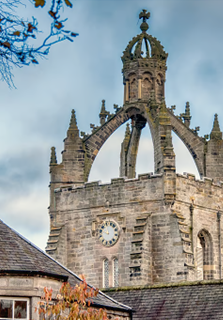
Kings College, University of Aberdeen: image copied from here.

At the University of Aberdeen, where I studied, it was mandatory to take several elective courses alongside the required degree syllabus. These allowed students to either study more widely or dive deeper into their chosen field. We could select any first- or second-year course from any subject that didn’t clash with our timetable – so I, naturally, decided to do both.

Initially, I started university studying Physics, with the hopes of working in green energy. To complement my science interests, I took one of the Sixth-Century courses, Mankind in the Universe, which (as far as I remember) was a short introduction to astronomy. I was interested in the topic and had considered studying Astrophysics at the Universities of Edinburgh or Saint Andrews – but I was turned off by how chilly the observatories were at the open days!

Alongside the broader science experience, I sampled several other fields during my first two years of study.

During my first few weeks of university, I unofficially tagged along with a friend to a couple of her History lectures, which were packed enough that no-one noticed I’d sneaked in. I took notes on her behalf and drew a cartoon ‘scapegoat’ to represent the scapegoat position Germany was forced into after World War 1. But I did also attend the wider selection of electives that I had properly signed up for.

A French Language course allowed me to keep up French for a while. I mostly remember watching a grainy recording of a news article, featuring a woman in thick, dark-rimmed glasses speaking to the interviewer in the slang dialect argot. This was around the time I was working my way through Victor Hugo’s Les Miserables (in English), and Hugo (paid by the word as he was) devotes an entire appendix to argot. So, when the term cropped up in class, I recognised it immediately and was suddenly exceptionally eager to reach that appendix (still several hundred pages away!).

I also briefly attended a Theology course on the Triune God (of all things!), which I dropped partway through due to ill health. Failing to complete the course has not, as far as I can tell, hindered my career or spiritual prospects – but I do remember it was quite fun to learn about the Council of Nicaea and the politicking behind it. And not really ‘getting’ the whole three-in-one thing.

I created my own Land Art snail in imitation of Smithson’s Spiral Jetty.

I took a Modern and Contemporary Art module, through the Art History department, which I thoroughly enjoyed. A few years previously, I had watched the BBC programme Desperate Romantics, about the Pre-Raphaelite brotherhood, in particular episodes 1-4, which followed the establishment and antics of the founding three members of the brotherhood. The class’s ‘modern’ art survey began its tour with the Pre-Raphaelites, which gave me confidence going in even as we moved through some of the less familiar (to me) major art styles of the 19th and 20th centuries. I remember particularly being interested by Whistler, whose paintings I’d seen at the Van Gogh Museum during my family’s holiday in Amsterdam; the Futurist movement, established in 1913, which abruptly abandoned its idolisation of technology once its artists experienced the horrors of the First World War; the distinction between medieval Gothic architecture and 18th–19th-century Gothick revival architecture (and a brief, unimpressed foray into Gothic literature); and Land Art, which was immortalised for me by Robert Smithson’s Spiral Jetty, that resembled a giant basalt snail. The last was so impactful that I even created my own Land Art snail on Aberdeen Beach.

In a similarly styled course, I also studied A Survey of Western Art Music, which took us, whistlestop, from 900 AD to the present day. I remember the final exam included a section where we had to identify the title and composer of set works by ear. My parents took me to HMV to purchase CDs of about twenty different composers from twenty different music traditions, and I created an iPod playlist. I spent a good deal of time listening to the playlist on repeat while going to sleep, and while reading and copying out pages of J Peter Burkholder’s A History of Western Music.

This was the course that actually prompted my transferral request directly into the second year of the BMus programme. Goodbye, future environmental scientist; hello, future music librarian (although at the time I was envisioning becoming a music historian). Fifteen years later, while reading Richard Papen’s transfer from Medical Science to English Literature to Classics in Donna Tartt’s The Secret History, I cannot help but notice the resemblance.

Graduation Day (9 years ago)

My switch was two years into the Physics course. It is sobering to realise that, had the university only offered three-year programmes, I would have been two-thirds of my way through a Physics degree before realising what I truly wanted to study. My life could have taken a completely different trajectory. I might not be working in the best job in the world at Chetham’s School of Music (although you can get academic librarians in any field). And, had I stayed with Physics, I might have struggled to find work in a post-Brexit landscape.

My little sister has a jokey expression: “Whatever’s for you won’t go past you.” In my case, I think I was very lucky, both with my experiences at the University of Aberdeen and in the years that followed.

Book ‘Review’: Oh, Castle of Otranto!

Recently, I was looking through my old books and I came across the copy of The Castle of Otranto by Horace Walpole that I had annotated in university.

Back when I was studying at the University of Aberdeen, I took an Art History elective on Modern and Contemporary Art. In an even broader definition of ‘modern’ than the twentieth- and twenty-first century framing often used by music scholars, the course spanned back as far back as the paintings of the Pre-Raphaelite Brotherhood, who were founded in the mid-nineteenth century.

During one of the earlier weeks of the course we discussed nineteenth-century architecture, looking at John Ruskin’s reviews of the Gothic revival and the Barry/Pugin designed Houses of Parliament. But the thing that most stayed with me from that lecture, other than the distinction between Gothic and Gothick (the former being the real deal, and the latter being the Victoriana knock-off), was that the lecturer mentioned, as I was to learn later merely in passing, for us to really understand Gothic(k) architecture, we should read Gothic literature. And she recommended Horace Walpole’s novel The Castle of Otranto – often credited as the first Gothic novel.

Annotations for Chapter 4

With the dedication of an overachieving student who was really enjoying a course, entirely unrelated to my base Physics degree, I purchased a copy of the novel, and set to work. At that point I was even more unfamiliar with the gothic genre than I am today, and my method for ensuring I would absorb the text was to read a chapter, then write down everything that I remembered from the reading. It being a relatively short book (only five chapters in total) I believe the process only took me a couple weeks to complete.

The book never came up again in the lectures, and we moved on to the twentieth-century arts. But reading back on my baby (eighteen-year-old) scholar chapter recaps fifteen years later, I thought they were fun enough to share here. Enjoy!

Chapter 1

  • At the wedding of Conrad and Isabella, Conrad is crushed by a helmet and dies.
  • Conrad’s father, Manfred, arrests an innocent peasant and accuses him of necromancy.
  • Manfred’s wife, Hippolita, and daughter, Matilda, are distraught but Manfred, more concerned about the loss of an heir than the death of a son, attempts to assault Isabella to continue his bloodline through her.
  • Isabella takes advantage of the distraction created by a painting coming to lie and escapes with the help of the peasant from earlier.
  • Manfred catches up with the peasant and is impressed by his apparent honesty, thus pardoning him.
  • Two servants inform Manfred of a ghostly giant they encountered while hunting for Isabella.
  • On finding no such giant, Manfred dismisses their claims and tells the peasant to stay the night. He wants to talk to him in the morning.

Chapter 2

  • In her chambers, Matilda awaits news of what has happened to Isabella.
  • Her Maid of Honour, Bianca, tells her of rumours among the servants of ghosts, and the peasant who was found by Manfred.
  • Startled by strange noises from the supposedly empty room below, Bianca is frightened, suspecting it is Conrad’s ghost.
  • Further investigation reveals it is actually the peasant, who begs in vain for news of Isabella.
  • The next morning, a holy man, Friar Jerome, brings news to Manfred and Hippolita that Isabella is hiding in Saint Nicholas’s altar.
  • It transpires that Jerome has been told about the previous night’s attempted-assault and, in an effort to protect Isabella, he inadvertently plants suspicions in Manfred’s mind that Isabella and last night’s peasant are lovers.
  • Manfred questions the peasant again and, on learning of his role in Isabella’s escape, orders the peasant’s immediate execution.
  • Noticing an arrow-shaped birthmark on the peasant’s shoulder, Jerome recognises him as his long-lost son and it is revealed that the ‘peasant’ is actually Theodore, Count of Falconara.
  • Manfred decides to use this to his advantage and offers to spare Theodore’s life if Jerome returns Isabella to him.
  • The chapter ends with eerie trumpet noises from nowhere and, in the courtyard, the helmet that killed Conrad nods three times.

Chapter 3

  • Frightened by the trumpet, Manfred says he will give Theodore to Jerome if the friar goes to the gate to discover the noise’s source.
  • Turns out it was a herald calling Manfred a usurper. In anger, Manfred reneges on his promise and, once again, orders the friar to return Isabella.
  • Jerome returns to the church only to find that Isabella has fled upon hearing news of Hippolyta’s supposed death.
  • Meanwhile, Manfred receives the herald’s master. While trying to convince the unknown knight to allow him to marry Isabella, they are interrupted by an army of monks who inform him of Isabella’s escape.
  • Both Manfred and the unknown knight set out separately to find Isabella.
  • Matilda takes advantage of her father’s absence to free Theodore from the cell he is being held in. During this brief encounter, the pair fall in love.
  • Theodore finds Isabella hiding in a cave and they are pretty soon attacked by the unknown knight, who Theodore accidentally mortally wounds.
  • As he dies, the knight reveals he is Isabella’s father.

Chapter 4

  • Turns out, Hippolita isn’t actually dead – she and Matilda greet everyone as they return to the castle carrying Isabella’s dead father’s corpse.
  • Oh wait! Isabella’s father, Sir Frederic, isn’t actually dead either. None of his wounds were all that severe!
  • Recovered slightly, Frederic tells Hippolita, Matilda, Isabella and Theodore that Manfred’s dictatorship is destined to end.
  • Manfred enters the room and mistakes Theodore for a spectre; but on realising his mistake, demands to know how Theodore escaped again.
  • Not wanting to get Matilda into trouble, Theodore blames his father, Jerome and goes on to explain, among other things, that, as a young boy he was abducted by pirates!
  • Later, Isabella and Matilda confess to each other that they both have feelings for Theodore. But, because Theodore obviously only loves Matilda, it is decided Matilda should have him.
  • Then Hippolita enters and tells Matilda that she is to marry Isabella’s father, Sir Frederic!
  • After much tears and angsting, all three women bring each other up to date on what’s going on. Hippolita finally realises her husband is a douche and plans to divorce her.
  • She decides to ask Friar Jerome for his advice but, when she arrives, she finds him and Theodore arguing about Theodore’s love for Matilda – which Jerome feels is ill-advised.
  • Jerome then goes on to convince Hippolita not to allow a divorce.
  • Manfred, who has convinced Frederic to consent to marry Matilda, finds Hippolita with Jerome and, on learning what Jerome has done, argues.
  • Jerome threatens Manfred with excommunication and, as Manfred and Hippolita leave, Manfred orders one of his servants to guard the convent and alert him if anyone from the castle tries to enter.

Chapter 5

  • Manfred reflects on all that has passed and comes to the conclusion that Isabella and Theodore are secret lovers.
  • He then proceeds to bribe Bianca (Matilda’s maid of honour) into ‘betraying’ Isabella, but Bianca refuses.
  • Later, Manfred and Frederic are talking and are interrupted by Bianca, who claims to have seen the giant spectre from Chapter 1.
  • Frederic believes her but Manfred is disdainful.
  • Later, on his own, Frederic meets a skeleton ghost, who tells him not to marry Matilda – this freaks him out.
  • Manfred is approached by the servant spy from earlier, who informs him that Theodore is at the convent with a woman.
  • Assuming the woman is Isabella, Manfred goes to the convent and stabs her. Only to find out too late it was actually Matilda.
  • Woe, angst and fainting ensue.
  • Matilda dies; sorry, “expires”!
  • Theodore, distraught, is made Lord of Otranto, and never marries.
  • Hippolita and a now completely reformed Manfred join religious orders.
  • Isabella and Frederic are fine but traumatised.

The End (Thank goodness!)

Literacy in the Library

One of the highlights of my week is when the Year 7 literacy class comes the library. Last year’s group learned about the non-fiction section, and about how the Dewey Decimal System can help them find books on the subjects they’re interested in. They used the music library and saw the range of music genres that we have on CD. They created library posters, designed their own book blurbs and wrote reviews of books and music. I led a project in which they created their own Zines. And best of all, they’ve been using the library more, both inside and out of class time. I’ve noticed they come up and talk to me more, they ask for books and I always try to buy their requests if we don’t have it already, and they have become far more confident library users, just in time for them to start needing the library more as they transition from the equivalent of primary school to secondary school.

So, I thought it would be fun to look back on the lessons where the library played a bigger role.

Where Dewey Start?

I cannot take credit for this literacy/library team-up. At the end of last year, the literacy teacher, Mr Wong, approached me for ideas about a one-off library lesson to introduce the Year 7s to the Dewey Decimal System. It was a fortunate coincidence that, when first starting in the role, I had looked into library lesson ideas and come across several library lesson packs on the website Twinkl – including one that specifically targeted Year 7s.

Guided by the ideas in the activity pack, and a bit of trial and error on how best to fit the lesson to our school library specifically, we’ve found that it works really well, and have now run this particular lesson six times. The students learn about the non-fiction library, and where they can find different books. I demonstrate the layout, making sure to point out anomalies (like the fact that they would find Fairytales in Social Science, Pets in Technology, or Computers in General Miscellaneous). This guides my development of the collection towards subjects that excite them (Dinosaurs!) and also lets them hear about the non-music subjects that we have books on, which is useful when over a quarter of the collection is classed under the 780s.

They then complete a worksheet that lets them explore the non-fiction collection further: they select books from each of the main 10 categories (i.e. the hundreds) and answer questions about them. They then work out where they would look to find the answers to a list of general knowledge questions. This helps them practice using the Dewey Decimal chart, and develops their study skills. For example, one of the students suggested that he could look in the biographies section to find out who discovered penicillin. While he’s not necessarily incorrect, this led to a discussion about how he might need to know the inventor’s name in order to find a biography, and it would rely on our having an Alexander Fleming biography in the collection. He agreed that the answer might be more likely to be mentioned in one of the books about Medicine, but insisted that if he needed to find out the answer he would ask Google (and, in this instance, quite right too!)

Reviewing the (book and music) Situation

Later in the year, the class went on to write music and book reviews. For the music reviews, I was able to direct them towards our magazine corner, where they could see examples of professionally published reviews in the music magazines the library carries. This highlighted to them that the magazines were there for them to use and also that they were learning skills that were useful in the real world. As Mr Wong pointed out, it is possible that this might actually be a viable career option for these musical students.

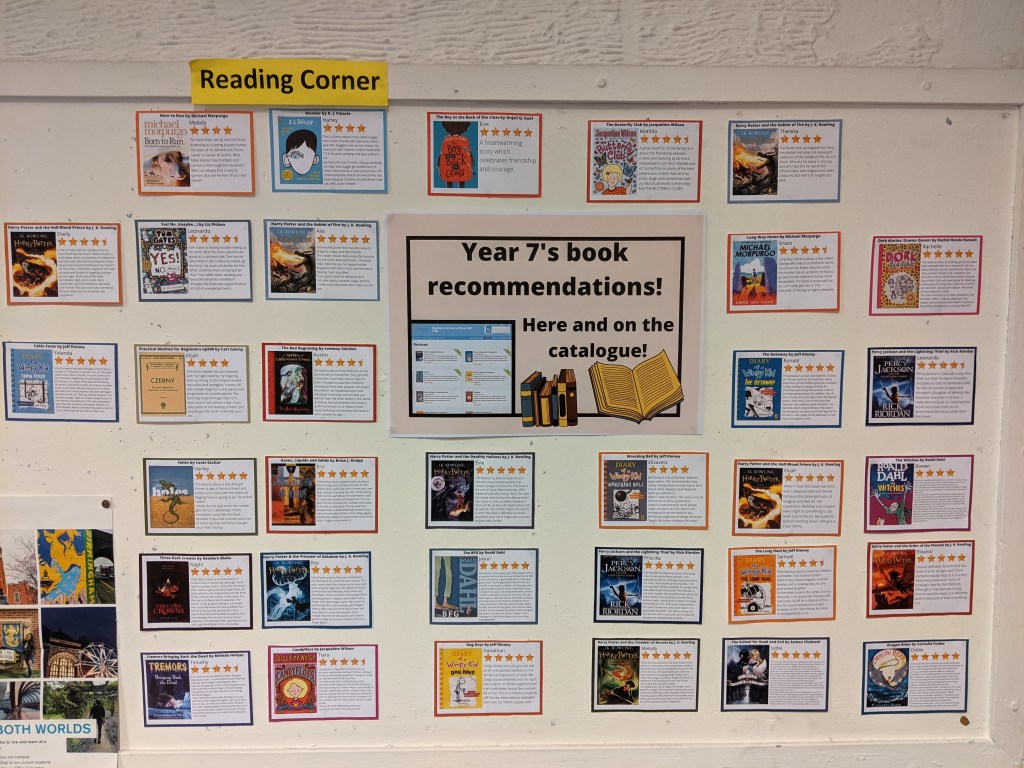
They also wrote book reviews, specifically of books that the library already carried. When they were completed and marked, I used Canva to uniformly style each of their reviews and set up the Reading Corner to be a more permanent “Year 7 Recommends” display. The reviews were also uploaded onto the library catalogue, which some of the students were very excited about.

The display was a success across the years. The Year 8 choristers (who have their Prep sessions in the library), had a lot of fun reading the reviews and talking about the books that had been recommended. There was also a noticeable surge in Rick Riordan issues among the Juniors after the Percy Jackson books had been put on display. I received multiple requests for the Magnus Chase and Heroes of Olympus series which now fill an entire shelf of our fiction collection!

Zine there, Done that

Towards the end of the school year, I suggested to Mr Wong that a good final project might be to make “Zines” – short magazines centered on a topic of interest, traditionally fan-made with a limited print run (if any). My idea was that each student could make their own Zine about a piece of media or hobby that they enjoyed. Then I would make copies of each of the Zines to add to the school library, and Chetham’s could have its own Zine collection.

I brought in a couple of example Zines that I had at home (including the Laser Girl one I made as a present for my sister when she got her PhD), and Mr Wong drew up a plan for how we would structure the lessons. The students spent several weeks planning and making their Zines. We taught the students the folding technique to make little 8-page booklets, and they planned out each page, and then worked on the Zines for a few weeks in the sessions before completing them for homework.

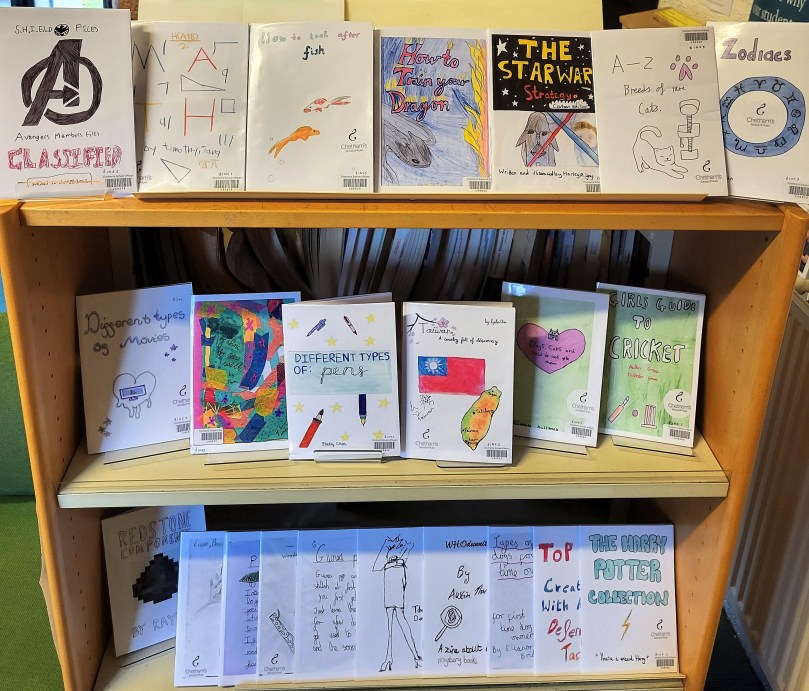
It was exciting to see the finished products, and we ended up with 23 Zines covering an eclectic range of topics:

  • movies (Star Wars; Marvel; genres)
  • books (Harry Potter; How to Train Your Dragon; the Evil Dentist; murder mysteries)
  • pets and animals (from dogs, cats and other pets to porcupines, ants and newts!)
  • hobbies (sewing; girl’s cricket; maths; music; Minecraft; different types of pens)
  • Taiwan
  • the Zodiac
  • Viruses

After the students were finished and the Zines had been graded, Mr Wong passed them to me and I began what turned out to be a far-too-long process of converting them to be useable in the library. I started by scanning each page, which made them quite faded. Not realising how many I would need to do (and how long each would take) I used software to boost their colour, and remove the awful grey tone of the paper background. My reasoning was that, since the library was benefitting from the students’ work, they shouldn’t be put on display in a condition that was worse than the students had given them to me in. Some of them had put in so much effort that I felt it would have been a shame to undermine that due to the technological limitations of our scanner.

As I went along, I developed methods of speeding up the process, but in retrospect, I spent far longer on them than I should have done (including working on them at home, while watching TV). If I hadn’t realised the enormity of the task when I did, I could have been there forever. 23 Zines of 8 pages each would have had me digitally enhancing 184 pages in total, which (if I’d spent as long as I was spending on some of the penciled pages) could have taken me up to 92 hours! In the end I kept all the work I’d already done, but I resorted to enhancing only the front and back pages (i.e. the outside covers), of the remaining Zines. We’re planning to do the Zines again this year, and this will be my new method, which will save me a lot of time. The actual process of printing, processing and covering them, then adding them to the library catalogue only took a couple of days (around my other library work).

The end results were very cool, and the Zines are a great addition to the library. I love finding ways to involve the kids, and I’m looking forward for them to see the display when they return after the October break.

Now, please enjoy some extracts from the student’s Zine project:

Duck egg blue traditional style bathroom suite from Victorian Plumbing Old London range.

We’re in!

Well, folks, we finally did it. Calum and I have finally completed the purchase of our first home – a lovely 1950s ex-council semidetached house with a utility room separate from the main kitchen and lots of storage for our tools and bikes. I think it feels quite cottage-like with built-in wooden cupboards, an adorable cubbyhole, and a rustic staircase that will be very pretty once it’s painted and recarpeted. My favourite part of our new house so far is our brand new bathroom, which we arranged to be fitted before we moved in.

When we purchased the house, the bathroom was actually two tiny rooms – a W.C. which contained just the toilet, and a bathroom containing the sink, bath and shower. Naturally, this was an entirely gross setup so we decided to prioritise getting the bathroom entirely remodelled. We hired an excellent plumber to tear down the wall between the two rooms, retile the surfaces and fit an entirely new set of sanitary wear.

Bathroom across two rooms – who invented this gross concept?

Initially Calum and I talked about getting an awesome gothic bathroom. We liked the look of an ornate black porcelain suite that I’d seen in a shop window in our local town centre, but it quickly became clear that the gothic dream would likely be out of our price range. So, I took my search online and came across the Old London traditional range at Victorian Plumbing.

Calum’s favourite colour is blue, and he was amenable when I suggested the full duck-egg blue set, with accompanying amenities in white and chrome. Although Victorian Plumbing was a little disappointing with delays, missed delivery days and lack of communication, the products themselves are great. I particularly like our set because the sink is part of a cabinet that we can use for towels, and there is more storage in the mirrored cabinet above the sink. We ordered a Victorian-style bath that looks like a rolltop, but is actually flat enough that we could get a shower door rather than needing to settle for a dirt-gathering curtain. I like the chrome griffin-like feet that Calum selected for the bath, but my favourite part of our bathroom appliances is the heated towel rail/radiator. It’s just so cosy!

Choosing tiles was quite difficult, since I was adamant that, although we would probably want blue on the walls, I didn’t want the room to look like either a swimming pool or a public bathroom. Our plumber suggested we might like linoleum flooring because it would be easy to clean and replace, but I was worried it might look a bit too 1970s.

I had found a reference photo online that showed a bathroom with wooden flooring, which I immediately loved but dismissed as impractical because I thought it would get damp and rotten too quickly. My mum came to the rescue and suggested that we might look at wood-effect tiles. In the end we settled on dark “Maddison Cherry” tiles for the floor, with simple white square wall tiles. But I also ordered some very thin, rustic, duck-egg blue rectangular tiles to create a border at the top of the white tiles. I think they’re very cute.

Look, no wall!!

After that we basically left our plumber to it. He was absolutely fantastic and finished the entire project in a couple of weeks. He knocked down the wall between the two rooms to make one proper-sized bathroom, and did a great job of the tiling and fitting. At all points he made sure he was working to our requirements: even if that meant using white polyfilla against his suggestion (he warns will yellow over time) and moving piping from inside to outside the house (even though it meant he needed to raise his original quote a little). He even went to B&Q on our behalf to purchase some shower equipment after we decided we wanted a new matching head rather than just keeping the original as we’d initially planned, and he got us a couple of taps for our radiator so that they would match the other taps in the bathroom, which was very sweet.

Honestly, I cannot recommend our plumber, Chris, enough – check out his Facebook site (Chrisdecor Home Improvements) if you’re looking for a reliable plumber in the Manchester area. We have him to thank for our beautiful bathroom and we’re so excited to start living in our beautiful new home.

The completed bathroom.

Alchemical Ink

Calum and I played a writing challenge this evening. We gave each other 4 prompts: a character, an item, a setting and a theme. Then we had to try to write a story based on that theme in 30 minutes. The time-dependent aspect got abandoned by the wayside, but we still wrote them within less than an hour (barring tidying for spelling and grammar).

Here is my result (and you can read Calum’s one here):

Prompts

Character Prompt: An alchemist
Item Prompt: A jar of ink
Theme Prompt: Preservation
Setting Prompt: A haunted castle.

Story

It wasn’t supposed to go like this. Normally, the ghosts were happy to be listened to. Were content to have their essence distilled down into a thick, ectoplasmic goop and mixed with the glowing pigment that would record their life story for it to be preserved for all times in the Sacred Archives. But as soon as the Alchemist crossed the drawbridge, leather satchel slung over her shoulder and incense at the ready, she could tell this time was different.

The slam of the portcullis, blocking her path, was her first clue. The second clue was the blood red writing on the courtyard wall – “you are not welcome here”. Then there was the unnatural cold and the angry howling.

The Alchemist took out a vial of acid and eroded through the portcullis bars, making a gap just big enough to squeeze through. Once she was inside, she reached back into her satchel and produced a bottle of lemon juice, which she mixed into a small ceramic bowl with the dust in the castle courtyard. Now she had her base concoction: it combined the substance of the place where the haunt dwelled, with the elusiveness of invisible ink. But it still required one more ingredient if she wanted to create a barrier to keep the ghost from escaping – part of the ghost itself.

The Alchemist’s eyes rested on the wall writing. Ghosts were mostly intangible, so to affect its physical surroundings, it had to mix its essence with the item it interacted with. Meaning the bleeding letters would be made of ghost? Careful not to get any on her hands, the Alchemist scraped some of the wall writing into the bowl with a tiny spatula. The substance was ready, but in this form it would not be nearly enough.

The Alchemist scanned the courtyard once more, searching, and she noticed a rusting water pump situated near a wall of ivy that shivered in the wind. The Alchemist started towards the pump, but as she walked, the courtyard’s cobbles protested. They wriggled and jostled, trying to get under her feet and trip her up. But the Alchemist lay on her side and rolled, so that each of the cobbles bumped her uncomfortably, but barely hindered her movement. With even the castle floor trying to keep her out, the alchemist did not trust the pump or ivy would be any more welcoming. Sure enough, as soon as the alchemist was in reach of the ivy, it lashed out and wrapped its angry vines around her legs, arms and neck, squeezing like a boa constrictor. But the Alchemist was prepared. From inside her sleeves, she produced a squishy bottle of vinegar, that she sprayed at the offending leaves, causing them to recoil. In her other fist she held a block of salt, that she rubbed on the ivy tendrils, drying them to the point where they had retreated back to the wall. Ivy defeated, the Alchemist held the salt rock under the spigot of the water pump, so that it purified whatever nasty concoction the ghost had added to the dirty brown liquid that emerged as the Alchemist pumped. Added to the lemon juice, courtyard dust and ghost extract, the resulting mixture wasn’t as pure as the alchemist would have liked, but it was now probably enough solution, so the diluted form would have to do. Bracing herself for further bruises, the Alchemist rolled back out to the portcullis and used a pastry brush to paint an X onto the bars. Now the ghost would be stuck here.

All that remained was to track the ghost down. The Alchemist moved through the castle, encountering and neutralising obstacle after obstacle that the ghost threw at her. In the kitchen, the Alchemist was attacked by flying knives; pouring ferromagnetic metals onto the floor attracted the knives downwards, so the ghost couldn’t lift them. A spark from her tinder box quickly cleared the huge stack of books that blocked her way in the study. In the great hall, the giant taxidermied stag heads animated and attacked, but were lulled to sleep by the funeral incense (myrrh) that the Alchemist burned. The Alchemist herself, being still alive, was not affected by the myrrh, but the ghost, well, it was dead, and its attacks became less forceful after that. As the Alchemist moved through each room, she crossed off the doors, so the ghost was shepherded until it had nowhere else to go.

Finally they got to the highest tower. The Alchemist, with sticky glue dripping from her shoes (which she had applied to climb the slope that had once been stairs), was puffing, frustrated and angry. By this point the ghostly howling had died down to a sullen sob. The Alchemist opened the final door, and there, curled in the corner watching her sulkily, was the ghost of a little servant boy.

The final inhabitant of the castle glared up at the Alchemist.

“It ain’t fair,” said the child. “I never got to live much. I should get to unlive without all you exorcisers comin’ to take me away.”

The Alchemist said nothing, but she settled down on the floor, pulled out her pen and glowing, ectoplasmic ink, and a small tea set. Over her Bunsen burner, the Alchemist boiled a pot of green tea and the tiny ghost accepted the teacup in his hardened ectoplasmic hand. Now that the ghost wasn’t haunting so large a space (only this small room), he was able to concentrate on holding better. The ghost told the Alchemist his story. He had worked in the castle as a stable boy. He had tended the horses and the dogs. Each evening he had sat by the castle stove and eaten his potato dinner. He had sent home a silver piece to his mother each month. And he had played in the snow with the other servant children when the adults weren’t looking. Then the plague had come and people started getting sick. To keep him well, the cook had hidden him behind the stove. But something had gone wrong. Maybe the cook had fled and forgotten to tell anyone about him. Maybe she had gotten too sick to retrieve him.

The boy had been stuck, trapped inside the wall, and when he awoke he was able to glide through the wall, but he was still trapped in the castle. And now he was all alone. He wanted his mother; he wanted his horses and dogs. He had cried for them. Howled for them. But the howling had alerted the village and the village had alerted the archive and the archive had sent the Alchemist. And as the story was told, the ink grew brighter. The child drank his tea, and the Alchemist picked up the quill and wrote the child’s story. As the Alchemist wrote, the child began to fade, particles of ectoplasm drifting towards the ink.

A smash of the teacup on the stone floor told the Alchemist the boy was gone. The Alchemist lifted the cracked china, the final dregs of tea not yet drunk. This was what the Alchemist needed. She dripped the tea, now combined with the boy’s spirit, into the ink, and the ink itself shimmered and bubbled in appreciation.

The archive wants to preserve people’s tales, but the story is not what the Alchemist wants. The life mixture, a thousand thousand souls combined and preserved in one little glowing bottle of inky gloop. That is true alchemy.

And now the boy’s story lies in the Sacred Archives. And the Alchemist moves onto another haunt, another story, and in her satchel, the ink glows a little brighter.

The Adventures of Laser Girl

Please indulge me a little with this nepotistic post about how awesome my sister is. Having passed her PhD in Physics (with a specialisation in Free Electron Lasers) last summer, Doctor Morgan has now got a job working on a FEL in California and has just moved out there this week. I’m super super proud of her, and to mark the occasion I want to share with you the comic I made for her last Christmas. As you can probably tell from the comic, I actually have very little idea what she does, to the point where I even misspell laser a couple of times. But she’s worked really hard and it’s such a fantastic achievement that I wanted to brag about it anyway. Well done, Jenny (and sorry for exposing your double life as a super hero)!

  • The Adventures of Laser Girl
  • Laser Girl! Laser Girl!
  • Travels all across the world
  • Goes for runs! Tortures Bond!
  • (This is a free electron!)
  • Published!
  • She's Doctor Laser Girl!
  • A series of crossing lasers, each with the onomatopoeic "PEW!" label.

Back to School reflection: What I did on my holiday

After a good amount of time off work over the summer holidays, I am happy (if a bit nervous!) to be returning to the school library tomorrow. I had a lot of plans for when I was off, and some of them I completed, some of them I at least started, and many of them I didn’t get around to. Either way, I thought it would be nice to reflect on the summer before the new school year washes all of it into oblivion.

School’s out for the students

The students finished their school year on Friday 9th of July, but I still had a lot to complete so I spent the following two weeks in the library most days working on four main tasks.

Firstly, I shelved almost all of the books and music that had been building on the Covid quarantine shelves. That was quite a lot of work, seeing as so much music was returned last-minute, and I’m still getting used to the layout of the chamber music library (where we have shelves and shelves of parts in brown envelopes). Full disclosure, there are a couple of items that have been left so that I can ask my ever-helpful evening staff where the music should go!

I catalogued and processed a huge pile of music. We had received a fantastic donation of beautifully bound full and miniature scores from a member of the public. They are in such good condition that I have decided to add all of them to the library stock (replacing tatty copies where possible), but with probably over a hundred items in total, getting through it all is quite a task. I made a dent, but never fear, there’s still plenty of cataloguing waiting for my return tomorrow!

I also did my best to spend the remaining library budget, having been advised if I don’t spend it I lose it. The students can look forward to a few more books, some replacement music for lost copies, and eight lovely new pairs of headphones – enough for every library computer. I don’t know where the previous pairs kept disappearing to, but I think it might be worth creating a headphone sign-out sheet, to make sure these new ones are always returned.

My biggest challenge in the weeks leading up to the end of term, and the two following weeks where I was in the library on my own, was creating lists of all of the music that was still out to school leavers and would need to be tracked down. This task was particularly difficult because, despite being a music school where ensemble music is in high demand, the library system software we use cannot track multiple borrowers. This means that every set of music is only ever out on one borrower’s account (regardless of how many parts there are). Although we try to keep a manual record of who has which part, with over a thousand outstanding items at the end of term, going through every single envelope to notify students of their unreturned music was a huge job – and certainly not one I want to have to do every single summer. I only just managed to get it all completed in time to send out final warning emails to all the students before I left for Scotland, but I’m going to have to work out a better system for future years, or I might have a nervous breakdown!

Four crates full of brown envelopes
All of the empty envelopes still waiting for parts to be returned to them!

Visiting my parents!

After all that stress, I was super excited to travel back to Scotland to visit my parents for a few weeks. It was so nice to see them again, and my sister, Jenny, was there too for part of my trip. On my first night, Jenny introduced me to the anime Assassination Classroom, which is about a group of school students trying to assassinate their evil yet adorable teacher: a betentacled alien that plans to destroy the world if his students don’t kill him first. It’s surprisingly good.

The weather was gorgeous every single day of my visit, so we did a lot of outdoor activities. One day we walked along the beach for a forest/water walk in Greenock and ate ice-cream and another day we went to a market in Helensburgh where we listened to Glaswegian busker Maryjane singing ‘Let It Go’ from Frozen (in the middle of a heatwave). My dad and I went for a 50km cycle along the River Clyde, which was super fun but also extremely tiring, and at one point I fell off my bike. Although I’m pretty sure I hated everything and everyone by the end of it, it was great to cycle with my dad again and we both really enjoyed it.

On another beautiful day we visited my aunt and uncle in Stirling where we walked around the King’s Knot and learned the story of the Stirling Wolf. Apparently, during a Viking raid, one of the raiders accidentally stepped on a wolf causing it to howl out and wake the sleeping Anglo-Saxon garrison. This gave the garrison time to prepare for the invasion and force the Vikings to retreat. And now the howling wolf emblem can be seen all over Stirling. How bizarre is that?!

What is property? Property is stress!

After my visit to my parents, I still had three weeks left of summer holiday, and in this time Calum and I wanted to make some headway into buying our first home. Calum took a week off work, so we set up a meeting with a mortgage broker and started looking at properties. In total, I was able to arrange eleven viewings although five of them cancelled on me before the viewing could take place. Calum and I attended three of the remaining viewings together, and I attended three on my own because Calum had to go back to work. Although it was quite frustrating and extremely stressful, there were still some good parts. On one extremely wet day, after a viewing, Calum and I visited Worsely Village, where we walked around the Tudor-style streets and along the canal in the rain. There were even some cute metal ducks!

Even with the support of my parents (who were great at sending me suitable houses that I might have missed), and Calum (who did everything he could while also working full time) and the mortgage broker (who’s invaluable advice was fantastic help), I found the entire process really grim. I looked at house websites for hours ever morning, calling up estate agents to try to arrange viewings only to be told the houses were already under offer, or they were no longer accepting viewings. Not to mention the palaver navigating the disgustingly stupid system of Freehold vs Leasehold housing (don’t even get me started).

But eventually, less than a week ago, we got an offer accepted. Hooray! It’s a nice house, in a pretty area, and well within our budget, which is fantastic. We will probably need to do some work on the bathroom, because for some reason quite a few houses in Manchester (including this one) have a toilet with no sink next door to the bathroom with the sink in it. This feels very disgusting to us, and we’ll need to get that changed, but otherwise the house is great. It has a lovely shed for our bikes, and a nice big living room, a pretty kitchen and a utility room where we can put our washer/dryer and install our first dishwasher (such luxury!). There are also two relatively big bedrooms. Calum’s has a wee cubby area where he will be able to set up his workspace, since he is planning to work from home more often, and mine has a huge built-in wardrobe and a cosy alcove where I think I’ll be able to fit my bed.

So that’s pretty exciting, and all we need to do now is meet with our mortgage broker again, set up our solicitor, get a survey from our mortgage provider and a homebuyer’s report, exchange contracts and keys, get a new bathroom, move all our stuff across to the new house, and move in. Easy-peasy.

SLA ‘New To School Libraries’ Webinar

Earlier this month, I attended an online webinar for new school librarians, hosted by the School Libraries Association (SLA). On the whole, I think it was pretty useful: it gave me cool ideas for how to use social media to promote the library; info on the different kinds of documents (policies, reports and plans) that a school library should have; suggestions for clubs and events the school library could run (I quite liked the sound of a graphic novels club); information on arranging the library layout (display spinners are your friend!); and advice on eBook providers, unions, stock weeding, and using book and publisher fairs to pick up library goodies like bookmarks and posters. But the flashiest idea I’ve worked into my library so far was inspired by a demonstration of how to make short showcase videos to let students and staff know what items the library has in its collection.

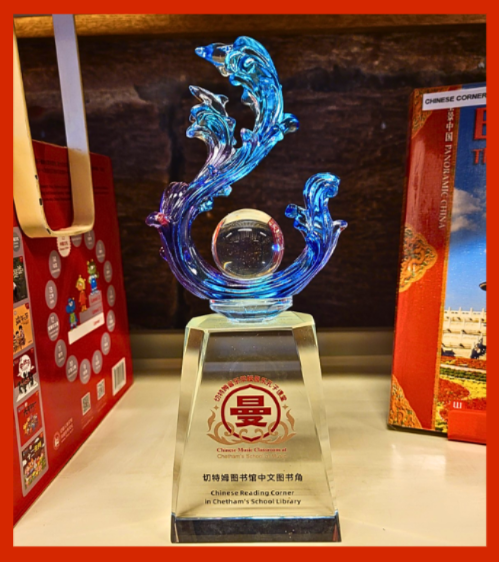
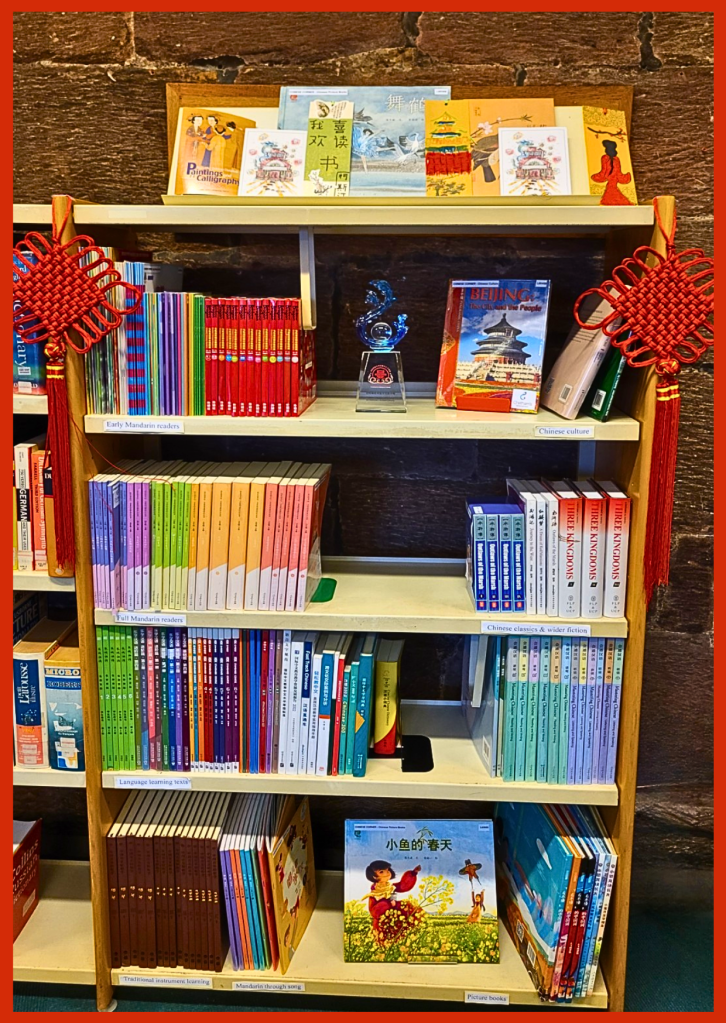
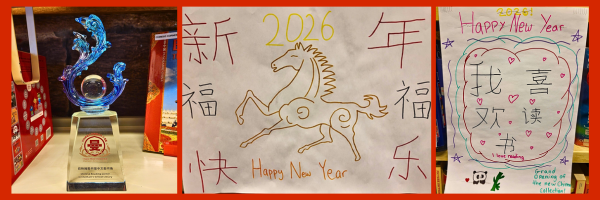
As a specialist music school, Chetham’s has a lot of international boarders and so the school celebrates Chinese New Year. About a month ago we were asked to see if we could do anything to contribute to the celebration, so I picked out a few China-themed books, with the intention of making a library display. However, since most of the students are studying from home at the moment, and haven’t seen the Burns display yet, I decided to instead make a video showcase that they could watch on Twitter. The webinar presenter suggested using the free software Animoto, but I used Movavi pro, which I already owned and which up to now I had mostly been using to make fan music videos for the Cats (1998) musical. Click on that link at your own risk(!).

We had plenty of relevant non-fiction books, but I was a little surprised by how few fiction books I could find set in or about China, or even just featuring Chinese characters. I think my difficulty can partly be attributed to my still being pretty unfamiliar with the library stock and partly to the shallow descriptions in our library catalogue entries (which I am slowly working to improve), so I am sure that I missed some potentially suitable items. But I still found it odd that the collection was so sparce, especially seeing as the school does have quite a lot of Chinese students.

I was doing a fiction shop anyway, because Scholastic had a sale of 10 My Story books for £6.99 (what a bargain, amirite?), so I purchased a few books to boost the China collection, including a very nice picture book about the Chinese Zodiac story. I added them to the Chinese-themed books, music and DVD that I had already set aside, and took photos of them dotted around the stacks. I then edited the photos into a slideshow with public domain music. I downloaded a Chinese New Year resource pack to make the video fancier and more coherent. I even edited the music a little because I only realised after I’d already created the jump-cut section with the non-fiction books that there should probably be some kind of introduction.

Overall, I’d say for my first library video the showcase worked out okay, and I had fun making it. It took roughly the same amount of time to create as a physical library display would, and it was more likely to be seen and enjoyed – particularly during the current lockdown. It received a fair amount of engagement, including some likes from teachers and students, which made me very happy. Although I probably won’t be creating videos a lot, they are a good tool to have in my kit to make everyone aware of the stock we carry. And I’m pretty excited to see what else I can do with them!