An “If We Were Villains” Tea Party, in Five Acts

Two Scotsfolk both alike in dignity,
In fair Manchester, hiding from the sun,
A hare-brained plan to hold a bookish party,
With puzzles, snacks and Shakespeare, packed with fun.
Read forth, I shall describe what did ensue:
A pair of star-eyed scholars did indulge
In misadventures, more for us than you,
Yet of our party’s acts I shall divulge.
Each humble passage of our antics blogged
Commemorates that we enjoyed our day,
And if you find the writing dense and clogged
I do beseech you, do not deign to say!
The which if you with patient eyes attend
You might enjoy, if make it to the end.

Prologue
Ever since I purchased the Dark Academia OwlCrate back in August 2025, which came with an If We Were Villains inspired teapot and teacup set, I’ve had machinations to host a tea party for Calum and myself, based on the novel and Dark Academia in general. The book is mostly told through the voice of Oliver, who as a student at the fictional elite performing arts university, Dellecher, took the blame for the murder of a classmate during his final year. Getting out of prison ten years later, he recounts what really happened (which the reader is expected to take with a tablespoon of salt) to the now-retired detective who worked the case. It’s just the kind of overindulgently theatrical melodrama that it makes sense to throw a party over.

Even before I finished reading the book, I’d already ordered a second cup and teapot so that Calum could have one too. And, for almost a year, I’ve been gradually accruing an assortment of activities and ideas from across the internet, waiting for the perfect time to take the plan to Calum.

Initially, when it was announced in March this year that there were plans to adapt the book into a TV show, I thought I might hold my tea party when it was released. But upon realising this is not the first time the book has been up for a TV version (a different studio had planned and then shelved an adaptation back in 2022), I decided it was too risky to wait for a project that may yet never come to fruition.

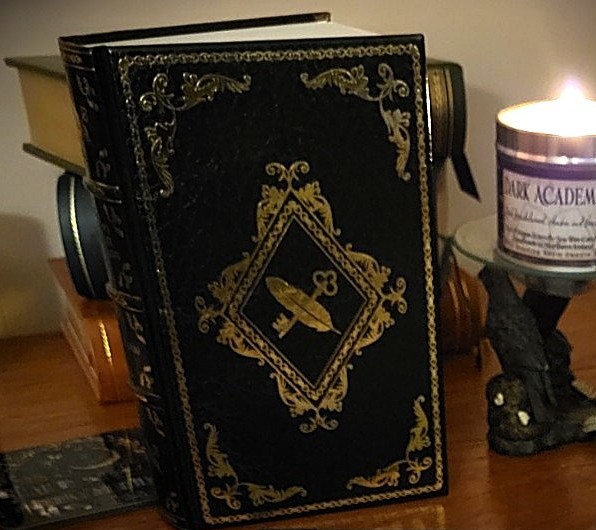
So on Bank Holiday Monday, during the heatwave sweeping the UK, Calum and I decided to stay in our far cooler house, put on ridiculously extravagant costumes, and celebrate the arrival of my super-fancy custom-bound copy of the book that I’d purchased as a belated birthday present to myself from Mrs Yoflam Books.

Act 1
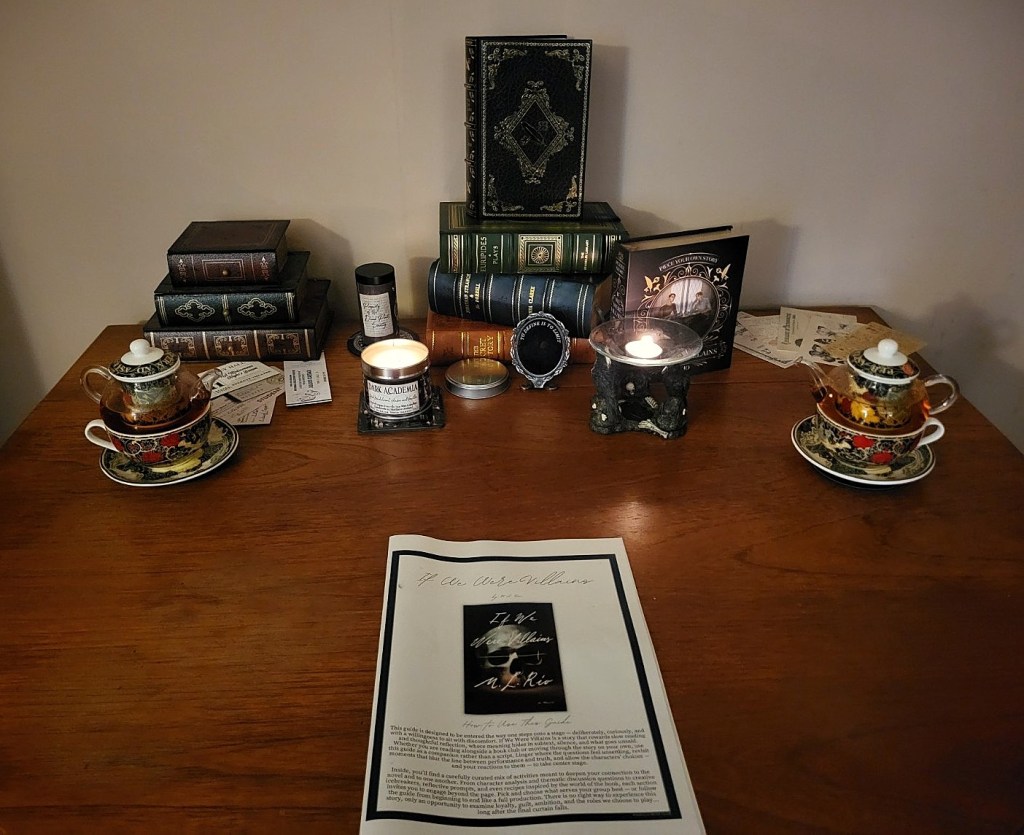
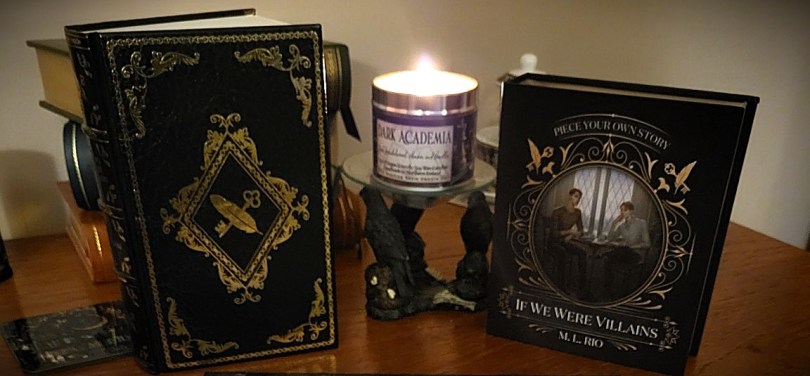
Dressed in our gothic Dark Academia attire, we decorated our table with some of my most If We Were Villains themed accoutrements, including a Dark Academia candle Calum had gifted me for Christmas, a mini chest of drawers in the shape of tomes, a tiny mirror with a quote from The Picture of Dorian Gray, and a selection of fan-made library cards and show tickets from various Dark Academia titles. I also stacked some of my fanciest leather-bound editions: rebinds of The Secret History and Jonathan Strange & Mr Norrell, the Franklin Library edition of Nine Plays by Euripides and, in pride of place atop them all, the newly arrived If We Were Villains.

Display set up, I laid out the activities for the evening.
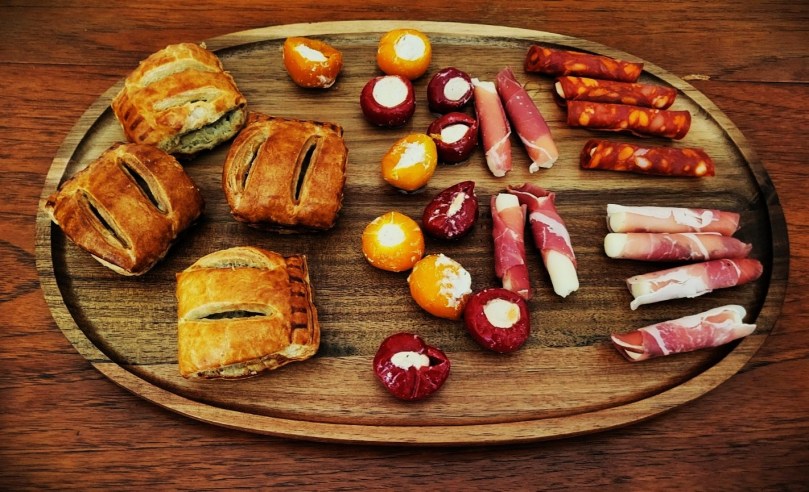
Don’t they just “mirror closeness and indulgence while subtly echoing how celebration and excess lead to unravelling”?

I had purchased an activity download from the Vanilla Book Club Etsy store, packed with suggestions for holding an If We Were Villains gathering. The pack included a music playlist, prompts for discussing the book, puzzles, and recommended themed food suggestions. One of these was a recipe for a Charcuterie board to “mirror the group’s closeness and indulgence”, so Calum and I created our own version with mini sausage rolls, stuffed peppers and cheese and salami ‘rollitos’, serving it (to ourselves) on a wooden platter.

Act 2

Then we started the activity book. Now, if anyone needed any further proof that Calum is the best partner in the world, I think it is about time to admit he hasn’t even read If We Were Villains and doesn’t intend to. He was truly mostly indulging my obsessions. For that reason, I’d been planning that we just do the wordsearch and other puzzles that didn’t require prior knowledge of the book to complete. But Calum suggested we go through the discussion prompts too!

This led to a several-hour conversation (or, several conversations, depending on how you look at it) where Calum would read out a question and I would provide an answer and then we’d talk about it. The prompts kept us on topic surprisingly well, even as we veered delightedly into related tangents:

  • Agents of Shield (talking about the parallels between Ward’s betrayal of the team and the significance of the narrative in If We Were Villains being conveyed largely by a trained actor.)
  • Ready Player One (discussing why the Shakespeare scenes in If We Were Villains work well, while Ready Player One’s description of a character quoting a scene from Monty Python and the Holy Grail word-for-word does not. It’s mostly to do with thematic relevance, character exploration, Oliver’s viewpoints of the action and the physical layout of verse on the page.)
  • Ender’s Game (in response to a prompt asking which character it would be most interesting to be the viewpoint character if it wasn’t Oliver, and Calum mentioning that one of the Ender’s Game sequels literally does that. It occurred to me later that that’s also what Midnight Sun is to Twilight.)
  • And the genre of Dark Academia more generally (for example, the significance of character ages – many Dark Academia novels are about teenagers or very young adults, and that lends a lens of sympathy that older characters wouldn’t receive – even when they’re doing terrible things, like murdering their classmates!).

Although Calum hasn’t read the book, he is very interested in media in general, and we are both pretty familiar with Shakespeare. So he was able to take my descriptions of scenes, plot points and overall effects of the book and discuss the text with me in genuine depth. The prompts actually really helped me to explain the relevant scenes and story; usually I’m very bad at describing book outlines after the fact. But because the questions were chunking the novel, I was able to give Calum the relevant information to discuss the prompt without being overwhelmed or just forgetting everything that happened. Both of us really enjoyed the process, and I think I (and Calum!) now have a much deeper understanding of the book.

Act 3
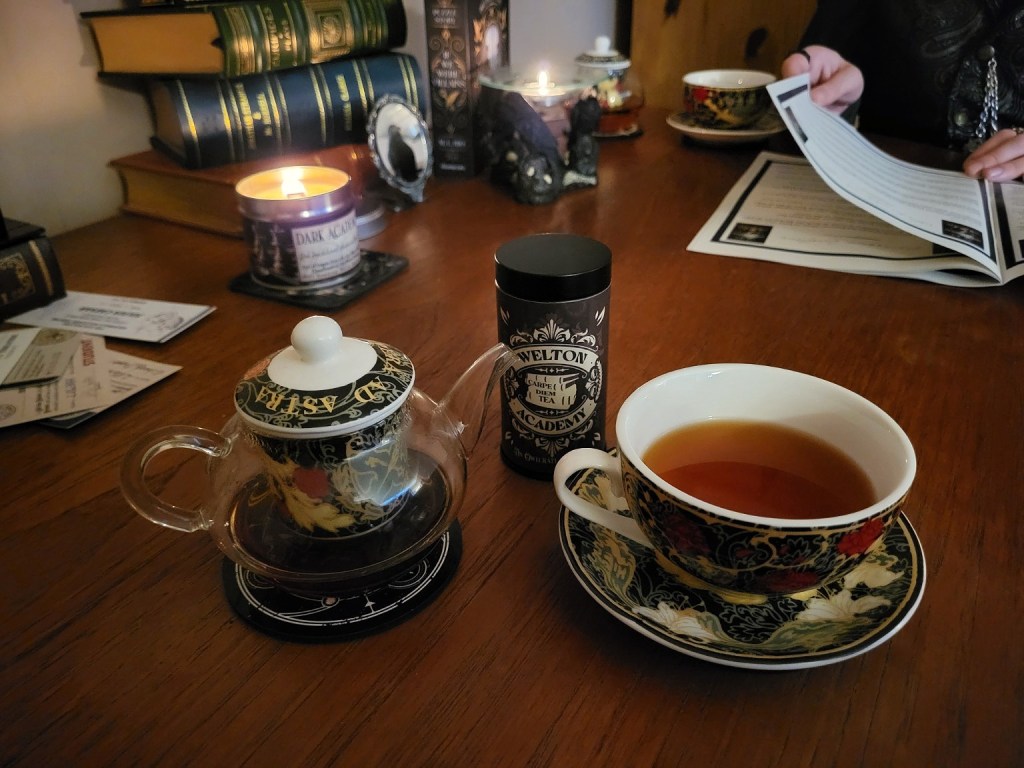
The tea was very nice, and surprisingly sweet.

As we discussed the prompts and completed the wordsearch (using a feather-quill biro that Calum had purchased as a prop for the RPG he is currently DM-ing), we drank our tea. The OwlCrate with the If We Were Villains teapot and teacup set had also included “Carpe Diem” tea (apparently inspired by the film, Dead Poets Society).

This was one of the films I had previously convinced Calum to watch with me, so the themed tea led us on another tangent about what does and does not ‘count’ as Dark Academia. Calum quite rightly pointed out that, while the film doesn’t really get ‘dark’ until its final few scenes, unlike quite a lot of media given the ‘Dark Academia’ publishing label, Dead Poets Society is still actually about the problems within the elite American school system. A lot of so-called Dark Academia is about students killing a classmate or investigating (or covering up) a murder, without exploring the institutions that the students are embedded in, in any meaningful way.

For example, I recently read (and very much enjoyed) Tana French’s The Likeness. Despite frequently making its way onto Dark Academia reading lists, I don’t remember it mentioning academics much at all. If I had to guess, it mostly gets included in these kinds of lists because the main group of murder suspects bear a deliberate resemblance to the students in Donna Tartt’s The Secret History. However, Calum noted that this was like putting Hotel Transylvania on a list of horror movies because it features vampires!

Act 4
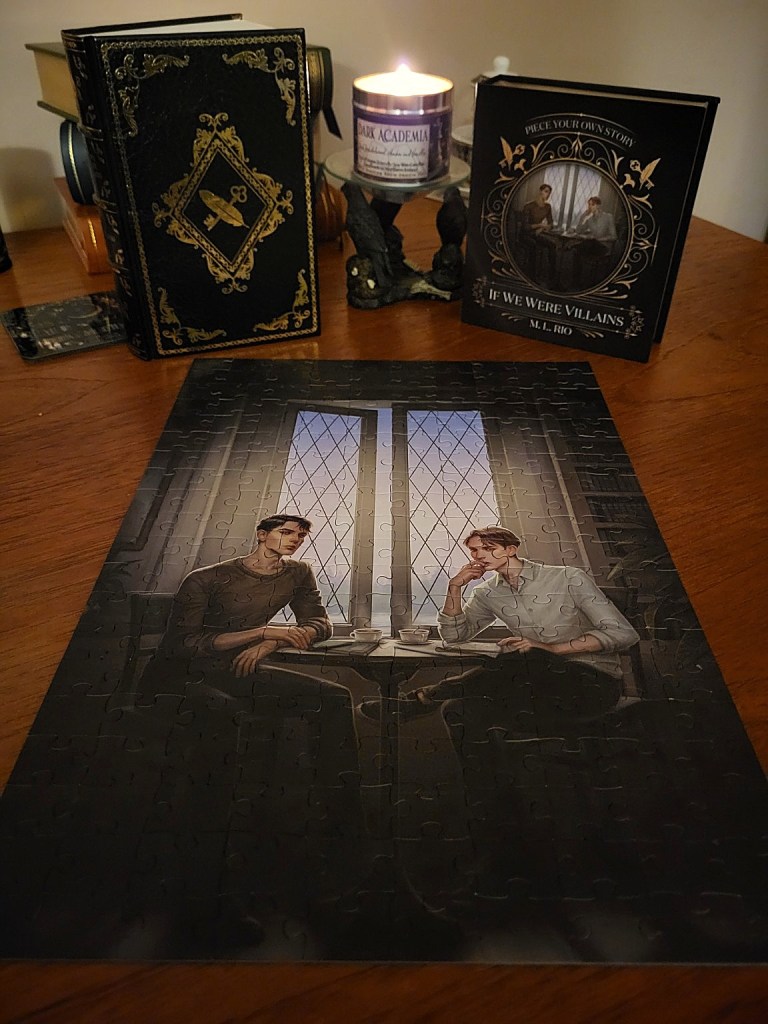
The activity prompts took a little longer than expected, so it was almost seven by the time we were eating our dinner (tomato soup, farmhouse bread and a camembert fondue) as we completed an If We Were Villains jigsaw.

I had purchased the puzzle on eBay months ago and was just waiting for the perfect time to complete it. Being Dark Academia themed, I should have realised that there’d be a lot of very similarly coloured, dark and difficult-to-see pieces. It made the outer edges particularly tricky to assemble, and it was a proper challenge trying to work out where on earth this or that tiny dark tile with a little line or vague detail was meant to go. (And there was me worrying that it might have been completed too easily!)

The image, I think, is meant to depict Oliver and James, although when it was completed Calum christened it something along the lines of “two moody twinks in a tea shop.” I’m planning to look into the logistics of getting the completed jigsaw glued so we can hang it on the wall in our living room!

Act 5
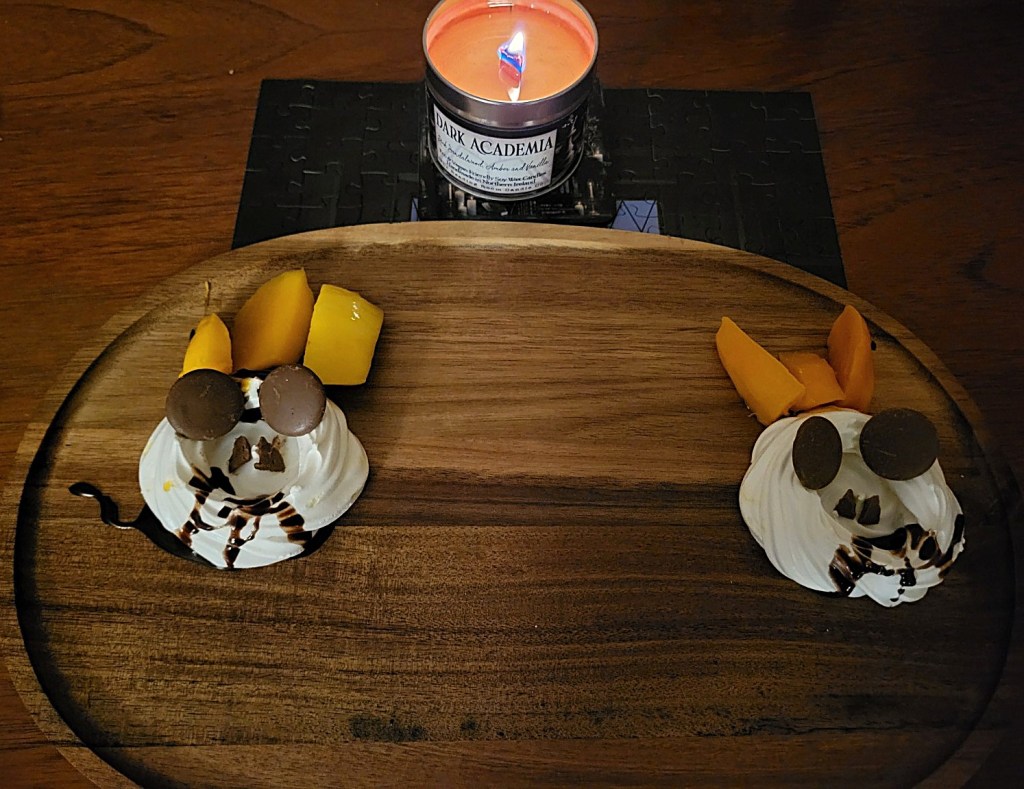
What do you think? Do they look at all like skulls with crowns on them?

After the jigsaw, we wound down to the final activity of our evening. I had got us some meringues and chocolate sauce and chocolate buttons and mango slices with a plan in mind that worked better in my head than it did in execution. The idea was for us to create skulls with mango crowns, like that famous Hamlet image. But the kitchen was very hot, and the chocolate melted very quickly, and the chocolate sauce was far more runny and less of an adhesive than I’d envisioned. Nonetheless, we persevered, and the resulting confections were still delicious on account of being meringue, chocolate and mango.

Epilogue

We ended the night with Calum doing a complete rendition of Mitch Benn’s Macbeth Rap, which he still knows entirely by heart – and me providing the “my name is” interjections. Eat your heart out, Dellecher.
Dark Academia Display

In a move that was very much less what-do-I think-my-students-will-enjoy in favour of what-do-I-want-to-make-a-display-about, I decided to create a Dark Academia display for my school library.

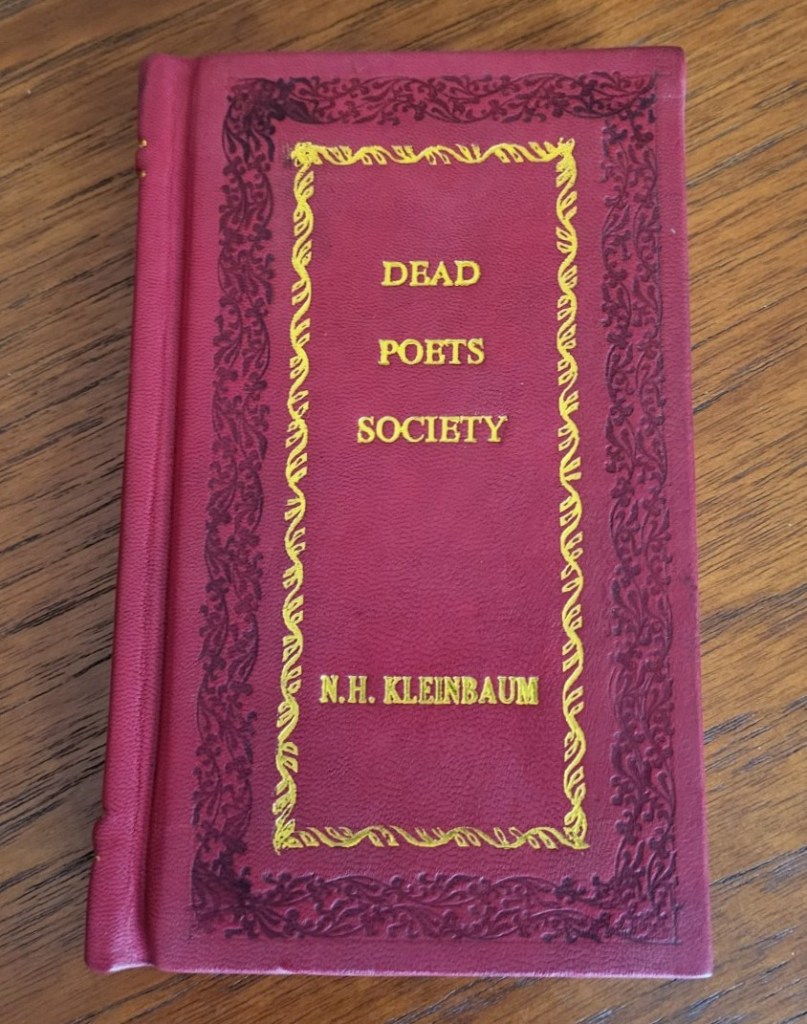
My fancy custom bound copy of
Dead Poets Society
(because I did not want to just have Robin William’s face on my bookshelf).

Ever since I read Donna Tartt’s The Secret History back in April, I have been on what can only be described as something of a Dark Academia fixation. I purchased a series of lectures from Signum University about Dark Academia, which I am still working (gloriously playing?) my way through, and I have been subjecting my poor, beleaguered Calum to every Dark Academia (and Dark Academia-adjacent) movie I could find. Some more enjoyable for him than others.

Bookwise, I’ve been dipping into various Dark Academia titles (If We Were Villains, Babel, the Atlas trilogy) only to stop partway through and move onto the next because I didn’t want any of them to end! I did read Hangsaman by Shirley Jackson and the ridiculous novelisation of The Dead Poets Society by N. H. Kleinbaum in their entireties – but then, I also gave each only two stars on Goodreads, so that maybe tells you something about my reading habits?

Anyway, on the pleasingly symmetrical date of 25/09/25, I finally completed the Dark Academia display I’d been working on since the school returned from the summer holidays. And I am proud enough of it to want to write about it.

Selecting the Books

I started by looking through our collection for existing Dark Academia titles. We already had a few young adult options: Ace of Spades had been nominated for the 2022 Carnegie awards, Atlas Six had been part of a recent donation to the school library, The Secret History and The Invisible Life of Addie La Rue had been purchased at the request of some students a few years ago, and a couple other books had been picked up along the way – often likely without Dark Academia in mind. (I can’t imagine anyone was thinking TikTok aesthetics when The Prime of Miss Jean Brodie was added to the collection back in 2010.)

At the end of last term, I had also cheaply purchased a set of young adult Dark Academia books from Scholastic, which meant we now had plenty of books to attract the older students. But I was still struggling for items that would appeal to our juniors. A Series of Unfortunate Events has The Austere Academy, which I added to my pile, and I was informed online that Lockwood and Co. has Dark Academia vibes (although, judging by the blurb, it reads less Dead Poets Society and more Dead Boy Detectives). To balance things out, I also ordered The Mysterious Benedict Society, which I had not read but enjoyed watching in its semi-recent TV adaption. If anyone has any 8-12-year-old Dark Academia recommendations, I would be very interested to hear them.

Incidentally, when the Scholastic pack arrived, I discovered I had already read one of the books in it. The Library of the Unwritten by A. J. Hackwith is a book that I had not only completed in 2021, but I had even given it five stars on Goodreads. This baffled me because, despite clearly enjoying it at the time, I must admit I hardly remember the book now. However, from what I do remember, although setting largely features a library in Hell, the book otherwise doesn’t seem especially Dark Academia. I wonder if it was perhaps lumped into the pack more because the Dark Academia category is currently selling well than because it actually explores any of the darker aspects of academia.

Perhaps, though, that is a somewhat hypocritical distinction. In scrambling for books to fill my display, I too broadened my scope for what counts as Dark Academia. (Looking at you, Picture of Dorian Gray.)

Designing the Display

The Completed Display

With the books selected, it was time to design the display itself. Across the top shelf, I draped a spiderweb tablecloth that I normally use for Halloween displays, and I piled up some of our oldest-looking tomes from the reserve section in the back office. I also unearthed a plastic compass that I had used for our Talk Like A Pirate Day display a few years ago, and I brought in a small Roman-style bust from home – because no Dark Academia display is complete without a small Roman-style bust.

Charlotte, the school library’s evening library assistant, created some Dark Academia recommendation bookmarks on Canva, which I thought was very cool. Finally, because the lower shelves looked quite bare, I bought some embroidered tapestry ribbon on Amazon to cover them, and I think the effect is quite nice. We can also use the ribbon for Christmas, so it is pleasingly performing double duty!

Reception

The display has proved quite popular, which I was very relieved by. In fact, before I could even get a photograph of the finished project, a sixth-form student had already taken out The Secret History! I also had a really lovely conversation with the head of the Lower School about the books – turns out she likes books about dragons too! – and I came away with several book recommendations, including Jodi Taylor’s The Chronicles of Saint Mary’s, which sounds very much up my street.

I even heard a group of students talking about how my display was ‘like TikTok’, and I still cannot decide whether that was a compliment. I am choosing to take it as confirmation that I am, in fact, ‘Down with the Kids’!

All in all, I was very happy with how the display turned out. And I thought it might interest you to know what books finally ended up on it. So I will leave you with the full booklist.

Booklist

Dark Academia Recommendations Bookmark
(Created by Charlotte Stevenson-Stoddard)

Junior

Shadowhall Academy: the Whispering Walls by Phil Hickes
The Austere Academy by Lemony Snicket
Who Could That Be At This Hour? by Lemony Snicket
The Mysterious Benedict Society by Trenton Lee Stewart
Lockwood & Co : the Screaming Staircase by Jonathan Stroud

Young Adult

Ace of Spades by Faridah Àbíké-Íyímídé
Where Sleeping Girls Lie by Faridah Àbíké-Íyímídé
A Dark Inheritance by H. F. Askwith
The Atlas Six by Olivie Blake
The Devil Makes Three by Tori Bovalino
Infernal Devices by Cassandra Clare
Legendborn by Tracy Deonn
The Library of the Unwritten by A. J. Hackwith
Truly Devious by Maureen Johnson
A Lesson in Vengeance by Victoria Lee
The Raven Boys by Maggie Stiefvater
The Invisible Life of Addie La Rue by V. E. Schwab
A Language of Dragons by S. F. Williamson

Adult

Never Let Me Go by Kazuo Ishiguro
The Historian by Elizabeth Kostova
Babel by R. F. Kuang
If We Were Villains by M. L. Rio
The Prime of Miss Jean Brodie by Muriel Spark
The Secret History by Donna Tartt
The Picture of Dorian Gray by Oscar Wilde

Book Review: Maurice by E. M. Forster (or The 65th Anniversary of the Greatest Terminal Note Ever Written)

Back in May, I listened to the audiobook of E. M. Forster’s Maurice. I had picked up something of the story prior to reading it, most specifically that it was unable to be published in Forster’s lifetime due to containing a romantic relationship between two men that ended happily. And naturally the first half of the twentieth century would be having none of that.

These days, I listen to audiobooks significantly more than reading printed editions, due to most of my reading happening on walks or during my commute. In this case the experience of listening to the audiobook was particularly interesting to me. For one thing, I spent some time dithering between two versions of Maurice when deciding which narrator to listen to: Peter Firth or Ben Whishaw. I eventually landed on the latter, Whishaw being a slightly smoother voice. But having, through this elaborate selection process, listened several times to the opening preview of the book, in which Maurice is taken aside by a teacher at his boarding school for the Talk (anatomical drawings in the beach sand and all), it is one of the segments that remains most vividly in my memory. Whether I want it to, or not.

I also found that listening to an audiobook of the story dispelled me of my previous belief, from merely reading the word, that Maurice was pronounced in the French style (Mor-eese) – à la the father from Disney’s Beauty and the Beast. It is, in fact pronounced Morris, like the dancer, which seems a less literary title, although perhaps that’s something of a strength.

The book itself follows Maurice Hall as he begins a relationship with a fellow university student, Clive Durham. The novel, having been written in 1913, unhelpfully alternates between first and surnames – so I was initially confused, thinking Maurice was attending Durham University rather than dating a lord of the same name.

I had just finished reading Donna Tartt’s The Secret History, which is, among other things, about a Greek Classics class getting manically caught up in the Dionysian revels of the Ancient Greeks they idolise. So it was amusing to hear Clive’s superior arguments using Classic same-sex relations to justify their own practices – which were kept ‘platonic’ on Clive’s insistence.

“What Italian boy,” E. M. Forster writes, “would have put up with it?”

I particularly enjoyed the bicycle sequence, wherein these two wealthy university students fool around so wildly they crash in the countryside, destroying the bicycle and making their way back on foot (of all things!), much to the indulging bemusement of the locals. Later Clive gets ill in Greece and, disillusioned with the ‘hellenic’ intellectualising of his youth, declares himself heterosexual, marries a (genuinely sweet) woman, and becomes some sort of magistrate. Forster admits that from this point in the novel his treatment of Clive deteriorates, declaring in the Terminal Note: “He has annoyed me.”

I liked Forster’s refusal to soften his characters. It was a common throughline that Maurice was not a particularly good person. E. M. Forster refers to him as “mentally torpid, not a bad businessman and rather a snob.” He’s also something of a misogynist – “he must either smash [his surroundings, mother and two sisters] or be smashed, there is no third course” – and it’s never quite clear how much of his disgust towards women is brought on by pressures to engage in heterosexual relations that disgust him, how much is an individual personal failing on Maurice’s part and how much merely a result being male in the early 1900s.

After Clive’s switch, Maurice goes to several doctors, including one infuriating hypnotist, to be medically treated for his homosexuality. He refers to himself as:

“An unspeakable of the Oscar Wilde sort.”

which I think is an absolutely delightful (if existentially horrifying) phrase.

Maurice then sleeps with Alec, Clive’s gamekeeper. From the start, I was extremely worried for Alec, due to both the uneven class disparity and the fact that Maurice had, by this point, proven himself to be very much not the sort of person to think carefully about an uneven class disparity.

Alec was pretty great, however, and held Maurice both romantically and structurally accountable, which I think Maurice certainly deserved (although Maurice himself didn’t seem to think so!). Alec refused to let Maurice ghost him, and even sent delightfully passive aggressive letters highlighting, in no uncertain terms, the differences in their situations, and the unfairness of Maurice to have exploited that. Their making up scene, where they wander the British Museum for several hours together, is very sweet. They have agreed, once they leave the museum, to never see each other again. So they just don’t leave.

Regarding the happy ending, the impetus for my reading the book in the first place, E. M. Forster writes:

“A happy ending was imperative. I should not have bothered to write otherwise. I was determined that in fiction anyway, two men should fall in love and remain in it for the ever and ever that fiction allows, and in this sense Maurice and Alec still roam the greenwood.”

That quote comes from the Terminal Note, written in September 1960 – still over a decade before the novel was published, and roughly forty years after it was first written. The Terminal Note is truly what made this reading (/listening!) experience particularly memorable for me. Forster discusses the impossibility of publishing a book where the same-sex lovers get away unpunished, and his support for the Wolfenden Report, that recommended (among other things) decriminalising homosexuality between consenting adults in private.

The first time I listened to the Terminal Note, I was on the tram. We got to the last section (I want to say paragraph – although with an audiobook, how can you tell?), and I genuinely slapped my hand to my mouth in shock. From an author’s afterword of all things!

Talking about the legalisation of homosexuality, Forster writes:

“If it could be slipped into our midst unnoticed, or legalised overnight by a decree in small print, there would be few protests. Unfortunately it can only be legalised by parliament, and members of parliament are obliged to think or to appear to think. Consequently the Wolfenden recommendations will be indefinitely rejected, police prosecutions will continue, and Clive on the bench, will continue to sentence Alec in the dock. Maurice may get off.

The jibe at politicians is amusingly barbed, and the elegant marriage of class and sexuality politics, narrated almost as a throwaway in the Whishaw recording, devastated me (the bold is my addition). I immediately rewound and relistened to the entire Terminal Note (which on its own raised my Goodreads rating of the book from three to four stars), and have been showing that paragraph to anyone who will indulge me ever since. Including, now, you.


Incidentally, the Wolfenden recommendations that Forster references were vetoed in parliament in June 1960 (four months before the Terminal Note was written), although the recommendations went on to advise the Sexual Offences Act of 1967, decriminalising same-sex relations between consenting adults over the age of 21 in their own home.

I actually did a placement with the National Library of Scotland during my Masters, through the British Library’s Unlocking Our Sound Heritage, where I was writing and quality controlling catalogue descriptions for a collection of sound recorded interviews with LGBTQ+ people in Edinburgh. One of the running themes in that collection was the harm caused by Section 28 (1988), which prevented local councils and schools from teaching or discussing LGBTQ+ issues or relationships.

What struck me at the time was the matter-of-fact manner the people in the interviews talked about it. I was seven when the act was repealed in 2000 (England & Wales even later, in 2003), and before working on the catalogues nineteen years later I hadn’t even encountered the term (although, I had unfortunately heard of “pretended family relationships”).

Twenty-one years was all it took for the Conservative government to undermine the marginal concession offered by that 1967 Sexual Offences Act. In that small 21-year span, Maurice was published in 1971 and the James Ivory film based on the book was produced in 1987. Then, in 1988, Section 28 struck.

Sometimes I fall into the trap of believing such backward attitudes are from an earlier time (the Eighties being pre-birth history). Looking at the dates around Maurice focuses, for me, the ease with which progressive changes can be quickly overridden. There were twenty-one years between the Sexual Offences Act and Section 28. Section 28 was fully repealed just twenty-two years ago.

Through that lens, the current political lasering of bigotry against transgender people has troubling temporal parallels, making any changes for the better since the ancient history of 2003 feel precariously fragile.

Electing for Electives at a Scottish University

Despite what Dark Academia and book burners would have you believe, I do think, rather pithily, no knowledge is bad knowledge. It has been fifteen years since I started my higher education journey as a physics student at the University of Aberdeen. Six years later I graduated with a BMus in Music. I thought it would be fun to look back at the chance electives that widened my University experience beyond the narrow specialisms that are touted as peak degree experience.

One of the advantages of studying at a Scottish university (alongside the free tuition) is that the standard undergraduate degree lasts four years, rather than the three-year courses offered by the rest of the UK (unless a placement year is included). This, I think, provides students with a far deeper dive into the subject, and crucially, a cushion of time for the baby seventeen- and eighteen-year-olds to work out where they want to be.

Incidentally, from many hours spent playing The Sims 2: University Expansion Pack as a teen, I believe that the US has a similar four-year framework, where students don’t even declare their major until partway through their degree. So, if they’d just sort out their student loans system…

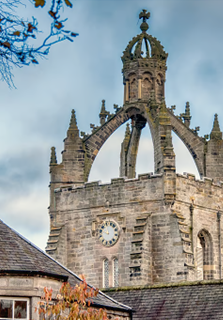
Kings College, University of Aberdeen: image copied from here.

At the University of Aberdeen, where I studied, it was mandatory to take several elective courses alongside the required degree syllabus. These allowed students to either study more widely or dive deeper into their chosen field. We could select any first- or second-year course from any subject that didn’t clash with our timetable – so I, naturally, decided to do both.

Initially, I started university studying Physics, with the hopes of working in green energy. To complement my science interests, I took one of the Sixth-Century courses, Mankind in the Universe, which (as far as I remember) was a short introduction to astronomy. I was interested in the topic and had considered studying Astrophysics at the Universities of Edinburgh or Saint Andrews – but I was turned off by how chilly the observatories were at the open days!

Alongside the broader science experience, I sampled several other fields during my first two years of study.

During my first few weeks of university, I unofficially tagged along with a friend to a couple of her History lectures, which were packed enough that no-one noticed I’d sneaked in. I took notes on her behalf and drew a cartoon ‘scapegoat’ to represent the scapegoat position Germany was forced into after World War 1. But I did also attend the wider selection of electives that I had properly signed up for.

A French Language course allowed me to keep up French for a while. I mostly remember watching a grainy recording of a news article, featuring a woman in thick, dark-rimmed glasses speaking to the interviewer in the slang dialect argot. This was around the time I was working my way through Victor Hugo’s Les Miserables (in English), and Hugo (paid by the word as he was) devotes an entire appendix to argot. So, when the term cropped up in class, I recognised it immediately and was suddenly exceptionally eager to reach that appendix (still several hundred pages away!).

I also briefly attended a Theology course on the Triune God (of all things!), which I dropped partway through due to ill health. Failing to complete the course has not, as far as I can tell, hindered my career or spiritual prospects – but I do remember it was quite fun to learn about the Council of Nicaea and the politicking behind it. And not really ‘getting’ the whole three-in-one thing.

I created my own Land Art snail in imitation of Smithson’s Spiral Jetty.

I took a Modern and Contemporary Art module, through the Art History department, which I thoroughly enjoyed. A few years previously, I had watched the BBC programme Desperate Romantics, about the Pre-Raphaelite brotherhood, in particular episodes 1-4, which followed the establishment and antics of the founding three members of the brotherhood. The class’s ‘modern’ art survey began its tour with the Pre-Raphaelites, which gave me confidence going in even as we moved through some of the less familiar (to me) major art styles of the 19th and 20th centuries. I remember particularly being interested by Whistler, whose paintings I’d seen at the Van Gogh Museum during my family’s holiday in Amsterdam; the Futurist movement, established in 1913, which abruptly abandoned its idolisation of technology once its artists experienced the horrors of the First World War; the distinction between medieval Gothic architecture and 18th–19th-century Gothick revival architecture (and a brief, unimpressed foray into Gothic literature); and Land Art, which was immortalised for me by Robert Smithson’s Spiral Jetty, that resembled a giant basalt snail. The last was so impactful that I even created my own Land Art snail on Aberdeen Beach.

In a similarly styled course, I also studied A Survey of Western Art Music, which took us, whistlestop, from 900 AD to the present day. I remember the final exam included a section where we had to identify the title and composer of set works by ear. My parents took me to HMV to purchase CDs of about twenty different composers from twenty different music traditions, and I created an iPod playlist. I spent a good deal of time listening to the playlist on repeat while going to sleep, and while reading and copying out pages of J Peter Burkholder’s A History of Western Music.

This was the course that actually prompted my transferral request directly into the second year of the BMus programme. Goodbye, future environmental scientist; hello, future music librarian (although at the time I was envisioning becoming a music historian). Fifteen years later, while reading Richard Papen’s transfer from Medical Science to English Literature to Classics in Donna Tartt’s The Secret History, I cannot help but notice the resemblance.

Graduation Day (9 years ago)

My switch was two years into the Physics course. It is sobering to realise that, had the university only offered three-year programmes, I would have been two-thirds of my way through a Physics degree before realising what I truly wanted to study. My life could have taken a completely different trajectory. I might not be working in the best job in the world at Chetham’s School of Music (although you can get academic librarians in any field). And, had I stayed with Physics, I might have struggled to find work in a post-Brexit landscape.

My little sister has a jokey expression: “Whatever’s for you won’t go past you.” In my case, I think I was very lucky, both with my experiences at the University of Aberdeen and in the years that followed.