Raising the Bar[tók] in Catalogue Retrieval Systems

Recently I’ve been thinking about all the parts of librarianship that often go unnoticed by the staff within my school. There’s a pressure, I think, to engage in the student-facing, ‘flashy’ side of school librarianship. Library displays draw eyes; bookmark competitions engage students creatively; library lessons are obvious student engagement; the zine collection is an archive of student work.

Even properly labelling and covering the physical library items is something I can point to and say, “this keeps the item from being damaged, and the label tells you where to put it”.

However, when it comes to the cataloguing side of librarianship, the work largely flies under the radar – despite being integral to ensuring the library runs smoothly.

Since I arrived at Chetham’s just over five years ago, one of my biggest projects (read: bugbears) has been mitigating the user-unfriendliness of the school catalogue.

The school library uses Reading Cloud software: a cataloguing software designed for schools and easily accessible for non-librarians to catalogue with. (Not a MARC record in sight!) It is functional for most school library collections, but it is not (and does not claim to be) designed for music libraries in the slightest.

Our school library has just over 36,000 items, which is quite small for an academic library, but rather large for a school one. Since Chetham’s is a specialist music school and the library is a combined school and music library, over 20,500 of these records are sheet music (including almost 10,000 chamber music sets). I’m putting this into perspective to demonstrate that it is feasible to work with all of the items in our collection (no awful surprises), but impossible to hold the collection in one head.

The catalogue is necessary for telling me what is in the three libraries (and where it is located), however, the Reading Cloud Software is not ideal for sheet music retrieval.

While library staff have access to a more advanced management system, the main difficulty is that Reading Cloud’s student interface has a slow and buggy Advanced Search. This is not such a problem for a regular school library, where most books have a single title, but music is far more complicated. It is frequently necessary to be able to specify the title and the composer of a piece before anything can be located.

Reading Cloud also allows users to easily sort their search by author, but not composer. It is possible to use the sidebar facets to remove CDs from a search (thank goodness). But music searchers must still attempt to navigate a janky Advanced Search that does not effectively filter by field, meaning that it is unrealistic to expect children or even staff to necessarily find what they are looking for – particularly with popular composers like Mozart or Beethoven, or any composers who don’t use opus numbers.

The Quick Search does not, automatically, search across multiple fields – and strict cataloguing standards assume users can use an Advanced Search if necessary. Reading Cloud, however, seems to expect students to get by with only the Quick Search function, the high-functioning Advanced Search being exclusively accessible to the library staff accounts (i.e. accounts with catalogue-editing permissions).

Which means, really, if I want the students to be able to use the library catalogue to suit their musical needs (and I do: the Year 7 literacy class receives a whole lesson on the library catalogue each year), the school catalogue must be adjusted to work as much like a Google search as possible. This means adapting my cataloguing to allow a Quick Search to retrieve the items requested.

Librarianship teaches that a good search system has two goals that it must strive for: Retrieval and Precision.

Assuming the library has the required item in stock, Retrieval describes whether the search returns the required item at all, and Precision describes how many unrelated items it also displays alongside the required item.

Enter my system. Since I started working at the school, I have been adding a line, purely for retrieval purposes, to the top of the summary field in each record:

Firstname Surname – Title [Classification or Location].

Although this line does not follow any orthodox cataloguing practice, these combined descriptors all have identical punctuation formats and allow the searcher to effectively apply a filter (or expander) to their queries without resorting to the Advanced Search (which, even for library staff, is slower than the Quick Search). This speeds up the time devoted to finding items, and makes it easier for students, school staff, and the library assistants (and me!) to check for items on the catalogue.

Children (at least the children in my school) have the tendency to assume that if something goes wrong they are at fault or have messed up. And it is both undermining to their confidence to be confronted with a rickety system, and embarrassing for me to have to explain that something should have been brought back but just wasn’t – often not through any fault of their own.

Bartók Case Study: This is what I’m Bar-Talking About

As an example of further back-end work that will never be noticed, last week I spent a sizeable amount of time working on the Bartók sheet music. It started because I wanted to add catalogue numbers to the records to make it clear in the catalogue exactly which Bartók sonata (for example) a particular record, described only as ‘sonata for piano’ was referring to. (If composers would just opus all of their compositions, my work as a music librarian would be much easier!)

First, I did a little research into Sz vs BB numbers, deciding which catalogue number system I wanted to use. I chose Sz because it seemed to be the more common system to be used these days, including by the Petrucci Music Library (IMSLP) of online scores, frequently used by the students and staff to supplement the school’s physical sheet music library. Even if that choice proves over time to be the wrong one, the Sz numbers are still useful for identifying items now and will help future cataloguers change the system over later if necessary without needing to consult the physical music.

After settling on using Sz, I then printed off a list of all 133 records of Bartók sheet music that we currently have in the school library. I went through each item in turn and worked out each item’s Sz number.

Some of the music was badly described, so I standardised how they were described in the title field a little more, then each item was given a summary entry:

Béla Bartók – Title [Classification or Location].

If the item required a contents list, this was also added, alongside any additional tags and missing information that was easily accessed from the original record (but I did not allow this to slow down or side-track the main project). Fortunately, most of the time, I was able to exclusively work from the existing record, which saved a lot of time. However, occasionally a record had been poorly catalogued to begin with, and in those instances I did return to the physical item and overhaul the full record.
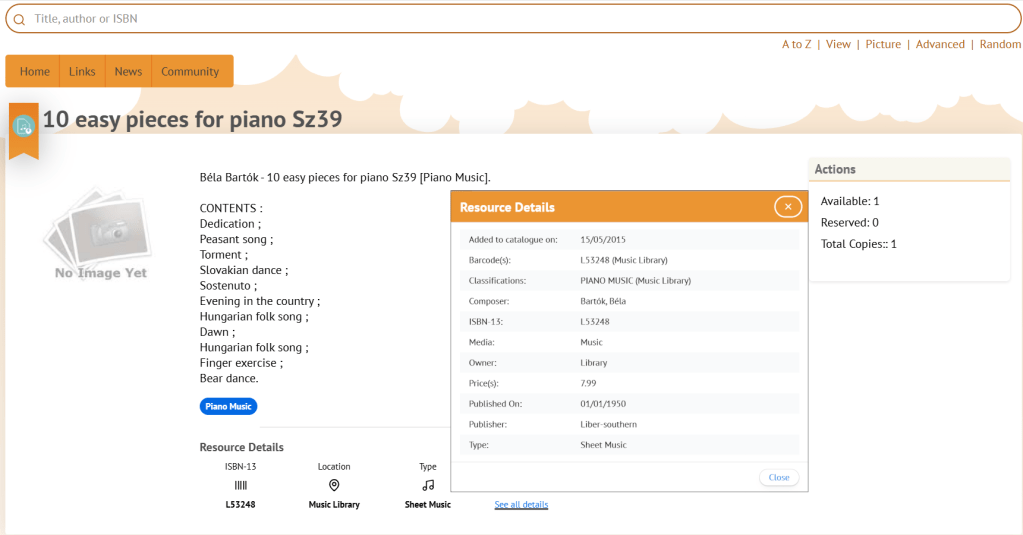
Example catalogue record as the user now sees it

Since completing this project, every piece of Bartók music we have in the school library is now retrievable searching (in the Quick Search):

  • just the Sz number (e.g. Sz80)
  • Bartók or Bartok and a title (e.g. Bartok sonata)
  • Bartók or Bartok and the location (e.g. Bartok piano music).

Or any combination thereof (e.g. Bartok sonata Sz80 piano music). None of this was possible before this project, and the addition of Sz catalogue numbers for the title fields means the pre-existing Advanced Search option is more useful for library staff as well.

Incidentally, during this process I discovered that Bartók actually only wrote one piano sonata important enough to justify its own Wikipedia page, which is why it was listed in the catalogue as merely “Sonata for piano” to begin with. But having the full record and retrievability still ensures the music will now be retrieved if a kid searches for “piano sonata Sz80” or “Bartok piano sonata”.

I find it harder to advocate for this kind of invisible work because, if a student or staff member is looking for Bartók in the catalogue now, all they will discover is a lack of friction finding it. They will not notice the ease, and it is not as attention-grabbing as a new library display or bookmark competition. But long after the display comes down, and the bookmarks have been replaced, this string of text in the summary field will still be helping Chetham’s students and staff to navigate the catalogue independently without being punished for a catalogue system that wasn’t designed for them.
Back to School reflection: What I did on my holiday

After a good amount of time off work over the summer holidays, I am happy (if a bit nervous!) to be returning to the school library tomorrow. I had a lot of plans for when I was off, and some of them I completed, some of them I at least started, and many of them I didn’t get around to. Either way, I thought it would be nice to reflect on the summer before the new school year washes all of it into oblivion.

School’s out for the students

The students finished their school year on Friday 9th of July, but I still had a lot to complete so I spent the following two weeks in the library most days working on four main tasks.

Firstly, I shelved almost all of the books and music that had been building on the Covid quarantine shelves. That was quite a lot of work, seeing as so much music was returned last-minute, and I’m still getting used to the layout of the chamber music library (where we have shelves and shelves of parts in brown envelopes). Full disclosure, there are a couple of items that have been left so that I can ask my ever-helpful evening staff where the music should go!

I catalogued and processed a huge pile of music. We had received a fantastic donation of beautifully bound full and miniature scores from a member of the public. They are in such good condition that I have decided to add all of them to the library stock (replacing tatty copies where possible), but with probably over a hundred items in total, getting through it all is quite a task. I made a dent, but never fear, there’s still plenty of cataloguing waiting for my return tomorrow!

I also did my best to spend the remaining library budget, having been advised if I don’t spend it I lose it. The students can look forward to a few more books, some replacement music for lost copies, and eight lovely new pairs of headphones – enough for every library computer. I don’t know where the previous pairs kept disappearing to, but I think it might be worth creating a headphone sign-out sheet, to make sure these new ones are always returned.

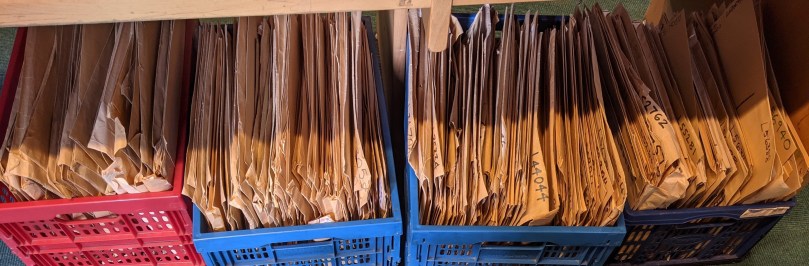
My biggest challenge in the weeks leading up to the end of term, and the two following weeks where I was in the library on my own, was creating lists of all of the music that was still out to school leavers and would need to be tracked down. This task was particularly difficult because, despite being a music school where ensemble music is in high demand, the library system software we use cannot track multiple borrowers. This means that every set of music is only ever out on one borrower’s account (regardless of how many parts there are). Although we try to keep a manual record of who has which part, with over a thousand outstanding items at the end of term, going through every single envelope to notify students of their unreturned music was a huge job – and certainly not one I want to have to do every single summer. I only just managed to get it all completed in time to send out final warning emails to all the students before I left for Scotland, but I’m going to have to work out a better system for future years, or I might have a nervous breakdown!

Four crates full of brown envelopes
All of the empty envelopes still waiting for parts to be returned to them!

Visiting my parents!

After all that stress, I was super excited to travel back to Scotland to visit my parents for a few weeks. It was so nice to see them again, and my sister, Jenny, was there too for part of my trip. On my first night, Jenny introduced me to the anime Assassination Classroom, which is about a group of school students trying to assassinate their evil yet adorable teacher: a betentacled alien that plans to destroy the world if his students don’t kill him first. It’s surprisingly good.

The weather was gorgeous every single day of my visit, so we did a lot of outdoor activities. One day we walked along the beach for a forest/water walk in Greenock and ate ice-cream and another day we went to a market in Helensburgh where we listened to Glaswegian busker Maryjane singing ‘Let It Go’ from Frozen (in the middle of a heatwave). My dad and I went for a 50km cycle along the River Clyde, which was super fun but also extremely tiring, and at one point I fell off my bike. Although I’m pretty sure I hated everything and everyone by the end of it, it was great to cycle with my dad again and we both really enjoyed it.

On another beautiful day we visited my aunt and uncle in Stirling where we walked around the King’s Knot and learned the story of the Stirling Wolf. Apparently, during a Viking raid, one of the raiders accidentally stepped on a wolf causing it to howl out and wake the sleeping Anglo-Saxon garrison. This gave the garrison time to prepare for the invasion and force the Vikings to retreat. And now the howling wolf emblem can be seen all over Stirling. How bizarre is that?!

What is property? Property is stress!

After my visit to my parents, I still had three weeks left of summer holiday, and in this time Calum and I wanted to make some headway into buying our first home. Calum took a week off work, so we set up a meeting with a mortgage broker and started looking at properties. In total, I was able to arrange eleven viewings although five of them cancelled on me before the viewing could take place. Calum and I attended three of the remaining viewings together, and I attended three on my own because Calum had to go back to work. Although it was quite frustrating and extremely stressful, there were still some good parts. On one extremely wet day, after a viewing, Calum and I visited Worsely Village, where we walked around the Tudor-style streets and along the canal in the rain. There were even some cute metal ducks!

Even with the support of my parents (who were great at sending me suitable houses that I might have missed), and Calum (who did everything he could while also working full time) and the mortgage broker (who’s invaluable advice was fantastic help), I found the entire process really grim. I looked at house websites for hours ever morning, calling up estate agents to try to arrange viewings only to be told the houses were already under offer, or they were no longer accepting viewings. Not to mention the palaver navigating the disgustingly stupid system of Freehold vs Leasehold housing (don’t even get me started).

But eventually, less than a week ago, we got an offer accepted. Hooray! It’s a nice house, in a pretty area, and well within our budget, which is fantastic. We will probably need to do some work on the bathroom, because for some reason quite a few houses in Manchester (including this one) have a toilet with no sink next door to the bathroom with the sink in it. This feels very disgusting to us, and we’ll need to get that changed, but otherwise the house is great. It has a lovely shed for our bikes, and a nice big living room, a pretty kitchen and a utility room where we can put our washer/dryer and install our first dishwasher (such luxury!). There are also two relatively big bedrooms. Calum’s has a wee cubby area where he will be able to set up his workspace, since he is planning to work from home more often, and mine has a huge built-in wardrobe and a cosy alcove where I think I’ll be able to fit my bed.

So that’s pretty exciting, and all we need to do now is meet with our mortgage broker again, set up our solicitor, get a survey from our mortgage provider and a homebuyer’s report, exchange contracts and keys, get a new bathroom, move all our stuff across to the new house, and move in. Easy-peasy.

Kirsty Morgan Music in sunny Manchester, outside Chetham's School of Music

Guess who’s the new librarian at Chetham’s School of Music?

Hey, guess who’s moving to England! Spoiler alert: it’s me! I’m going to be the new librarian (well, “Head of Learning Resources”) at Chetham’s School of Music in Manchester. And I’m super looking forward to it. Okay, sure, I’m a bit nervous, but I’m mostly excited. It will be a chance to combine my enjoyment of music librarianship with a person-facing role, which I think will be great.

Don’t get me wrong, I’ve very much enjoyed working at the National Library on their Music Retroconversion Project. I’ve learned so much about music librarianship and cataloguing and libraries. And it’s been fun to work on a project that has a definite endpoint and final product. I was also given the opportunity to write three blog posts about the project for the National Library’s Blog – which was really cool. However, I did miss getting to interact with library patrons – they make every day different and I like helping people find what they’re looking for.

Moreover, working in a music school library has kinda been a background totally-never-gonna-happen-fantasy dream for me since university.

Tag Cloud Schema

When I was studying my ILS Masters at the University of Strathclyde, we were assigned to create “schema” (i.e. different models of organising knowledge) for a set of 10 items. I chose a collection of showtunes for solo voice with piano accompaniment, and arranged them in ways that would best suit a hypothetical Musical Theatre School Library. It was one of my favourite assignments because, aside from the obvious perk of working with showtunes for uni credits, I found it really interesting to think about what information would be needed by the school pupils if they were looking for audition pieces. I enjoyed the problem solving aspect of arranging my schemas to suit that. Things like key, range, time-signature, tempo, voice type, number of bars, etc. didn’t obviously fit into the standard bibliographic categories, so I chose models that gave me the freedom to customise.

This was the first spark that made me think it would be really cool to work in a music school library, but I didn’t seriously think that could happen, since there are very few such jobs in the country. Therefore, imagine my delight when JUST as my National Library contract was coming to an end, the position at Chetham’s School of Music was advertised!

Chetham’s Library

So, obviously I applied and was pleased when I progressed to the interview stage. I travelled to Manchester by train for the interview, and it was my first visit to Manchester ever. I was so excited. I went down the day before and stayed at a nearby Travelodge. That evening I had a sausage supper from the local chip shop, and the staff there were super friendly and wished me luck for my interview. I completed the interview while wearing a mask (which was definitely an experience). And the people at Chetham’s were all very lovely and the school was this really pretty castle-like building in the centre of Manchester. What’s more, the school shares a site with Chetham’s Library, the oldest free public reference library in the English-speaking world. I didn’t get the opportunity to visit it because it’s currently closed, but I will at some point because it looks just like something out of a fantasy story. I’m sure there’s all kinds of magical tomes and cursed writings and probably a ghost or ten hiding among the stacks!

Anyway, shortish story shorter, the people at Chetham’s School liked me and offered me the position and I start in November! How utterly, awesomely, amazingly super is that?!! Yay!

I was Anti-Rickrolled!

I was Anti-Rickrolled by a catalogue card today! In case you don’t know, Rickrolling was a trend few years ago, where a person’s expectations of seeing a funny, cute, interesting, exciting, etc. video were subverted by the video instead turning out to be a clip of Rick Astley singing the song Never Gonna Give You Up. The internet is weird.

Working as the Music Retroconversion Project Junior Editor (pre-COVID)

So, anyway, in my job as Junior Editor on the National Library of Scotland’s Music Retroconversion Project, I review hundreds of music records each day, against scanned images of the original catalogue cards, to check they are correct to go into the online catalogue.

The batch I am working on right now initially shows the front of the card with the title, performer and shelfmark of the music record, then you click to see the back of the card, which displays a list of song titles.

Imagine my excitement when one of the cards I was reviewing was a Rick Astley album! I even said out loud to no-one, “Oh my gosh, am I actually going to get Rickrolled by a catalogue card?!”

My somewhat-unjustified elation was cut short when I clicked to see the back of the card – and the song wasn’t there. There was a whole bunch of different Rick Astley songs that I’d never heard of, but not the famous one! Not the one that was used to subvert, annoy and prank expectations. And thus, by not having the song on the record as I’d been anticipating, I was if anything MORE Rickrolled that I’d have been otherwise.

Well played, catalogue card … Well played.

Food for thought at the IAML Annual Study Weekend 2019

DSC_1237
It’s so adorable!

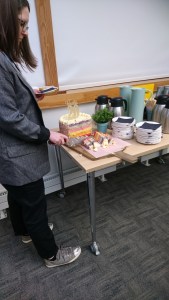
I was very pleased and excited to have been awarded a bursary to attend the International Association of Music Library (IAML)’s 2019 Annual Study weekend, which took place back in April. The report that I wrote about the experience is here, so please do check that out. As always, I never want to JUST plug my writing on other sites here, and like adding something extra to this blog when I do shamelessly promote myself. So, for that reason, please enjoy this rundown of all the awesome foodstuffs provided at the conference. Firstly, look at the quaint pick-n-mix that was made available. The sweets were in little flowerpots and the bags were tiny paper cones. How adorable is that?

DSC_1233
This cake was not a lie. It was delicious.

There was also a rainbow cake to celebrate 20 years of the Cecilia database, which contains information about all of the different music collections in the UK and Ireland. It’s a potentially really helpful tool, that I’m hoping might assist me in my future job searching. And the cake was really lovely – it tasted like vanilla.

I did not get a picture of any of the conference dinners or lunches that were provided. But they were pretty nice, too. I did learn very quickly, after the first night, that, as a fussy eater who doesn’t like to eat slabs of meat, I was better to request the vegetarian option. It meant I got to eat a wide variety of different risottos, and there was a very nice (if a little hard to cut) chocolate tart at the fancy conference dinner party.

I got a little nervous when it came to the dinner party. Everyone was beautifully dressed up, and I didn’t have anything special to wear (and I also wasn’t sure whether the bursary had provided for the dinner, so that was also a little stressful before it was sorted out). Everything turned out fine, though. And one of the waiters joked that I was very posh for drinking the Bottlegreen Elderflower Cordial with (gasp) sparkling water!

DSC_1236
Briefly relaxing before dinner.

Although I don’t drink alcohol, I was quite proud of myself for being sociable in the bar at the end of each day. It was a little noisy, but I really enjoyed talking to the music librarians, who were all really nice and friendly. I did stay up quite late both evenings, so I was super tired from all the excitement and socialising. It was quite nice to have a little break when everyone was getting ready for the dinner party.

The staff were also really nice and let me take some of the complimentary berry teabags to my hotel room. It was really relaxing to unwind in the early hours of the morning, watching Poirot with my fruit tea before going to sleep.

All in all, it was an awesome conference and the food was generally really nice. But for my proper thoughts on the conference from a music librarianship perspective, do check out the report I wrote for IAML.