Book Review: Maurice by E. M. Forster (or The 65th Anniversary of the Greatest Terminal Note Ever Written)

Back in May, I listened to the audiobook of E. M. Forster’s Maurice. I had picked up something of the story prior to reading it, most specifically that it was unable to be published in Forster’s lifetime due to containing a romantic relationship between two men that ended happily. And naturally the first half of the twentieth century would be having none of that.

These days, I listen to audiobooks significantly more than reading printed editions, due to most of my reading happening on walks or during my commute. In this case the experience of listening to the audiobook was particularly interesting to me. For one thing, I spent some time dithering between two versions of Maurice when deciding which narrator to listen to: Peter Firth or Ben Whishaw. I eventually landed on the latter, Whishaw being a slightly smoother voice. But having, through this elaborate selection process, listened several times to the opening preview of the book, in which Maurice is taken aside by a teacher at his boarding school for the Talk (anatomical drawings in the beach sand and all), it is one of the segments that remains most vividly in my memory. Whether I want it to, or not.

I also found that listening to an audiobook of the story dispelled me of my previous belief, from merely reading the word, that Maurice was pronounced in the French style (Mor-eese) – à la the father from Disney’s Beauty and the Beast. It is, in fact pronounced Morris, like the dancer, which seems a less literary title, although perhaps that’s something of a strength.

The book itself follows Maurice Hall as he begins a relationship with a fellow university student, Clive Durham. The novel, having been written in 1913, unhelpfully alternates between first and surnames – so I was initially confused, thinking Maurice was attending Durham University rather than dating a lord of the same name.

I had just finished reading Donna Tartt’s The Secret History, which is, among other things, about a Greek Classics class getting manically caught up in the Dionysian revels of the Ancient Greeks they idolise. So it was amusing to hear Clive’s superior arguments using Classic same-sex relations to justify their own practices – which were kept ‘platonic’ on Clive’s insistence.

“What Italian boy,” E. M. Forster writes, “would have put up with it?”

I particularly enjoyed the bicycle sequence, wherein these two wealthy university students fool around so wildly they crash in the countryside, destroying the bicycle and making their way back on foot (of all things!), much to the indulging bemusement of the locals. Later Clive gets ill in Greece and, disillusioned with the ‘hellenic’ intellectualising of his youth, declares himself heterosexual, marries a (genuinely sweet) woman, and becomes some sort of magistrate. Forster admits that from this point in the novel his treatment of Clive deteriorates, declaring in the Terminal Note: “He has annoyed me.”

I liked Forster’s refusal to soften his characters. It was a common throughline that Maurice was not a particularly good person. E. M. Forster refers to him as “mentally torpid, not a bad businessman and rather a snob.” He’s also something of a misogynist – “he must either smash [his surroundings, mother and two sisters] or be smashed, there is no third course” – and it’s never quite clear how much of his disgust towards women is brought on by pressures to engage in heterosexual relations that disgust him, how much is an individual personal failing on Maurice’s part and how much merely a result being male in the early 1900s.

After Clive’s switch, Maurice goes to several doctors, including one infuriating hypnotist, to be medically treated for his homosexuality. He refers to himself as:

“An unspeakable of the Oscar Wilde sort.”

which I think is an absolutely delightful (if existentially horrifying) phrase.

Maurice then sleeps with Alec, Clive’s gamekeeper. From the start, I was extremely worried for Alec, due to both the uneven class disparity and the fact that Maurice had, by this point, proven himself to be very much not the sort of person to think carefully about an uneven class disparity.

Alec was pretty great, however, and held Maurice both romantically and structurally accountable, which I think Maurice certainly deserved (although Maurice himself didn’t seem to think so!). Alec refused to let Maurice ghost him, and even sent delightfully passive aggressive letters highlighting, in no uncertain terms, the differences in their situations, and the unfairness of Maurice to have exploited that. Their making up scene, where they wander the British Museum for several hours together, is very sweet. They have agreed, once they leave the museum, to never see each other again. So they just don’t leave.

Regarding the happy ending, the impetus for my reading the book in the first place, E. M. Forster writes:

“A happy ending was imperative. I should not have bothered to write otherwise. I was determined that in fiction anyway, two men should fall in love and remain in it for the ever and ever that fiction allows, and in this sense Maurice and Alec still roam the greenwood.”

That quote comes from the Terminal Note, written in September 1960 – still over a decade before the novel was published, and roughly forty years after it was first written. The Terminal Note is truly what made this reading (/listening!) experience particularly memorable for me. Forster discusses the impossibility of publishing a book where the same-sex lovers get away unpunished, and his support for the Wolfenden Report, that recommended (among other things) decriminalising homosexuality between consenting adults in private.

The first time I listened to the Terminal Note, I was on the tram. We got to the last section (I want to say paragraph – although with an audiobook, how can you tell?), and I genuinely slapped my hand to my mouth in shock. From an author’s afterword of all things!

Talking about the legalisation of homosexuality, Forster writes:

“If it could be slipped into our midst unnoticed, or legalised overnight by a decree in small print, there would be few protests. Unfortunately it can only be legalised by parliament, and members of parliament are obliged to think or to appear to think. Consequently the Wolfenden recommendations will be indefinitely rejected, police prosecutions will continue, and Clive on the bench, will continue to sentence Alec in the dock. Maurice may get off.

The jibe at politicians is amusingly barbed, and the elegant marriage of class and sexuality politics, narrated almost as a throwaway in the Whishaw recording, devastated me (the bold is my addition). I immediately rewound and relistened to the entire Terminal Note (which on its own raised my Goodreads rating of the book from three to four stars), and have been showing that paragraph to anyone who will indulge me ever since. Including, now, you.


Incidentally, the Wolfenden recommendations that Forster references were vetoed in parliament in June 1960 (four months before the Terminal Note was written), although the recommendations went on to advise the Sexual Offences Act of 1967, decriminalising same-sex relations between consenting adults over the age of 21 in their own home.

I actually did a placement with the National Library of Scotland during my Masters, through the British Library’s Unlocking Our Sound Heritage, where I was writing and quality controlling catalogue descriptions for a collection of sound recorded interviews with LGBTQ+ people in Edinburgh. One of the running themes in that collection was the harm caused by Section 28 (1988), which prevented local councils and schools from teaching or discussing LGBTQ+ issues or relationships.

What struck me at the time was the matter-of-fact manner the people in the interviews talked about it. I was seven when the act was repealed in 2000 (England & Wales even later, in 2003), and before working on the catalogues nineteen years later I hadn’t even encountered the term (although, I had unfortunately heard of “pretended family relationships”).

Twenty-one years was all it took for the Conservative government to undermine the marginal concession offered by that 1967 Sexual Offences Act. In that small 21-year span, Maurice was published in 1971 and the James Ivory film based on the book was produced in 1987. Then, in 1988, Section 28 struck.

Sometimes I fall into the trap of believing such backward attitudes are from an earlier time (the Eighties being pre-birth history). Looking at the dates around Maurice focuses, for me, the ease with which progressive changes can be quickly overridden. There were twenty-one years between the Sexual Offences Act and Section 28. Section 28 was fully repealed just twenty-two years ago.

Through that lens, the current political lasering of bigotry against transgender people has troubling temporal parallels, making any changes for the better since the ancient history of 2003 feel precariously fragile.

Book ‘Review’: Oh, Castle of Otranto!

Recently, I was looking through my old books and I came across the copy of The Castle of Otranto by Horace Walpole that I had annotated in university.

Back when I was studying at the University of Aberdeen, I took an Art History elective on Modern and Contemporary Art. In an even broader definition of ‘modern’ than the twentieth- and twenty-first century framing often used by music scholars, the course spanned back as far back as the paintings of the Pre-Raphaelite Brotherhood, who were founded in the mid-nineteenth century.

During one of the earlier weeks of the course we discussed nineteenth-century architecture, looking at John Ruskin’s reviews of the Gothic revival and the Barry/Pugin designed Houses of Parliament. But the thing that most stayed with me from that lecture, other than the distinction between Gothic and Gothick (the former being the real deal, and the latter being the Victoriana knock-off), was that the lecturer mentioned, as I was to learn later merely in passing, for us to really understand Gothic(k) architecture, we should read Gothic literature. And she recommended Horace Walpole’s novel The Castle of Otranto – often credited as the first Gothic novel.

Annotations for Chapter 4

With the dedication of an overachieving student who was really enjoying a course, entirely unrelated to my base Physics degree, I purchased a copy of the novel, and set to work. At that point I was even more unfamiliar with the gothic genre than I am today, and my method for ensuring I would absorb the text was to read a chapter, then write down everything that I remembered from the reading. It being a relatively short book (only five chapters in total) I believe the process only took me a couple weeks to complete.

The book never came up again in the lectures, and we moved on to the twentieth-century arts. But reading back on my baby (eighteen-year-old) scholar chapter recaps fifteen years later, I thought they were fun enough to share here. Enjoy!

Chapter 1

  • At the wedding of Conrad and Isabella, Conrad is crushed by a helmet and dies.
  • Conrad’s father, Manfred, arrests an innocent peasant and accuses him of necromancy.
  • Manfred’s wife, Hippolita, and daughter, Matilda, are distraught but Manfred, more concerned about the loss of an heir than the death of a son, attempts to assault Isabella to continue his bloodline through her.
  • Isabella takes advantage of the distraction created by a painting coming to lie and escapes with the help of the peasant from earlier.
  • Manfred catches up with the peasant and is impressed by his apparent honesty, thus pardoning him.
  • Two servants inform Manfred of a ghostly giant they encountered while hunting for Isabella.
  • On finding no such giant, Manfred dismisses their claims and tells the peasant to stay the night. He wants to talk to him in the morning.

Chapter 2

  • In her chambers, Matilda awaits news of what has happened to Isabella.
  • Her Maid of Honour, Bianca, tells her of rumours among the servants of ghosts, and the peasant who was found by Manfred.
  • Startled by strange noises from the supposedly empty room below, Bianca is frightened, suspecting it is Conrad’s ghost.
  • Further investigation reveals it is actually the peasant, who begs in vain for news of Isabella.
  • The next morning, a holy man, Friar Jerome, brings news to Manfred and Hippolita that Isabella is hiding in Saint Nicholas’s altar.
  • It transpires that Jerome has been told about the previous night’s attempted-assault and, in an effort to protect Isabella, he inadvertently plants suspicions in Manfred’s mind that Isabella and last night’s peasant are lovers.
  • Manfred questions the peasant again and, on learning of his role in Isabella’s escape, orders the peasant’s immediate execution.
  • Noticing an arrow-shaped birthmark on the peasant’s shoulder, Jerome recognises him as his long-lost son and it is revealed that the ‘peasant’ is actually Theodore, Count of Falconara.
  • Manfred decides to use this to his advantage and offers to spare Theodore’s life if Jerome returns Isabella to him.
  • The chapter ends with eerie trumpet noises from nowhere and, in the courtyard, the helmet that killed Conrad nods three times.

Chapter 3

  • Frightened by the trumpet, Manfred says he will give Theodore to Jerome if the friar goes to the gate to discover the noise’s source.
  • Turns out it was a herald calling Manfred a usurper. In anger, Manfred reneges on his promise and, once again, orders the friar to return Isabella.
  • Jerome returns to the church only to find that Isabella has fled upon hearing news of Hippolyta’s supposed death.
  • Meanwhile, Manfred receives the herald’s master. While trying to convince the unknown knight to allow him to marry Isabella, they are interrupted by an army of monks who inform him of Isabella’s escape.
  • Both Manfred and the unknown knight set out separately to find Isabella.
  • Matilda takes advantage of her father’s absence to free Theodore from the cell he is being held in. During this brief encounter, the pair fall in love.
  • Theodore finds Isabella hiding in a cave and they are pretty soon attacked by the unknown knight, who Theodore accidentally mortally wounds.
  • As he dies, the knight reveals he is Isabella’s father.

Chapter 4

  • Turns out, Hippolita isn’t actually dead – she and Matilda greet everyone as they return to the castle carrying Isabella’s dead father’s corpse.
  • Oh wait! Isabella’s father, Sir Frederic, isn’t actually dead either. None of his wounds were all that severe!
  • Recovered slightly, Frederic tells Hippolita, Matilda, Isabella and Theodore that Manfred’s dictatorship is destined to end.
  • Manfred enters the room and mistakes Theodore for a spectre; but on realising his mistake, demands to know how Theodore escaped again.
  • Not wanting to get Matilda into trouble, Theodore blames his father, Jerome and goes on to explain, among other things, that, as a young boy he was abducted by pirates!
  • Later, Isabella and Matilda confess to each other that they both have feelings for Theodore. But, because Theodore obviously only loves Matilda, it is decided Matilda should have him.
  • Then Hippolita enters and tells Matilda that she is to marry Isabella’s father, Sir Frederic!
  • After much tears and angsting, all three women bring each other up to date on what’s going on. Hippolita finally realises her husband is a douche and plans to divorce her.
  • She decides to ask Friar Jerome for his advice but, when she arrives, she finds him and Theodore arguing about Theodore’s love for Matilda – which Jerome feels is ill-advised.
  • Jerome then goes on to convince Hippolita not to allow a divorce.
  • Manfred, who has convinced Frederic to consent to marry Matilda, finds Hippolita with Jerome and, on learning what Jerome has done, argues.
  • Jerome threatens Manfred with excommunication and, as Manfred and Hippolita leave, Manfred orders one of his servants to guard the convent and alert him if anyone from the castle tries to enter.

Chapter 5

  • Manfred reflects on all that has passed and comes to the conclusion that Isabella and Theodore are secret lovers.
  • He then proceeds to bribe Bianca (Matilda’s maid of honour) into ‘betraying’ Isabella, but Bianca refuses.
  • Later, Manfred and Frederic are talking and are interrupted by Bianca, who claims to have seen the giant spectre from Chapter 1.
  • Frederic believes her but Manfred is disdainful.
  • Later, on his own, Frederic meets a skeleton ghost, who tells him not to marry Matilda – this freaks him out.
  • Manfred is approached by the servant spy from earlier, who informs him that Theodore is at the convent with a woman.
  • Assuming the woman is Isabella, Manfred goes to the convent and stabs her. Only to find out too late it was actually Matilda.
  • Woe, angst and fainting ensue.
  • Matilda dies; sorry, “expires”!
  • Theodore, distraught, is made Lord of Otranto, and never marries.
  • Hippolita and a now completely reformed Manfred join religious orders.
  • Isabella and Frederic are fine but traumatised.

The End (Thank goodness!)

Never Meet Your Heroes; You’ll Only Disappoint Them

Earlier this month, I was in Edinburgh to review Company Wayne MacGregor’s production, Autobiography, for Bachtrack. This post isn’t about that. Rather, it’s about an incident that took place earlier that day, where I, by chance, got the opportunity to meet my favourite living children’s author, Theresa Breslin, at the Edinburgh International Book Festival.

A little backstory. I’ve loved Theresa Breslin’s books since I was in primary school. I enjoyed the Dream Master series because it reminded me of E. Nesbit, Enid Blyton and Edgar Eager. Her book Remembrance taught me about pacifism during the First World War. I learned about how awful dyslexia was for children in the past from Whispers In the Graveyard. And, although Marcus Sedgewick is a writer I also enjoy, I’m still slightly disappointed that the Booktrust Teenage Prize opted for his book, My Swordhand Is Singing, over Breslin’s The Medici Seal…

(although, at least the Booktrust had the decency to choose a more than halfway decent book as its winner, unlike SOME competitions I could name *cough*Carnegie*cough*…seriously, Just In Case was the actual worst.)

My point is I’ve been a Theresa Breslin fan for a while, so when, a couple of years ago, I saw that she was signing books at the Edinburgh Book Festival on a day that I happened to be there, you’d have thought I’d jump at the opportunity to meet her and get a book signed. And, I almost did, I swear… but I chickened out. It felt too weird for a 20-odd year old to be standing in line alongside a bunch of kids to get a book signed by a children’s author.

And then I forever felt bad about not having met Theresa Breslin when I had the chance. I was even lamenting about it to one of my work colleagues less than a month ago.

But then, earlier this month, I was in Edinburgh for a Bachtrack review, and I had time to burn. So my best friend Calum and I went to the book festival, where Theresa Breslin, coincidentally, was signing books again. Would you hate me if I told you I almost chickened out a second time? I am, undoubtedly, my own worst enemy.

But I didn’t chicken out, because Calum was there and he convinced me to go through with it. I was still a little nervous, but I bought a copy of Spy for the Queen of Scots and waited in a fairly short line.

And, unsurprisingly, Theresa Breslin was super nice. She asked whether I’d been at the talk that she and Holly Webb had given earlier that day… which I hadn’t. I managed to babble something about just having seen she was signing books and that I’d really liked her when I was wee. I didn’t say that she was still one of my favourite authors and that the last time I read one of her books was this year. That would have been weird.

Spy For the Queen of Scots - dedicated page2 (3)
Look at the pretty title page!

The meeting was a blur. She signed and dedicated the book to me, and then it was over. I was in a slight state of shock for about fifteen minutes after the signing and I kept asking Calum whether it had gone okay and checking I hadn’t made a fool of myself. I think it’s the most fan-girly I’ve ever been in my entire life. (Oh my gosh, what would happen if I, in some weird turn of unlikely events, were to meet Julie Andrews?! Would I faint? Or cry? Or cry and then faint?!)

All things considered, although I was nervous, it could have gone a lot worse. And now I have a book signed by Theresa Breslin, which I am extremely ecstatic about! I’ve even wrapped the book in some laminate casing to keep it nice. And it was an awesome extra add-on to a fun day out with my friend and then a not-so-fun dance show in the evening. And two out of three ain’t bad – I count that as a really good day!

Book Review: Oedipus the King

First published on 50 Book Challenge on 9 July 2016.


I was browsing Audible recently, and discovered that for a very limited time the three Oedipus plays written by Sophocles were free to download. Naturally, I downloaded them immediately, and that night I listened to the first play of the trio, Oedipus The King (aka. Oedipus Rex).

I knew a little about the Oedipus story going in. I knew that he was the son of a king, but had been sent away because of a prophecy that told how he was destined to kill his father and sleep with his mother. I knew that this then backfired, because having not been brought up in their company, Oedipus then did not recognise his parents when it came to killing or sleeping with them. And I knew that Sigmund Freud named his theory that suggests all men want to sleep with their mothers after Oedipus. (I’m sure there is more to Freud’s theory than just that, but I’m a musician not a psychologist, so that’s basically all I’ve picked up.)

What I didn’t know, and was interested to discover, was that all of the stuff I knew about Oedipus had actually already occurred before the events of the play happen. Oedipus is already king, having unknowingly murdered his dad and correctly guessed the riddle of the Sphinx. Thebes, the land Oedipus rules, is plagued by a blight from Apollo, who is angry at the murderer of the previous king. Unsurprisingly, Oedipus calls down all kinds of punishments on the murderer, unaware that it was, of course, himself who committed the regicide. It would be a bit mean to judge Sophocles for his clichéd storytelling just because so many writers who came after him used the same techniques (yes, I’m looking at you, Shakespeare), but I admit, as I listened, I did have to repeatedly remind myself of the fact that this stuff was new when it was being written and therefore the play wasn’t as formulaic as I, a 21st-century listener, was experiencing it to be.

Most of the play is taken up with Oedipus getting angry at innocent people. He gets angry when the prophet, who he hired to reveal the murderer, accuses Oedipus of the crime. He gets angry at his wife’s brother (i.e. his own uncle, because incest makes family relations complicated) for bringing the prophet to him, despite the fact that Oedipus had ordered him to do so. And then, when he finally finds out the truth, he gets so angry with himself that he stabs his own eyes out with his wife’s/mother’s brooches.

Basically, Oedipus is a very angry person, and that leads to something I found particularly unsettling. Sophocles obviously wanted to paint Oedipus as a hero and a great man at the beginning of the story. Oedipus had defeated the Sphinx and lifted the curse on Thebes, and he makes a lot of good choices when he learns about Apollo’s plague, calling for help before his advisors get the chance to tell him that’s what he ought to do. But the play glosses over the fact that, even at the start, Oedipus is guilty of mass murder. Even although he didn’t know one of the people he killed happened to be his biological father, he still deliberately killed five men who had made him angry one time. This is probably a clash of cultures between Ancient Greece and 21st-century Scotland, but even before the reveal, Oedipus isn’t, and never has been, a good person. Sure, he gets upset once he realises one of the people he murdered was his father, but in all honesty he seems more put out by the fact that he happened to accidentally marry and have kids with his mother!

And, yes, incest is probably the ickier of the two, but it’s certainly not the less moral, particularly seeing as Oedipus had no way to know that the woman he was marrying was his mother, whereas he had every reason to know that he was killing five men who had done barely anything to provoke him. (The reason Oedipus gives for committing mass murder, by the way, is that he refused to get out of the way of the king’s carriage so one of the drivers used the horse’s whip on him, which certainly wasn’t the kindest move on the part of the whip wielder, but still didn’t warrant murder.)

Anyway, finding his wife/mother has committed suicide on discovering the incest, Oedipus, blind and ashamed, begs to be banished from the kingdom, and requests that his uncle/brother-in-law take care of his daughters/sisters. His wish is granted, and the play bleakly ends.

All in all, it was a surprisingly enjoyable listen, given the grim subject matter. The Audible version was well performed with pretty music in between the scenes. I particularly liked the scenes with the gods, especially the point when they deferred to the wisdom of the party-god Dionysus, which I found very amusing. I liked the performance a lot. The story has clearly stood the test of time, and I’m glad to have read (well, listened to) it.


Book Review: The Invisible Man

First published on 50 Book Challenge on 17 June 2016.


Invisible is a colour, right? Either way, I’m counting it as one under the “book with a colour in its title” category because: (a) there’s stuff I want to say about this book, and (b) it didn’t really fit into any of the other categories either. If that rankles your linguistic or scientific sensibilities then I guess that’s a shame, but I’m sure you’ll get over it. Besides, it’s my blog and it follows my rules. So, yeah. Disclaimer over, let’s talk about The Invisible Man by H. G. Wells.

The titular invisible man is a scientist named Griffin who deliberately turns himself invisible only to realise that being invisible is more of a burden than a freedom. Although the reasoning for always keeping his body unseen under clothing and bandages is revealed to the characters fairly late on in the story, the title obviously makes it clear to the readers right from the start. This meant that the reader, like Griffin, was more knowledgeable about the situation than any of the viewpoint characters, which gave us an early insight into how it must have felt to be Griffin surrounded by the ignorance of all the other humans.

I do feel that there are some unfortunate implications in the first half of the novel, given that most of the characters are fairly unpleasant stereotypes of people less well off than H. G. Wells himself was. All of the working class women are nosy busybodies, while the working class men are all slow idiots. The landlady that Griffin rents a room from is particularly infuriating. She hovers around Griffin despite his repeated requests to be left alone, and she deliberately ignores her husband’s subtle hints that she should stop talking. And, sure, it transpired that Griffin was a complete psychopath and probably deserved a bit of inconvenience, but she had no reason to know that. He was paying her for a room, requested to be left in peace, and she blatantly ignored his wishes. If a person asks you to leave them alone and respect their privacy, then it’s only decent to leave them alone and respect their privacy.

Eventually Griffin does lose his patience and swears at her, and although the novel paints this in a negative light, I’d say she darn well deserved it. If I had to spend all my time around such intervening inconsiderate jerk-bags, I too might end up slightly unhinged and start taking the view that these prying gossipmongers weren’t worth my effort to try not to hurt. And, okay, I wouldn’t go on a full murder-rampage like Griffin ended up doing, but she absolutely brought his cussing on herself. Heck, and then she had the gall to get all ruffled up and indignant, which was utterly uncalled for!

Aaanyway, after some time, his secret invisibility is discovered and Griffin has to go on the run. Because he doesn’t want to draw attention to himself, he removes his visible clothes and convinces a tramp named Thomas Marvel to carry his books and money for him. The tramp foolishly attempts to rob him, and is subsequently chased by the invisible man to a town where, by pure chance, a fellow scientist who knew Griffin at university lives. The scientist is named Dr. Kemp, and he’s probably the first reasonable character to appear in the novel – which is also kinda unfortunate given he’s also one of the first middle-class characters to turn up. (The book was written a long time ago, so I guess it’s not really fair to judge H. G. Wells for his apparent classism, but it’s still worth pointing out that it is present, I think.)

Kemp is the first guy who is really willing to help Griffin even after the invisibility is revealed to him, and so he is also the first person to whom Griffin discloses the events that led to his becoming an invisible fugitive. This is the point for me where the novel became really interesting as we hear, in Griffin’s words, how it felt to be an invisible man. He talks about how he can’t wear clothes if he wants to remain invisible, but he did need to try to steal some clothing to keep out the cold winter. He talks about how the food he eats remains visible for a while after he’s eaten, so he has to hide while it’s digesting. He talks about how dogs can still smell him but, because they can’t anyone there, they go crazy around him.

We also slowly realise how deep Griffin’s disregard for his fellow humans goes. ​Although Griffin doesn’t see anything wrong with, for example, knocking out a disabled old man, robbing, gagging and tying him up, Kemp is understandably horrified and he refuses to aid Griffin in setting up a “reign of terror”, instead sending word to the police station to come and arrest Griffin.

Realising that Kemp has betrayed him, Griffin flees and develops a vendetta against Kemp, murdering innocent people and assaulting one of Kemp’s servants. I really enjoyed the fact that in order to catch Griffin, Kemp discloses all the relevant information he picked up from Griffin’s story. What at the time had seemed to be merely a “how I got here” explanation was turned into a how-to guide on how to destroy an invisible man. Eventually Griffin is killed, and slowly, as his cells die, he reverts to being visible again. The novel ends with Marvel, the tramp who had stolen Griffin’s notebooks, determining to do better as an invisible person that Griffen managed, and the scene where he attempts to decipher Griffin’s notes is actually rather adorable. It’s clear that Marvel has no idea what to make of the language in the notebooks, “Hex, little two up in the air, cross and a fiddle-de-dee,” and through this we know Griffin’s formula is lost forever.

All in all, I had a lot of fun reading The Invisible Man by H. G. Wells. It’s not too long or laborious, which is something I really like about Wells’s novels. I was able to finish it in two evenings, and I’m a very slow reader. I thought some of the details were pretty cool ideas, in particular the fact that Griffin’s food remained visible after he’d eaten (and its subsequent use as a Chekov’s gun). I do think the second half of the novel was more interesting than the first half, but it was overall a good read that I enjoyed very much.

Book Review: You’re Never Weird on the Internet (Almost)

First published on 50 Book Challenge on 4 December 2015.


I first came across Felicia Day while watching the web series Doctor Horrible’s Singalong Blog, which is a musical starring Neil Patrick Harris as an aspiring supervillian and Nathan Fillion as his jerkass superhero nemesis. (I definitely recommend checking it out if you haven’t seen it.) But I didn’t put a name to her face until a few years later, when I saw her in some videos on the YouTube show TableTop – in which Wil Wheaton plays board games with a few of his friends. I thought she was really funny and always seemed to be having a good time playing games for a living, but it was a throwaway comment she made on during one of the TableTop episodes that especially drew me to her. It turned out that, like me, Felicia Day was a music major. I’ve often been told that music is a hobby, not a viable career option, so encountering a person who had studied music at university (and managed to make a living out of it) made me feel a lot more confident about my own choice of degree. I was encouraged that there was still a possibility that I wouldn’t end up spending most of my adult life in unfulfilled, penniless misery. It sounds sort of pathetic as I write it out, but at the time I found it really affirming to know that someone that I admired had made the same degree choice that I had.

So, when I saw that Felicia Day had written a memoir, of course I bought and read it. And, in all seriousness, I loved it. The writing style was casual and personal, the topics that Felicia chose to talk about were interesting and relevant, and she managed to highlight some serious issues in a funny, lighthearted manner without trivialising the content.

The book starts with Felicia talking about her eccentric, home-schooled childhood, and her life at university. I enjoyed reading the precociously cute diary entries she had written as a little girl and learning about some of the antics that she and her brother got up to as kids.

“Do you know what I would like more than anything (except environmental and biological stability forever) in the world? I would like to travel in time like in Quantum Leap. It would be so wonderful!”

Excerpt from Felicia Day’s childhood diary.

Unfortunately for my sense of solidarity with a fellow music major, however, it turned out that Felicia had been something of a music prodigy, which I most certainly am not. She had attended university as a young teenager and was an expert violinist. (And she could sing, too, as demonstrated by her performance in Doctor Horrible’s Singalong Blog, mentioned above.) But even though her music abilities far exceeded my own, I could still identify with her problems with social anxiety. Felicia’s frank, open style of discussing her own feelings of awkwardness around her classmates and lecturers, despite being provably extremely talented, kept her story accessible and amusing.

She also wrote openly about her struggle with gaming addiction, which I found really interesting. I’ve (thankfully) never experienced this problem myself, but I’ve known people who have, and reading this section of Felicia’s memoir really gave me a deeper understanding of the condition. The descriptions of denial, lost ‘real world’ relationships, created ‘in-game’ friendships, and involvement with a support group were extremely moving, and I felt invested in her experiences and journey.

For this reason, I was particularly heartened to read about her recovery process, which was aided by producing and working on the webseries The Guild. The series was based on the gaming community, which she of course had an in-depth understanding of, and it was really nice to see how she used something as parasitic as an addiction to create a work that was loved by so many people. As well as this, there was an enlightening glimpse into the world of movie-making, which I found really fun to read. I even sought out The Guild series and binge-watched the entire show in one evening… I regret nothing!

In a similar vein to the addiction, I really liked the way Felicia tackled writing about her later experiences with burnout, depression and online harassment (i.e. #gamergate). Although these were some pretty sobering subject matters, Felicia managed to include enough mood-lightening humour to balance her more serious content. I thought she wrote very astutely about depression, giving words to feelings that are difficult to express, and I found some of the nasty things people online had done to her really chilling: from death and sexual assault threats to having her home address posted online. At one point she described having received a frightened phone call from her colleague, Wil Wheaton, telling her that she needed to disable the comments on one of her blog posts because there were people posting very personal details about her. Reading this passage and her subsequent ordeal trying to take the comments down while not actually being able to access the internet for herself (on account of having no signal) was pretty harrowing for me as an observer – how awful it must have been for her at the time. It is horrifying that people would be so callous.

I really admire her writing style during the sections about the online harassment; she was surprisingly rational and level-headed. There was anger but it was never unjustified and, while she didn’t make allowances for out-of-line behaviour, she wasn’t needlessly provocative, either. The occasional joke certainly relieved tension while maintaining the ​seriousness of the situation.

I don’t tend to read memoirs very often (the only others that I’ve completed were comedian David Mitchell’s book Backstory and Forever Liesl by actress Charmian Carr). I don’t know why I haven’t read more of them; I’ve highly enjoyed the three that I have read. I really like Felicia Day’s style of acting, and presenting, and also, it turns out, writing. It was a fun and enlightening book. I thought it was great.

Book Review: Pantomime

First published on 50 Book Challenge on 22 October 2015.


Last May, one of my best friends suggested that I read the young adult novel Pantomime, by Laura Lam. I borrowed the book at the time, but university exams and then other time constraints meant that I didn’t complete it until a few days ago. However, having been urged to get a move on so that it can be lent to some other people, I took a few hours’ break from studying in order to finish the book.

Pantomime follows an intersex teenager, who has been raised as a girl (Iphigenia Laurus) but runs away to join the circus adopting a male identity (Micah Gray). It is a pretty original premise for a story – I had never come across any other novels that feature a non-cis protagonist who is openly described as such. (Admittedly, I’d also never actively sought out books about non-cis people, and a quick Google search brought up a few others). It’s clear, though, that there is a significant dearth of books about people who aren’t cisgender, which alone makes Pantomime worth checking out, even if it weren’t for all the other factors that make the book a good read.

I liked the style that Pantomime was written in. It subverted the common model of alternating chapters between two characters by making the chapters shared between one character, with the twist that one of the viewpoints is really a flashback to Micah’s old life as Iphigenia. As well as being an interesting approach to a fairly formulaic writing style, it allowed Micah’s backstory to be gradually revealed over the course of the book. This made the horrifying discovery of the exact events that prompted the kid to runaway from home all the more effective. What would have already been a major plot-shifting reveal now occurred only after it had been made clear that living as Iphigenia was considerably less fulfilling and more distressing than living as Micah was. This put the reader in a better position to understand Iphigenia’s subsequent feelings and actions. If the timeline had been more linear, we would only have met Iphigenia at the point of the reveal, and might have accidentally arrived at some incorrect or problematic conclusions (for example, that Iphigenia was the ‘real’ identity).

Pantomime is a Gaslamp Fantasy set on the magical world of Ellada. I initially thought that the background magical elements were slightly gratuitous, but they did come in useful without being too contrived and throughout they added to the fantastic feel of the circus, and the setting in general. The little excerpts from in-universe writings that opened each chapter were a nice touch, and I liked Lam’s use of expressive, sometimes antiquated, language that enhanced the overall atmospheric effect while still remaining accessible.

I thought that all of the characters were rounded and entertaining, even the minor ones. I particularly liked the circus cook, a lovable grump who gave meager food rations unless confronted and didn’t receive nearly enough page-time in my opinion, and Iphigenia’s brother, who is the only person from her old life who knows “Gene’s” secret but accepts her for who she is anyway. If the romantic aspects of the plot felt a little unnecessary, they weren’t overbearingly so, and the decidedly-unromantic romantic aspects of the plot were fittingly dark and freaky.

In fact, although Pantomime is a book aimed at young adults, Laura Lam doesn’t shy away from dark themes. The reactions of some of the characters when they found out Iphigenia/Micah’s true identity was pretty harrowing to read, and I was unprepared for the dramatic darkening in tone in the final few pages. This was no bad thing, though; I very much enjoyed the last few chapters because, up until that point, I had found the story fairly predictable.

There was one point I noticed where the narrative seemed to be undermining its own purpose. It felt a little odd that a book that focused so heavily on the gender identity of its main character would describe a porcelain doll as “something any little girl would cherish.” (p.151). At the time, I found it grating that gender stereotypes were taken for granted by a character who ought to know better, but on reflection it could also be that Micah had been influenced by the Victorian-style culture around him despite also being an outcast. I really like the subtlety there, and it makes me wonder if there was similar subtext elsewhere that I might have missed.

The inclusion of an intersex character at all was a refreshing change from the norm, which makes it so gutting that this also (tangentially) resulted in one of the main problems I had with the book. It seems likely that most major publishing houses wouldn’t risk printing a book about a non-cis person, and the publishing company that Laura Lam has gone through is a very small one that probably doesn’t have the resources to rigorously check spelling and grammar. This unfortunately means that the book contains a considerable number of distracting errors that are detrimental to the reading experience and made it difficult for me to stay immersed in the story. But this was a minor quibble and, since the book is about to be re-released, I expect most of these problems have been identified and corrected in the new edition.

I really enjoyed Pantomime. It was a fun book with an angle that few authors have ever gone for. The problems I had with the grammar and spelling were distracting, but the detailed world building and colourful descriptions more than made up for that. All in all, it was a good read – thank you, Ali, for recommending it.

Vikingdom Coming

Last weekend my parents and I attended Largs’s annual Viking Festival. The weather was fantastically sunny, the best they’d had all week, and I want to tell you about this really fun day.

DSC_0013
Arkansas Ramblers

We woke unreasonably early, about half past nine in the morning (the horror!), and drove for an hour and a half to arrive in time to see my mother’s friends from work performing on the music stage. These friends were members of the recently established, Glasgow-based band the Arkansas Ramblers, a group of ten musicians who perform Old Time Americana, Country and Bluegrass music. I really enjoyed the performance; there was a nice mixture of older music, such as the pro-unionist, Civil-War tune ‘Kingdom Coming’ to more recent compositions like ‘Ashokan Farewell’, which was written in 1982 but still fit the overall tone with its mellow traditional sound.

The stand-out section for me was the fantastic duet, ‘Tennessee Waltz’, between Bernadette Collier and Sandy Semeonoff. The harmonies during the chorus are spine-tinglingly rustic, with Collier taking the tune while Semeonoff offers a simple tenor accompaniment that hangs very close to the melody and makes heavy use of third and sixth intervals. The sound is very characteristic of the genre and the voices blend together splendidly. It was fantastic.

It wasn’t even entirely out of place to have traditional American music playing at a Viking festival. After all, the Vikings reached the Americas centuries before Christopher Columbus was born – and towards the end Bill Macaulay, the founder of the group, had even donned a knitted Viking helmet!

After the performance was over, I explored the rest of the festival. There were myriad stalls selling a variety of crafts, lotions, foods, and souvenirs. There were also several fairground attractions, but more fun, for me, was the Viking Village.

DSC_0026

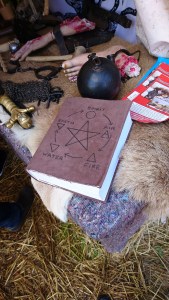
Doctor’s manual (made from vellum). Also plastic amputations, because medicine was horrible back then.

The Viking Village was like an outdoor museum, with wicker huts, old-fashioned stalls, and experts dressed in old Norse outfits who were eager to tell you about their specific roles in the village. There was a fletcher making arrows, a doctor who told us about ancient Norse medicine, a couple of metal workers using traditional Norse tools to shape souvenir coins, and a variety of traders selling furs, bracelets, candles and (harmless) weapons. The candle seller talked about how the keepers of bees were particularly well regarded in old Norse society – they would make mead from the honey, which pleased the locals, and the leftover beeswax would be donated to the churches and made into candles. Meanwhile, the book crafter was showing some children the animal-skin vellum that was used for paper and the children took turns trying (and failing) to rip the tough material.

I got my runes read by a very nice rune reader. She had a bag of tokens and I picked one blind. I drew the “prosperity” token, which looked like a wonky F. Although somewhat fitting given I start my new job tomorrow, I imagine all of the other tokens would have been equally vaguely relevant, too. It was still fun and interesting to experience the ancient Norse superstition, although at the same time it did feel a little uncomfortably New Age-y. That said, I did receive a pretty card and got to keep the token, which was a nice souvenir.

DSC_0027

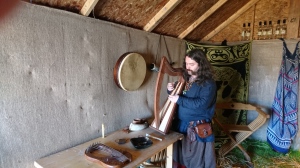
My favourite hut was the one with the Norse musical instruments. It was really great to see so many ancient instruments; there was an ancient Norse lyre, some ancient panpipes, a type of drum called a bodhrán (which is technically Irish, but oh well), and a bukkehorn made from an animal horn. The man in the hut was playing a tiny harp called a clarsach, which is mainly associated with Celtic origins, but was also played by the Norse people. It was a pretty tune – I didn’t recognise it, but it was soft and atmospheric. I liked it.
DSC_0034
After the Viking Village, my parents and I went to an ice-cream parlour on the beach and had gigantic sundaes. I could only eat about a quarter of my Marshmallow Heaven – vanilla and raspberry ice-cream, with a mountain of cream, and marshmallows, and several wafers, and marshmallow sauce! It was amazing, but it was also huge.

Later that evening, we also got a traditional fish and chip supper (although mine was a smoked sausage, because fish in batter is gross). We were staying out late in order to attend the Festival of Fire, but the restaurant was so understaffed, it took forty minutes for the food to come. It was a bit nerve-wracking – I was worried we’d miss the parade! Luckily, crisis was averted and we arrived just as the parade was starting.

DSC_0029
There were all sorts of characters wandering around, but by far the best costume goes to this guy, who had a clockpunk metal dragon draped around his neck!

The Festival of Fire, was pretty rad; the parade gave everyone who had dressed up the opportunity to show off their amazing costumes. I particularly enjoyed the burly man who, trying to get past a huge crowd of bystanders, called out, “I have an axe, and I’m not afraid to use it!”

I was sceptical that it would get dark in time for the fire in the Festival of Fire to really make an impact, but pleasingly I was proved wrong. As we followed the burning torches through the stalls, and anachronistically through the funfair, the evening light dimmed into nighttime darkness.

We reached the sea, where a Viking longboat was set aflame. It was spectacular, but there were so many people it was difficult to get a good view. Even harder to see, though, was the short re-enactment battle. I didn’t especially mind; there were a lot of children, and it made sense to let them get the better view. My parents and I (along with a lot of other people) were up on a nearby hill where it was a bit dark to see the fighting, but the fantastic fire dancer who followed was very visible. He spun the flames around him in loops and juggled burning torches to the accompanying theatrical Norse music.

The evening ended with a pretty impressive fireworks display. I’ve never been so close to fireworks – it was like they were exploding directly above me! It was very loud, and I had to cover my ears for most of it, but the cost/benefit of the proximity still ultimately landed on the good side!

All in all, it was a very enjoyable day, and driving home listening to the CD of Icelandic singer, Hafdís Huld, was an appropriate end to a lovely Nordic-inspired experience.

DSC_0052
Burn, boaty, burn (Viking Inferno!)

Book Review: A Deadly Deception

First published on 50 Book Challenge on 17 July 2015.


I found this challenge harder than I expected I would. It turns out there are very few fiction books set in my hometown of Bearsden, which is a suburb just outside Glasgow. The most famous book – if Google is to be believed – is one about ‘family and incest’, which I was certainly in no hurry to read. Luckily for me, however, my mother was on hand to save the day. I’m visiting my parents in Bearsden at the moment for the summer holidays, and she suggested we check the local library to see if they had any books set in Bearsden. As well as the aforementioned ‘family and incest’ book, she found Margaret Thomson Davis’s A Deadly Deception.

It wasn’t the kind of book I would generally choose to read – I wouldn’t have given it a second glance if not for this challenge, let alone continued to the end. The book made me angry and I found it infuriating to have to read about a bunch of unlikable characters making horrible mistakes. However, having left ten days between finishing the book and writing this review, I’ve realised that the revolting characters and bad decisions are what makes the book worth reading.

The book follows pensioner, Mabel Smith, who becomes a phone sex worker in order to supplement her pension and shop at Marks and Spencer. Each to their own, I guess. She creates an intimate, over-the-phone relationship with thirty-nine-year-old John – who believes she is a young, curvaceous, blonde-haired, blue-eyed beauty. This would be fine apart from the fact that neither Mabel nor John seem to understand the boundaries that sex workers need to set up and clients need to respect. Sex workers provide a service – a fake fantasy that the client pays them to enact. As a phone sex worker, Mabel was wrong to natter about her own personal life to her client. She had no reason to believe that he wasn’t a complete psycho (which he, of course, turned out to be) and in this sort of situation especially, it is unsafe to mix work with pleasure. Even if she initially gave him the benefit of the doubt, a risky decision in itself, once it became clear that John wasn’t going to stop requesting that they meet in person, that should have sent clear warning bells that this man was at best emotionally dependent on her and at worst a dangerous criminal. At which point, the sensible thing for Mabel to have done would be to end the transaction and block his number from calling her.

John, her client, is just as bad. Even if we ignore the fact that he’s evil, why would he assume that the random woman who he’d called on a sex line was telling him the truth about anything? It was purely a coincidence that she was so incapable of understanding her job that she gave away true information that allowed him to track her location down to the exact apartment block. For all he knew, she could have been fabricating everything. In fact, it would have been more sensible to assume that she was lying to him because that’s how sex work has to function for it to be in any way safe! Oh, and for reference, if you do phone a sex line, the worker on the other end does not owe you anything physical. There are other types of sex worker who deal in the physical side of relationships.

Both of these main characters are already ridiculously incompetent, but it doesn’t stop there! Not only does Mabel blabber about her personal life to her client, she also used a teenager from her apartment block as a muse when describing her sex-worker persona’s appearance to John. Not only is this incredibly dangerous, it’s also an invasion of privacy. Does it really need to be said that modelling your sex-worker persona on another person without their permission is disgustingly sleazy and outright wrong? 

This muse girl, Cheryl, and her boyfriend, Tommy, were the nicest characters in the book. Her drive to create a better life than her alcoholic father had given her was really endearing and she had the sweetest relationship with her boyfriend, who the envious John literally deliberately set fire to at one point (gah, that man makes me so mad!). Their adorable relationship made it all the more heartbreaking to read about these disgusting adults making stupid choices that could well have ruined these two innocent kids’ lives forever. I know it’s fiction, but I really found myself invested in those two characters’ stories and I wanted things to go well for them. I choose to imagine that after the terrible events of this book, the poor girl gets some counselling to work through the horrible ordeal that John put her through and she and Tommy can finally safely move into that flat in the West End together and just live a happy normal life.

It was interesting to read the different characters’ descriptions of the Glasgow and Bearsden areas. Cheryl was enthusiastic about the shops in the city centre while Mabel was intimidated by all of these outlets exclusively targeted towards young people. I enjoyed reading about the buskers down Buchanan Street, and being familiar with the area made the descriptions all the more vivid. I was particularly amused by the mention of the Clanadonia Drummers, who often busk there. The portrayal of Bearsden Cross was just as recognisable, with a detailed description of the Aulds bakery that Mabel visits and that still exists today, despite having been written at a time when Woolworths still existed. Presumably the Marks and Spenser that is at Bearsden Cross nowadays hadn’t been built when the book was written – Mabel has to make her way into the city centre to get the self-indulgent delicacies that she funds with the sex line revenue.

A side plot that occurs in this story, which only crosses the above plot in passing, is about a refuge for abused women that takes up a floor of Cheryl and Mabel’s apartment block. Although these sections didn’t really seem very related to the main story, I found them compelling and interesting to read. This side plot starts with Mrs Janet Peacock who escapes her abusive husband and Stepford life in Bearsden and moves into the refuge in the rougher area of Springburn. It’s understandably a bit of a culture shock as she’s introduced to her roommate, the working-class alcoholic Mary.

I wasn’t keen on how these two women were so stereotypical of their middle- and working-class backgrounds. It seems like a tired cop-out for all the well-off suburbans to have dirty little secret skeletons in their closets while all the poorer city folk are loud and obnoxious. I had a similar problem when I read J. K. Rowling’s The Casual Vacancy. That said, it was hard to actively dislike any of the characters at the refuge. Most of their problems stemmed from the abuse they had experienced, but it was clear that they were all working to come to terms with their situations and fight past the pain. This made a nice change from Mabel and John’s attitudes, who both blamed their failings on other people. (Mabel had been obliged to look after her old-aged parents so was now hedonistic and inconsiderate; John had been left by his wife so had a vendetta against all women.) Something I really liked about the refuge scenes was that, although the abuse had hurt them, these characters were well-rounded and, though present, their past was not their only defining characteristic.

This subplot also raised a whole bunch of dilemmas that I’d never had any reason to think about before reading this book. The sister of one of the abused women reacted really unthinkingly after receiving a letter she received from the woman. The sister was ignorant of the abuse, but I was still appalled that, on receiving the cryptic letter asking to meet, her reaction was to phone the husband and let him know where his wife was. It occurred to me, though, that many people never talk about abuse or how to act in such a situation. That’s a failing of our society and one that I think Margaret Thompson Davis addresses fairly well here. Although, the subsequent storming of the refuge by the armed husband seemed a bit sensationalist.

Another dilemma came when the women in the refuge discovered that Mary, the alcoholic, had begun drinking again. Although it was against the rules of the refuge, they decided not to alert the care staff. This was really troubling for me, because I was torn about the correct course of action. If they told the care staff about Mary’s drinking, she might have been forced to leave the refuge, which would have been utterly devastating for the vulnerable woman. On the other hand, if they didn’t tell the care staff, who then found out about the incident, all of the women might have been forced to leave and Mary could have gotten badly hurt. I honestly don’t know what I would do in such a situation, and am just seriously grateful that I’m not forced to makes that choice!

In A Deadly Deception, Margaret Thompson Davis addresses issues that many people might not consider until they find themselves in a similar situation and unsure of what to do or how to proceed. What are the unspoken mores of sex work? How should you act if someone has left their husband and is acting weird? What can you expect if you decide to seek help in your old age or if you’re being abuse? The subject matter is grim and frightening, and the plot is pretty extreme, but it isn’t salacious. And it certainly affected me and made me think about unpleasant but real experiences that I would have otherwise ignored. It wasn’t an enjoyable read, and I probably wouldn’t recommend it to a friend, but it was thought-provoking and stuck in my head long after I finished it. That’s pretty commendable.

Book Review: Five on a Treasure Island

First published on 50 Book Challenge on 13 June 2015.


I have a confession to make. I never read any of the Famous Five novels growing up. I knew their basic premise – four middle-class English children and a dog drink lashings of ginger beer and enjoy idealised summer holiday adventures together – but my main exposure to the franchise came from the mid-nineties TV show and being cast as Suspicious Character No. 1 in a drama production (loosely based on the books) when I was eight. However, nothing could have prepared me for the twee nostalgia bombardment that awaited me as I plunged into the first book of the series, Five on a Treasure Island.

In this first instalment, three siblings (Julian, Dick and Anne) stay with relatives while their parents go off on holiday without them. They meet their kindly Aunt Fanny, their stern Uncle Quentin and their cousin Georgina, who prefers to be referred to a George and treated as a boy. Whether or not George is meant to be transgender is unclear; the narrative always refers to the character with female pronouns, but George clearly doesn’t like being thought of as a girl and their only human friend is a lad from the village who always refers to George as ‘Master George’. Personally, I think it likely that George is transgender in the same way as Sherlock Holmes is often considered to be asexual. The terms themselves are not used in the books, due to the time periods in which they were written, but the characters’ descriptions and behaviours would suggest that they do fall into these categories.

George is initially standoffish towards her cousins but she warms to them after they give her ice-cream and agree not to tell her parents that George has a forbidden pet dog (Timmy) who stays with her friend, the village boy. As a cynophobe I may be unfairly biased, but I found it infuriating how infatuated the children are with the unruly Timmy. The dog is a nuisance, barking at strangers and getting into trouble (what’s that, Enid Blyton? Did Timmy fall down a well?), and George is a pretty incompetent owner. The children repeatedly take the poorly trained dog to an island where the dog torments the rabbits on several occasions despite George’s attempts to call him to stop.

I wouldn’t mind so much, but the narrative goes to great lengths to assure the reader how intelligent Timmy is supposed to be – “of course he can understand me!” George exclaims at one stage – and for most of the book I assumed that this was intentional. While written in third person, the narrative is heavily skewed to resemble the children’s thought patterns, so I wondered whether the reader was meant to pick up on the discrepancies and realise that Timmy is described in the same way as everything is described – through the rose-tinted lens of childhood. But at the end of the story, after the Famous Five prevent a robbery of hundreds of gold ingots, George’s mother gets gooey-eyed over Timmy, too. And even Uncle Quentin, who had quite rightly forbidden the badly behaved dog from entering the house, has a change of heart and allows the dog to stay.

In fact, the entire last chapter was a huge let down. Up until that point I was prepared to suspend my disbelief and let Enid Blyton away with the idealised childhood scenario she was creating, but this overly simplistic resolution to the plot was unsatisfactory, for me: finding the treasure solves all of George’s family’s problems, which seems like a bit of a copout. Uncle Quentin no longer has any money worries and can now pursue his passion for academia without having to feel guilty for not providing for his family. As stated above, George is allowed to keep Timmy and the family now has enough money to send George to the same boarding school that Anne attends – a boarding school that just so happens to allow children to keep pets. So Timmy can come too!

Seriously, though. That last one got to me. What kind of boarding school allows its pupils to have dogs? What about the kids with allergies, or fears of animals? And who’s going to look after these dogs when the children are in lessons? And who’s going to be making sure that the children treat these pets correctly? And, yes, it seems kind of unfair that I’d argue against this minor point when I’m perfectly fine with four pre-teens and a dog taking down a robbery – but the latter is the main driving force of the story, so I can get behind that. As far as I can tell, the whole boarding-school dog scenario adds nothing except to reinforce the idealness of the already over-the-top conclusion.

That said, there were sections of the book that I very much liked. I thought it was sweet that the children learn the new word ‘ingots’ from the treasure map and then gleefully use it as much as possible throughout the rest of the book. I liked George’s idea to sign the note that the criminals force her to write to her cousins with ‘Georgina’, thus indicating that something was wrong. I enjoyed the frank dialogues between the children – especially towards the beginning before they become real friends. And, despite being a relatively short book, the pace is very relaxed (at least until the last chapter).

All in all, it was a cute read with distinctive and relatable protagonists and a leisurely, summer-holiday feel. I’d probably have really got into these books as a kid, and they certainly beat Scooby Doo any day. ‘Spiffing’!