Despite what Dark Academia and book burners would have you believe, I do think, rather pithily, no knowledge is bad knowledge. It has been fifteen years since I started my higher education journey as a physics student at the University of Aberdeen. Six years later I graduated with a BMus in Music. I thought it would be fun to look back at the chance electives that widened my University experience beyond the narrow specialisms that are touted as peak degree experience.
One of the advantages of studying at a Scottish university (alongside the free tuition) is that the standard undergraduate degree lasts four years, rather than the three-year courses offered by the rest of the UK (unless a placement year is included). This, I think, provides students with a far deeper dive into the subject, and crucially, a cushion of time for the baby seventeen- and eighteen-year-olds to work out where they want to be.
Incidentally, from many hours spent playing The Sims 2: University Expansion Pack as a teen, I believe that the US has a similar four-year framework, where students don’t even declare their major until partway through their degree. So, if they’d just sort out their student loans system…
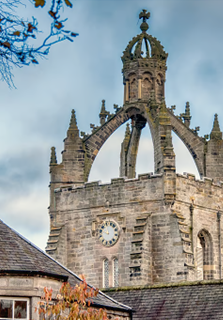
At the University of Aberdeen, where I studied, it was mandatory to take several elective courses alongside the required degree syllabus. These allowed students to either study more widely or dive deeper into their chosen field. We could select any first- or second-year course from any subject that didn’t clash with our timetable – so I, naturally, decided to do both.
Initially, I started university studying Physics, with the hopes of working in green energy. To complement my science interests, I took one of the Sixth-Century courses, Mankind in the Universe, which (as far as I remember) was a short introduction to astronomy. I was interested in the topic and had considered studying Astrophysics at the Universities of Edinburgh or Saint Andrews – but I was turned off by how chilly the observatories were at the open days!
Alongside the broader science experience, I sampled several other fields during my first two years of study.
During my first few weeks of university, I unofficially tagged along with a friend to a couple of her History lectures, which were packed enough that no-one noticed I’d sneaked in. I took notes on her behalf and drew a cartoon ‘scapegoat’ to represent the scapegoat position Germany was forced into after World War 1. But I did also attend the wider selection of electives that I had properly signed up for.
A French Language course allowed me to keep up French for a while. I mostly remember watching a grainy recording of a news article, featuring a woman in thick, dark-rimmed glasses speaking to the interviewer in the slang dialect argot. This was around the time I was working my way through Victor Hugo’s Les Miserables (in English), and Hugo (paid by the word as he was) devotes an entire appendix to argot. So, when the term cropped up in class, I recognised it immediately and was suddenly exceptionally eager to reach that appendix (still several hundred pages away!).
I also briefly attended a Theology course on the Triune God (of all things!), which I dropped partway through due to ill health. Failing to complete the course has not, as far as I can tell, hindered my career or spiritual prospects – but I do remember it was quite fun to learn about the Council of Nicaea and the politicking behind it. And not really ‘getting’ the whole three-in-one thing.

I took a Modern and Contemporary Art module, through the Art History department, which I thoroughly enjoyed. A few years previously, I had watched the BBC programme Desperate Romantics, about the Pre-Raphaelite brotherhood, in particular episodes 1-4, which followed the establishment and antics of the founding three members of the brotherhood. The class’s ‘modern’ art survey began its tour with the Pre-Raphaelites, which gave me confidence going in even as we moved through some of the less familiar (to me) major art styles of the 19th and 20th centuries. I remember particularly being interested by Whistler, whose paintings I’d seen at the Van Gogh Museum during my family’s holiday in Amsterdam; the Futurist movement, established in 1913, which abruptly abandoned its idolisation of technology once its artists experienced the horrors of the First World War; the distinction between medieval Gothic architecture and 18th–19th-century Gothick revival architecture (and a brief, unimpressed foray into Gothic literature); and Land Art, which was immortalised for me by Robert Smithson’s Spiral Jetty, that resembled a giant basalt snail. The last was so impactful that I even created my own Land Art snail on Aberdeen Beach.
In a similarly styled course, I also studied A Survey of Western Art Music, which took us, whistlestop, from 900 AD to the present day. I remember the final exam included a section where we had to identify the title and composer of set works by ear. My parents took me to HMV to purchase CDs of about twenty different composers from twenty different music traditions, and I created an iPod playlist. I spent a good deal of time listening to the playlist on repeat while going to sleep, and while reading and copying out pages of J Peter Burkholder’s A History of Western Music.
This was the course that actually prompted my transferral request directly into the second year of the BMus programme. Goodbye, future environmental scientist; hello, future music librarian (although at the time I was envisioning becoming a music historian). Fifteen years later, while reading Richard Papen’s transfer from Medical Science to English Literature to Classics in Donna Tartt’s The Secret History, I cannot help but notice the resemblance.

My switch was two years into the Physics course. It is sobering to realise that, had the university only offered three-year programmes, I would have been two-thirds of my way through a Physics degree before realising what I truly wanted to study. My life could have taken a completely different trajectory. I might not be working in the best job in the world at Chetham’s School of Music (although you can get academic librarians in any field). And, had I stayed with Physics, I might have struggled to find work in a post-Brexit landscape.
My little sister has a jokey expression: “Whatever’s for you won’t go past you.” In my case, I think I was very lucky, both with my experiences at the University of Aberdeen and in the years that followed.



 Kirsty's Keyboard