Electing for Electives at a Scottish University

Despite what Dark Academia and book burners would have you believe, I do think, rather pithily, no knowledge is bad knowledge. It has been fifteen years since I started my higher education journey as a physics student at the University of Aberdeen. Six years later I graduated with a BMus in Music. I thought it would be fun to look back at the chance electives that widened my University experience beyond the narrow specialisms that are touted as peak degree experience.

One of the advantages of studying at a Scottish university (alongside the free tuition) is that the standard undergraduate degree lasts four years, rather than the three-year courses offered by the rest of the UK (unless a placement year is included). This, I think, provides students with a far deeper dive into the subject, and crucially, a cushion of time for the baby seventeen- and eighteen-year-olds to work out where they want to be.

Incidentally, from many hours spent playing The Sims 2: University Expansion Pack as a teen, I believe that the US has a similar four-year framework, where students don’t even declare their major until partway through their degree. So, if they’d just sort out their student loans system…
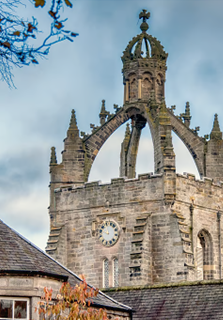
Kings College, University of Aberdeen: image copied from here.

At the University of Aberdeen, where I studied, it was mandatory to take several elective courses alongside the required degree syllabus. These allowed students to either study more widely or dive deeper into their chosen field. We could select any first- or second-year course from any subject that didn’t clash with our timetable – so I, naturally, decided to do both.

Initially, I started university studying Physics, with the hopes of working in green energy. To complement my science interests, I took one of the Sixth-Century courses, Mankind in the Universe, which (as far as I remember) was a short introduction to astronomy. I was interested in the topic and had considered studying Astrophysics at the Universities of Edinburgh or Saint Andrews – but I was turned off by how chilly the observatories were at the open days!

Alongside the broader science experience, I sampled several other fields during my first two years of study.

During my first few weeks of university, I unofficially tagged along with a friend to a couple of her History lectures, which were packed enough that no-one noticed I’d sneaked in. I took notes on her behalf and drew a cartoon ‘scapegoat’ to represent the scapegoat position Germany was forced into after World War 1. But I did also attend the wider selection of electives that I had properly signed up for.

A French Language course allowed me to keep up French for a while. I mostly remember watching a grainy recording of a news article, featuring a woman in thick, dark-rimmed glasses speaking to the interviewer in the slang dialect argot. This was around the time I was working my way through Victor Hugo’s Les Miserables (in English), and Hugo (paid by the word as he was) devotes an entire appendix to argot. So, when the term cropped up in class, I recognised it immediately and was suddenly exceptionally eager to reach that appendix (still several hundred pages away!).

I also briefly attended a Theology course on the Triune God (of all things!), which I dropped partway through due to ill health. Failing to complete the course has not, as far as I can tell, hindered my career or spiritual prospects – but I do remember it was quite fun to learn about the Council of Nicaea and the politicking behind it. And not really ‘getting’ the whole three-in-one thing.

I created my own Land Art snail in imitation of Smithson’s Spiral Jetty.

I took a Modern and Contemporary Art module, through the Art History department, which I thoroughly enjoyed. A few years previously, I had watched the BBC programme Desperate Romantics, about the Pre-Raphaelite brotherhood, in particular episodes 1-4, which followed the establishment and antics of the founding three members of the brotherhood. The class’s ‘modern’ art survey began its tour with the Pre-Raphaelites, which gave me confidence going in even as we moved through some of the less familiar (to me) major art styles of the 19th and 20th centuries. I remember particularly being interested by Whistler, whose paintings I’d seen at the Van Gogh Museum during my family’s holiday in Amsterdam; the Futurist movement, established in 1913, which abruptly abandoned its idolisation of technology once its artists experienced the horrors of the First World War; the distinction between medieval Gothic architecture and 18th–19th-century Gothick revival architecture (and a brief, unimpressed foray into Gothic literature); and Land Art, which was immortalised for me by Robert Smithson’s Spiral Jetty, that resembled a giant basalt snail. The last was so impactful that I even created my own Land Art snail on Aberdeen Beach.

In a similarly styled course, I also studied A Survey of Western Art Music, which took us, whistlestop, from 900 AD to the present day. I remember the final exam included a section where we had to identify the title and composer of set works by ear. My parents took me to HMV to purchase CDs of about twenty different composers from twenty different music traditions, and I created an iPod playlist. I spent a good deal of time listening to the playlist on repeat while going to sleep, and while reading and copying out pages of J Peter Burkholder’s A History of Western Music.

This was the course that actually prompted my transferral request directly into the second year of the BMus programme. Goodbye, future environmental scientist; hello, future music librarian (although at the time I was envisioning becoming a music historian). Fifteen years later, while reading Richard Papen’s transfer from Medical Science to English Literature to Classics in Donna Tartt’s The Secret History, I cannot help but notice the resemblance.

Graduation Day (9 years ago)

My switch was two years into the Physics course. It is sobering to realise that, had the university only offered three-year programmes, I would have been two-thirds of my way through a Physics degree before realising what I truly wanted to study. My life could have taken a completely different trajectory. I might not be working in the best job in the world at Chetham’s School of Music (although you can get academic librarians in any field). And, had I stayed with Physics, I might have struggled to find work in a post-Brexit landscape.

My little sister has a jokey expression: “Whatever’s for you won’t go past you.” In my case, I think I was very lucky, both with my experiences at the University of Aberdeen and in the years that followed.

Book ‘Review’: Oh, Castle of Otranto!

Recently, I was looking through my old books and I came across the copy of The Castle of Otranto by Horace Walpole that I had annotated in university.

Back when I was studying at the University of Aberdeen, I took an Art History elective on Modern and Contemporary Art. In an even broader definition of ‘modern’ than the twentieth- and twenty-first century framing often used by music scholars, the course spanned back as far back as the paintings of the Pre-Raphaelite Brotherhood, who were founded in the mid-nineteenth century.

During one of the earlier weeks of the course we discussed nineteenth-century architecture, looking at John Ruskin’s reviews of the Gothic revival and the Barry/Pugin designed Houses of Parliament. But the thing that most stayed with me from that lecture, other than the distinction between Gothic and Gothick (the former being the real deal, and the latter being the Victoriana knock-off), was that the lecturer mentioned, as I was to learn later merely in passing, for us to really understand Gothic(k) architecture, we should read Gothic literature. And she recommended Horace Walpole’s novel The Castle of Otranto – often credited as the first Gothic novel.

Annotations for Chapter 4

With the dedication of an overachieving student who was really enjoying a course, entirely unrelated to my base Physics degree, I purchased a copy of the novel, and set to work. At that point I was even more unfamiliar with the gothic genre than I am today, and my method for ensuring I would absorb the text was to read a chapter, then write down everything that I remembered from the reading. It being a relatively short book (only five chapters in total) I believe the process only took me a couple weeks to complete.

The book never came up again in the lectures, and we moved on to the twentieth-century arts. But reading back on my baby (eighteen-year-old) scholar chapter recaps fifteen years later, I thought they were fun enough to share here. Enjoy!

Chapter 1

  • At the wedding of Conrad and Isabella, Conrad is crushed by a helmet and dies.
  • Conrad’s father, Manfred, arrests an innocent peasant and accuses him of necromancy.
  • Manfred’s wife, Hippolita, and daughter, Matilda, are distraught but Manfred, more concerned about the loss of an heir than the death of a son, attempts to assault Isabella to continue his bloodline through her.
  • Isabella takes advantage of the distraction created by a painting coming to lie and escapes with the help of the peasant from earlier.
  • Manfred catches up with the peasant and is impressed by his apparent honesty, thus pardoning him.
  • Two servants inform Manfred of a ghostly giant they encountered while hunting for Isabella.
  • On finding no such giant, Manfred dismisses their claims and tells the peasant to stay the night. He wants to talk to him in the morning.

Chapter 2

  • In her chambers, Matilda awaits news of what has happened to Isabella.
  • Her Maid of Honour, Bianca, tells her of rumours among the servants of ghosts, and the peasant who was found by Manfred.
  • Startled by strange noises from the supposedly empty room below, Bianca is frightened, suspecting it is Conrad’s ghost.
  • Further investigation reveals it is actually the peasant, who begs in vain for news of Isabella.
  • The next morning, a holy man, Friar Jerome, brings news to Manfred and Hippolita that Isabella is hiding in Saint Nicholas’s altar.
  • It transpires that Jerome has been told about the previous night’s attempted-assault and, in an effort to protect Isabella, he inadvertently plants suspicions in Manfred’s mind that Isabella and last night’s peasant are lovers.
  • Manfred questions the peasant again and, on learning of his role in Isabella’s escape, orders the peasant’s immediate execution.
  • Noticing an arrow-shaped birthmark on the peasant’s shoulder, Jerome recognises him as his long-lost son and it is revealed that the ‘peasant’ is actually Theodore, Count of Falconara.
  • Manfred decides to use this to his advantage and offers to spare Theodore’s life if Jerome returns Isabella to him.
  • The chapter ends with eerie trumpet noises from nowhere and, in the courtyard, the helmet that killed Conrad nods three times.

Chapter 3

  • Frightened by the trumpet, Manfred says he will give Theodore to Jerome if the friar goes to the gate to discover the noise’s source.
  • Turns out it was a herald calling Manfred a usurper. In anger, Manfred reneges on his promise and, once again, orders the friar to return Isabella.
  • Jerome returns to the church only to find that Isabella has fled upon hearing news of Hippolyta’s supposed death.
  • Meanwhile, Manfred receives the herald’s master. While trying to convince the unknown knight to allow him to marry Isabella, they are interrupted by an army of monks who inform him of Isabella’s escape.
  • Both Manfred and the unknown knight set out separately to find Isabella.
  • Matilda takes advantage of her father’s absence to free Theodore from the cell he is being held in. During this brief encounter, the pair fall in love.
  • Theodore finds Isabella hiding in a cave and they are pretty soon attacked by the unknown knight, who Theodore accidentally mortally wounds.
  • As he dies, the knight reveals he is Isabella’s father.

Chapter 4

  • Turns out, Hippolita isn’t actually dead – she and Matilda greet everyone as they return to the castle carrying Isabella’s dead father’s corpse.
  • Oh wait! Isabella’s father, Sir Frederic, isn’t actually dead either. None of his wounds were all that severe!
  • Recovered slightly, Frederic tells Hippolita, Matilda, Isabella and Theodore that Manfred’s dictatorship is destined to end.
  • Manfred enters the room and mistakes Theodore for a spectre; but on realising his mistake, demands to know how Theodore escaped again.
  • Not wanting to get Matilda into trouble, Theodore blames his father, Jerome and goes on to explain, among other things, that, as a young boy he was abducted by pirates!
  • Later, Isabella and Matilda confess to each other that they both have feelings for Theodore. But, because Theodore obviously only loves Matilda, it is decided Matilda should have him.
  • Then Hippolita enters and tells Matilda that she is to marry Isabella’s father, Sir Frederic!
  • After much tears and angsting, all three women bring each other up to date on what’s going on. Hippolita finally realises her husband is a douche and plans to divorce her.
  • She decides to ask Friar Jerome for his advice but, when she arrives, she finds him and Theodore arguing about Theodore’s love for Matilda – which Jerome feels is ill-advised.
  • Jerome then goes on to convince Hippolita not to allow a divorce.
  • Manfred, who has convinced Frederic to consent to marry Matilda, finds Hippolita with Jerome and, on learning what Jerome has done, argues.
  • Jerome threatens Manfred with excommunication and, as Manfred and Hippolita leave, Manfred orders one of his servants to guard the convent and alert him if anyone from the castle tries to enter.

Chapter 5

  • Manfred reflects on all that has passed and comes to the conclusion that Isabella and Theodore are secret lovers.
  • He then proceeds to bribe Bianca (Matilda’s maid of honour) into ‘betraying’ Isabella, but Bianca refuses.
  • Later, Manfred and Frederic are talking and are interrupted by Bianca, who claims to have seen the giant spectre from Chapter 1.
  • Frederic believes her but Manfred is disdainful.
  • Later, on his own, Frederic meets a skeleton ghost, who tells him not to marry Matilda – this freaks him out.
  • Manfred is approached by the servant spy from earlier, who informs him that Theodore is at the convent with a woman.
  • Assuming the woman is Isabella, Manfred goes to the convent and stabs her. Only to find out too late it was actually Matilda.
  • Woe, angst and fainting ensue.
  • Matilda dies; sorry, “expires”!
  • Theodore, distraught, is made Lord of Otranto, and never marries.
  • Hippolita and a now completely reformed Manfred join religious orders.
  • Isabella and Frederic are fine but traumatised.

The End (Thank goodness!)