Bagatelle: A short, whimsical piece that shouldn’t be taken too seriously. Literally, a trifle. (Fun fact: Calum and I refer to the dessert as bagatelles between ourselves!)
One of the mildly frustrating things about working in the school library at Chetham’s is that the adjoining public library rather dominates the “Chetham’s Library” brand. And, don’t get me wrong: rightly so. The public library is an absolute treasure with packed tours, historic artefacts and social significance to Manchester and beyond. There are long stone corridors, dark-wood shelves, desks and other antique furniture and historic paintings alongside ancient tomes – some of which are actually chained in place! Even my own writing about starting at the school joked about the likelihood of finding some kind of ghostly presence or cursed writing among its stacks.
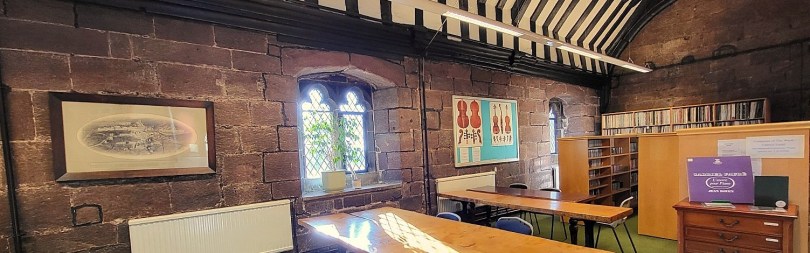
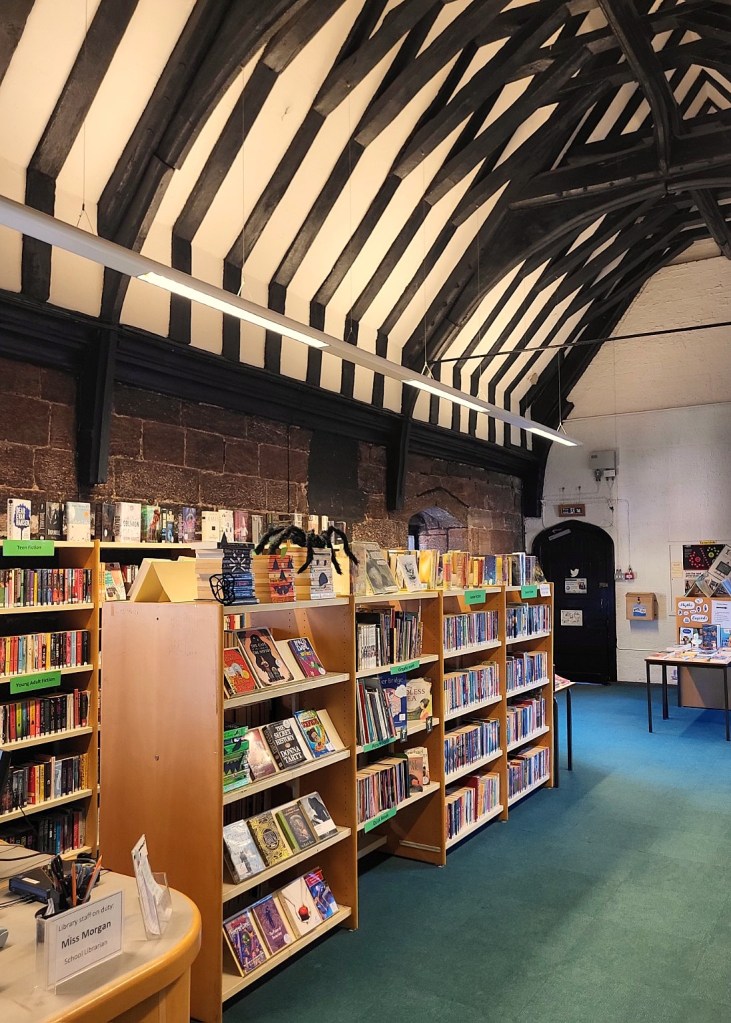
But, and I’m obviously biased here, I think the school’s own library, which is sometimes called the Learning Resource Centre to differentiate it (although who’s going to Google that?), is quite gorgeous in its own right. New and prospective students, teachers, school visitors and parents come in and look up at black-against-white Tudor beam ceilings and around at the exposed medieval stonework walls and beautiful diamond-paned, arched mullioned windows, and there’s a moment of ‘woah’ at a space that is quite unusual for a school LRC. While each break time students perch on the huge stone windowsills, lever-arch folders of Music Theory or Geography or Brass Band Music or English Lit open across their knees, until the clock hits ‘fifty-eight’, when they will dart off to their next lesson or practice session. It is a rare week that goes by without some child or other’s ring-binder being left in these alcoves for the evening library staff to discover on their final rounds.
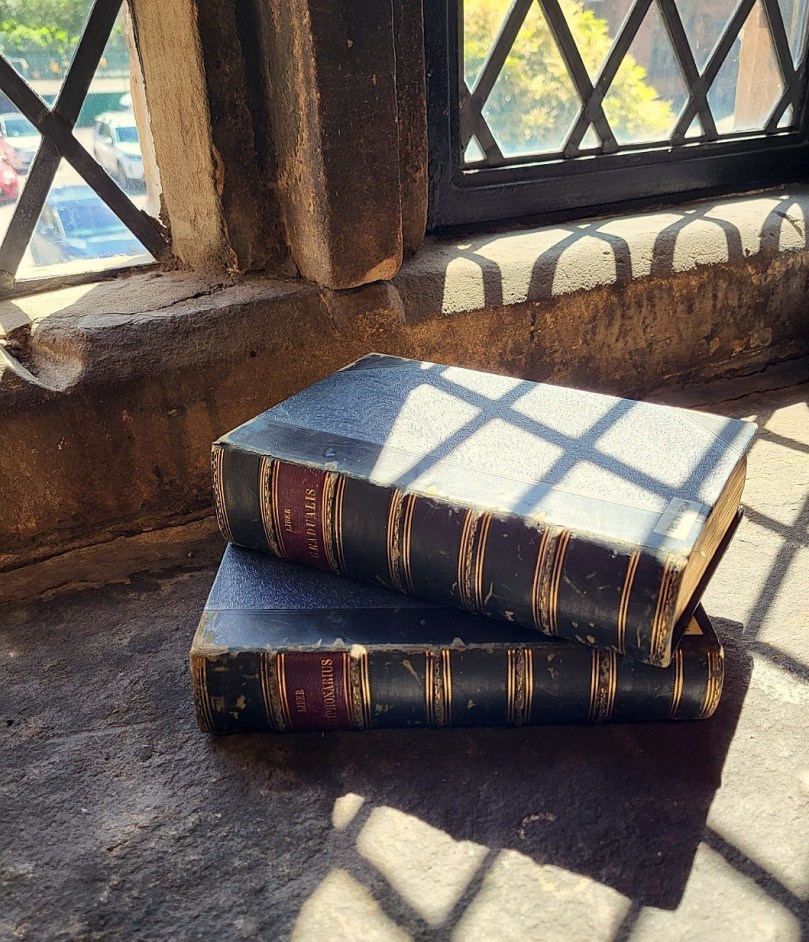
We even have our own small collection of old tomes, ten of which were recently borrowed to serve as prop ‘spellbooks’ in the Junior Play, an adaptation of Journey to the West. My particular favourites are a pair of music volumes containing pieces written in ancient neumes – precursors to modern music notation.
Interestingly, the area used to be the school dormitory in the first half of the twentieth century (before Chetham’s became a music school), with rows of beds and, I believe I was told once, an adjoining kitchen. It must have been quite some bedroom, although the close sleeping quarters would have left much to be desired.
But, within the wonderful historic building, these four rooms still comprise a working school and music library. There is a suite of eleven computers for the students to use, with printing, photocopying and scanning facilities; fiction and non-fiction collections like any school should have (although with a far denser non-fiction music emphasis); a music library with solo sheet music, CDs and LPs that can be browsed in person; and envelopes upon envelopes of chamber music that can only be browsed digitally through the online catalogue. There are long benches for students to study at and a library classroom that is sometimes used for exams, lessons, meetings or by well-behaved Sixth Formers who need extra study space.
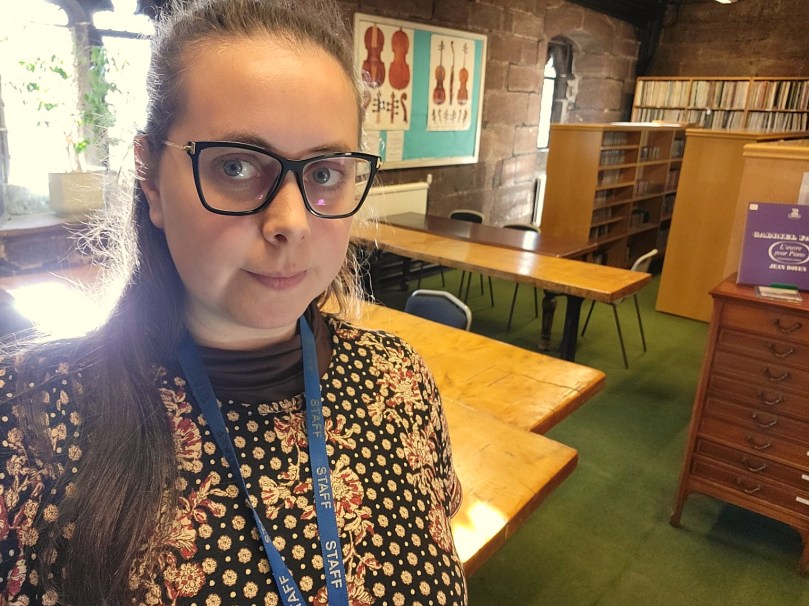
I’ve talked before about how much I enjoy this somewhat unusual position at the intersection of music librarianship and school librarianship, but the physical setting significantly contributes to the rarefied environment. A 15th-century building doesn’t physically make catalogue anomalies or book processing or emailing parents to request help retrieving one viola part of a £60 music set from their eleven-year-old any easier, but I think it makes the space special for the students, teachers and library staff who use and work in the library.
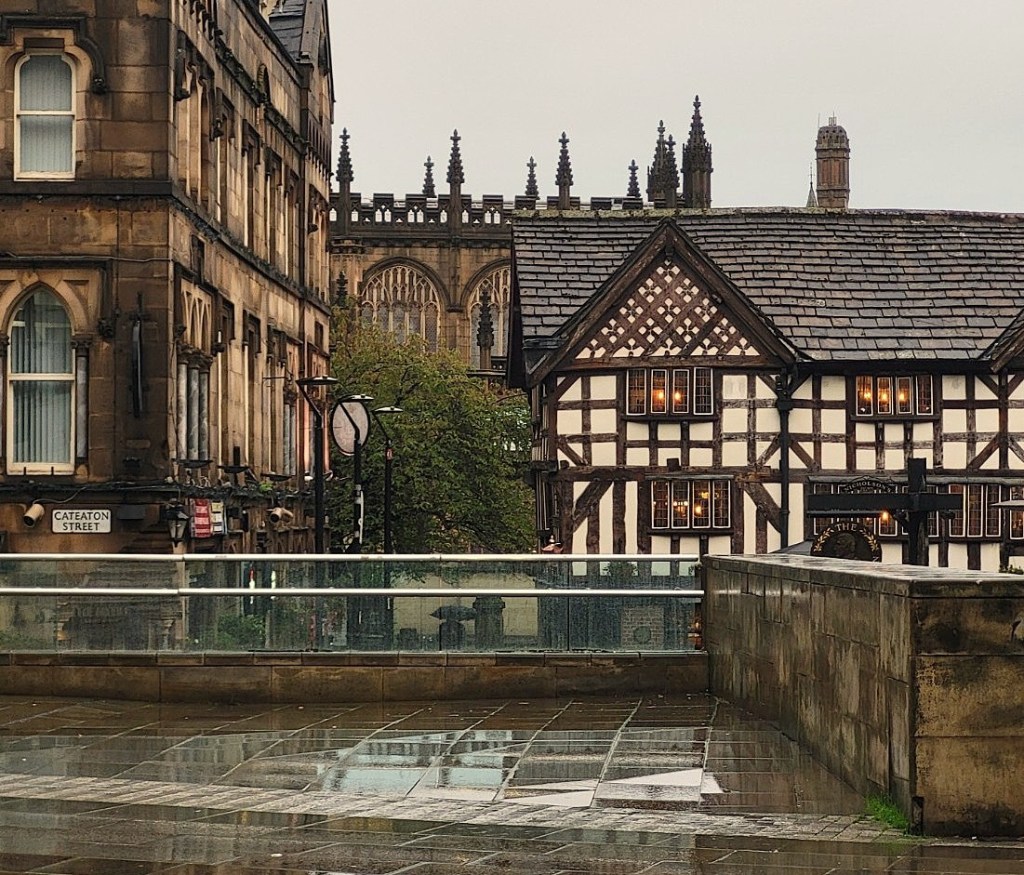
Certainly, from a personal job-satisfaction perspective, the historic ambience of the school library is a significant perk of the role. Walking from the tram stop down Deansgate and seeing Manchester’s Medieval Quarter (with its cobbled streets, Tudor tavern and Gothic cathedral) peeking up over the 21st-century glass balcony, I sometimes cannot quite believe how lucky I am to work where I do. And I thought, on the sixth anniversary of discovering that I would be moving to Manchester to begin with, that was something worth celebrating.