Book Review: A Deadly Deception

First published on 50 Book Challenge on 17 July 2015.


I found this challenge harder than I expected I would. It turns out there are very few fiction books set in my hometown of Bearsden, which is a suburb just outside Glasgow. The most famous book – if Google is to be believed – is one about ‘family and incest’, which I was certainly in no hurry to read. Luckily for me, however, my mother was on hand to save the day. I’m visiting my parents in Bearsden at the moment for the summer holidays, and she suggested we check the local library to see if they had any books set in Bearsden. As well as the aforementioned ‘family and incest’ book, she found Margaret Thomson Davis’s A Deadly Deception.

It wasn’t the kind of book I would generally choose to read – I wouldn’t have given it a second glance if not for this challenge, let alone continued to the end. The book made me angry and I found it infuriating to have to read about a bunch of unlikable characters making horrible mistakes. However, having left ten days between finishing the book and writing this review, I’ve realised that the revolting characters and bad decisions are what makes the book worth reading.

The book follows pensioner, Mabel Smith, who becomes a phone sex worker in order to supplement her pension and shop at Marks and Spencer. Each to their own, I guess. She creates an intimate, over-the-phone relationship with thirty-nine-year-old John – who believes she is a young, curvaceous, blonde-haired, blue-eyed beauty. This would be fine apart from the fact that neither Mabel nor John seem to understand the boundaries that sex workers need to set up and clients need to respect. Sex workers provide a service – a fake fantasy that the client pays them to enact. As a phone sex worker, Mabel was wrong to natter about her own personal life to her client. She had no reason to believe that he wasn’t a complete psycho (which he, of course, turned out to be) and in this sort of situation especially, it is unsafe to mix work with pleasure. Even if she initially gave him the benefit of the doubt, a risky decision in itself, once it became clear that John wasn’t going to stop requesting that they meet in person, that should have sent clear warning bells that this man was at best emotionally dependent on her and at worst a dangerous criminal. At which point, the sensible thing for Mabel to have done would be to end the transaction and block his number from calling her.

John, her client, is just as bad. Even if we ignore the fact that he’s evil, why would he assume that the random woman who he’d called on a sex line was telling him the truth about anything? It was purely a coincidence that she was so incapable of understanding her job that she gave away true information that allowed him to track her location down to the exact apartment block. For all he knew, she could have been fabricating everything. In fact, it would have been more sensible to assume that she was lying to him because that’s how sex work has to function for it to be in any way safe! Oh, and for reference, if you do phone a sex line, the worker on the other end does not owe you anything physical. There are other types of sex worker who deal in the physical side of relationships.

Both of these main characters are already ridiculously incompetent, but it doesn’t stop there! Not only does Mabel blabber about her personal life to her client, she also used a teenager from her apartment block as a muse when describing her sex-worker persona’s appearance to John. Not only is this incredibly dangerous, it’s also an invasion of privacy. Does it really need to be said that modelling your sex-worker persona on another person without their permission is disgustingly sleazy and outright wrong? 

This muse girl, Cheryl, and her boyfriend, Tommy, were the nicest characters in the book. Her drive to create a better life than her alcoholic father had given her was really endearing and she had the sweetest relationship with her boyfriend, who the envious John literally deliberately set fire to at one point (gah, that man makes me so mad!). Their adorable relationship made it all the more heartbreaking to read about these disgusting adults making stupid choices that could well have ruined these two innocent kids’ lives forever. I know it’s fiction, but I really found myself invested in those two characters’ stories and I wanted things to go well for them. I choose to imagine that after the terrible events of this book, the poor girl gets some counselling to work through the horrible ordeal that John put her through and she and Tommy can finally safely move into that flat in the West End together and just live a happy normal life.

It was interesting to read the different characters’ descriptions of the Glasgow and Bearsden areas. Cheryl was enthusiastic about the shops in the city centre while Mabel was intimidated by all of these outlets exclusively targeted towards young people. I enjoyed reading about the buskers down Buchanan Street, and being familiar with the area made the descriptions all the more vivid. I was particularly amused by the mention of the Clanadonia Drummers, who often busk there. The portrayal of Bearsden Cross was just as recognisable, with a detailed description of the Aulds bakery that Mabel visits and that still exists today, despite having been written at a time when Woolworths still existed. Presumably the Marks and Spenser that is at Bearsden Cross nowadays hadn’t been built when the book was written – Mabel has to make her way into the city centre to get the self-indulgent delicacies that she funds with the sex line revenue.

A side plot that occurs in this story, which only crosses the above plot in passing, is about a refuge for abused women that takes up a floor of Cheryl and Mabel’s apartment block. Although these sections didn’t really seem very related to the main story, I found them compelling and interesting to read. This side plot starts with Mrs Janet Peacock who escapes her abusive husband and Stepford life in Bearsden and moves into the refuge in the rougher area of Springburn. It’s understandably a bit of a culture shock as she’s introduced to her roommate, the working-class alcoholic Mary.

I wasn’t keen on how these two women were so stereotypical of their middle- and working-class backgrounds. It seems like a tired cop-out for all the well-off suburbans to have dirty little secret skeletons in their closets while all the poorer city folk are loud and obnoxious. I had a similar problem when I read J. K. Rowling’s The Casual Vacancy. That said, it was hard to actively dislike any of the characters at the refuge. Most of their problems stemmed from the abuse they had experienced, but it was clear that they were all working to come to terms with their situations and fight past the pain. This made a nice change from Mabel and John’s attitudes, who both blamed their failings on other people. (Mabel had been obliged to look after her old-aged parents so was now hedonistic and inconsiderate; John had been left by his wife so had a vendetta against all women.) Something I really liked about the refuge scenes was that, although the abuse had hurt them, these characters were well-rounded and, though present, their past was not their only defining characteristic.

This subplot also raised a whole bunch of dilemmas that I’d never had any reason to think about before reading this book. The sister of one of the abused women reacted really unthinkingly after receiving a letter she received from the woman. The sister was ignorant of the abuse, but I was still appalled that, on receiving the cryptic letter asking to meet, her reaction was to phone the husband and let him know where his wife was. It occurred to me, though, that many people never talk about abuse or how to act in such a situation. That’s a failing of our society and one that I think Margaret Thompson Davis addresses fairly well here. Although, the subsequent storming of the refuge by the armed husband seemed a bit sensationalist.

Another dilemma came when the women in the refuge discovered that Mary, the alcoholic, had begun drinking again. Although it was against the rules of the refuge, they decided not to alert the care staff. This was really troubling for me, because I was torn about the correct course of action. If they told the care staff about Mary’s drinking, she might have been forced to leave the refuge, which would have been utterly devastating for the vulnerable woman. On the other hand, if they didn’t tell the care staff, who then found out about the incident, all of the women might have been forced to leave and Mary could have gotten badly hurt. I honestly don’t know what I would do in such a situation, and am just seriously grateful that I’m not forced to makes that choice!

In A Deadly Deception, Margaret Thompson Davis addresses issues that many people might not consider until they find themselves in a similar situation and unsure of what to do or how to proceed. What are the unspoken mores of sex work? How should you act if someone has left their husband and is acting weird? What can you expect if you decide to seek help in your old age or if you’re being abuse? The subject matter is grim and frightening, and the plot is pretty extreme, but it isn’t salacious. And it certainly affected me and made me think about unpleasant but real experiences that I would have otherwise ignored. It wasn’t an enjoyable read, and I probably wouldn’t recommend it to a friend, but it was thought-provoking and stuck in my head long after I finished it. That’s pretty commendable.

Book Review: Five on a Treasure Island

First published on 50 Book Challenge on 13 June 2015.


I have a confession to make. I never read any of the Famous Five novels growing up. I knew their basic premise – four middle-class English children and a dog drink lashings of ginger beer and enjoy idealised summer holiday adventures together – but my main exposure to the franchise came from the mid-nineties TV show and being cast as Suspicious Character No. 1 in a drama production (loosely based on the books) when I was eight. However, nothing could have prepared me for the twee nostalgia bombardment that awaited me as I plunged into the first book of the series, Five on a Treasure Island.

In this first instalment, three siblings (Julian, Dick and Anne) stay with relatives while their parents go off on holiday without them. They meet their kindly Aunt Fanny, their stern Uncle Quentin and their cousin Georgina, who prefers to be referred to a George and treated as a boy. Whether or not George is meant to be transgender is unclear; the narrative always refers to the character with female pronouns, but George clearly doesn’t like being thought of as a girl and their only human friend is a lad from the village who always refers to George as ‘Master George’. Personally, I think it likely that George is transgender in the same way as Sherlock Holmes is often considered to be asexual. The terms themselves are not used in the books, due to the time periods in which they were written, but the characters’ descriptions and behaviours would suggest that they do fall into these categories.

George is initially standoffish towards her cousins but she warms to them after they give her ice-cream and agree not to tell her parents that George has a forbidden pet dog (Timmy) who stays with her friend, the village boy. As a cynophobe I may be unfairly biased, but I found it infuriating how infatuated the children are with the unruly Timmy. The dog is a nuisance, barking at strangers and getting into trouble (what’s that, Enid Blyton? Did Timmy fall down a well?), and George is a pretty incompetent owner. The children repeatedly take the poorly trained dog to an island where the dog torments the rabbits on several occasions despite George’s attempts to call him to stop.

I wouldn’t mind so much, but the narrative goes to great lengths to assure the reader how intelligent Timmy is supposed to be – “of course he can understand me!” George exclaims at one stage – and for most of the book I assumed that this was intentional. While written in third person, the narrative is heavily skewed to resemble the children’s thought patterns, so I wondered whether the reader was meant to pick up on the discrepancies and realise that Timmy is described in the same way as everything is described – through the rose-tinted lens of childhood. But at the end of the story, after the Famous Five prevent a robbery of hundreds of gold ingots, George’s mother gets gooey-eyed over Timmy, too. And even Uncle Quentin, who had quite rightly forbidden the badly behaved dog from entering the house, has a change of heart and allows the dog to stay.

In fact, the entire last chapter was a huge let down. Up until that point I was prepared to suspend my disbelief and let Enid Blyton away with the idealised childhood scenario she was creating, but this overly simplistic resolution to the plot was unsatisfactory, for me: finding the treasure solves all of George’s family’s problems, which seems like a bit of a copout. Uncle Quentin no longer has any money worries and can now pursue his passion for academia without having to feel guilty for not providing for his family. As stated above, George is allowed to keep Timmy and the family now has enough money to send George to the same boarding school that Anne attends – a boarding school that just so happens to allow children to keep pets. So Timmy can come too!

Seriously, though. That last one got to me. What kind of boarding school allows its pupils to have dogs? What about the kids with allergies, or fears of animals? And who’s going to look after these dogs when the children are in lessons? And who’s going to be making sure that the children treat these pets correctly? And, yes, it seems kind of unfair that I’d argue against this minor point when I’m perfectly fine with four pre-teens and a dog taking down a robbery – but the latter is the main driving force of the story, so I can get behind that. As far as I can tell, the whole boarding-school dog scenario adds nothing except to reinforce the idealness of the already over-the-top conclusion.

That said, there were sections of the book that I very much liked. I thought it was sweet that the children learn the new word ‘ingots’ from the treasure map and then gleefully use it as much as possible throughout the rest of the book. I liked George’s idea to sign the note that the criminals force her to write to her cousins with ‘Georgina’, thus indicating that something was wrong. I enjoyed the frank dialogues between the children – especially towards the beginning before they become real friends. And, despite being a relatively short book, the pace is very relaxed (at least until the last chapter).

All in all, it was a cute read with distinctive and relatable protagonists and a leisurely, summer-holiday feel. I’d probably have really got into these books as a kid, and they certainly beat Scooby Doo any day. ‘Spiffing’!

“That’s a Quarter of a Century – Makes a Girl Think”

So, it was my twenty-fifth birthday this week. Thanks to everyone who wished me happy birthday – in person and via social medias.
The title of this post comes from Marilyn Monroe’s character in Some Like It Hot, where she talks about getting married. For the record, I currently have no intention of getting married, I just like the out-of-context quote, so I used it.
Aaaaaanyway, I’ve been planning this comic strip since I started this new blog, so I really hope you like it.Birthday Blues Comic Strip - with text

Feature: Echo Chamber

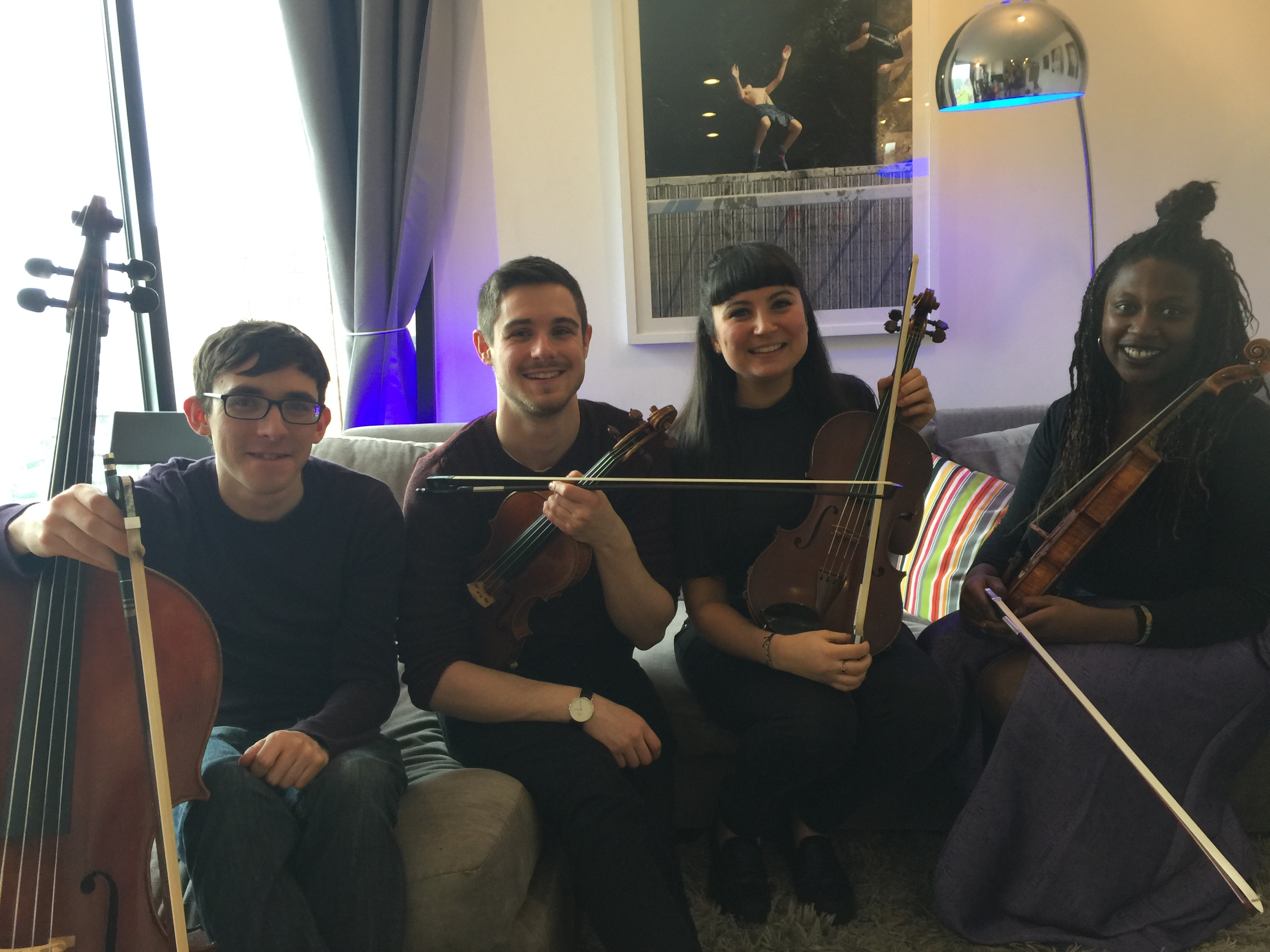
Imagine sitting on a couch next to a stranger, surrounded by arcade games and Nintendo wall decorations, staring into the face of a paper mâché mounted smilodon head, while a string quartet plays a mashup of medieval chant and Jimi Hendrix. This was the unique musical experience that the Mancunian string quartet Echo Chamber offered four nights ago (Monday 6th) at the MegaBYTE cafe in Glasgow.

An arcade cafe might, on the surface, seem an odd choice of venue for a classical music concert. Similarly, Jimi Hendrix and Kanye West are not necessarily the most intuitive musical companions to Franz Schubert, Arvo Pärt, or Pérotin. But Echo Chamber, although still very new on the music scene, is eager to challenge some of the social mores that have sprouted up around classical music.

The choice of venue was a result of the quartet’s association with the company Groupmuse, an organisation that provides a platform for people to set up classical music concerts in small, unlikely venues. Quite often, that even involves a member of the public arranging a concert in their own living room! The idea, which has already taken off in the States, is to build a community of like-minded people who really enjoy classical music and listening to it in unexpected places. As violinist Stephen Bradshaw put it when we talked after the concert:

Chamber music is very much a tradition of friends coming together to play music. It is often described as being like a conversation. As soon as you take that out of a small room and put it in a big concert hall, some of the more salient elements of that are lost.

This is very true. Although a concert hall’s acoustics may be better, this particular experience really invokes the salons of, say, Haydn and Mozart, friends who occasionally met to play string quartets together, or the 19th-century Viennese parlours that Franz Schubert gathered in with his circle. Although, perhaps an even more fitting analogue there would be the Schubertiads, established after Schubert’s death, which often involved fans of Schubert coming together in drawing rooms to celebrate the music they loved in an informal setting in the company of others who shared their passion. This practice fell out of fashion eventually; even as early as 1946, the music critic Alec Robertson was bemoaning the loss of these cosy gatherings. But perhaps Groupmuse’s house concerts will inspire a resurgence.

If such a renewal is to take place, Echo Chamber’s unique style is perfect for the situation. Their repetoire, inspired by listening to songs on shuffle in Spotify and the Radio 3 show Late Junction, is vibrantly innovative. As Bradshaw pointed out, there’s no rule that says you can’t pair 13th-century music with Kanye West, so if it sounds good together, why not go for it? The unconventional musical juxtapositions are interesting and engaging and during each performance there’s a sense of a shared joke between the players and the audience, which is enhanced by how close everyone is gathered. The cello was less than an arm’s length away from where I was sitting.

This was an unforeseen addition to this particular evening’s arrangement (even for the players!). After the first piece, the quartet’s artistic director, Leo Mercer, suggested we all moved to sit around one table with each member of the quartet situated at one of the four corners. Personally, my initial reaction was intrigued bemusement, but I was pleasantly surprised by how relaxed the rest of the concert turned out to be, given its intimate nature.

I think also, this was a really positive inclusion for a concert of this style, where the individuality and variation from concert to concert is a big attraction. The quartet also includes improvisation for the musical transitions, and these are completely different each performance. For example, Monday night’s transition between Pérotin’s Viderunt Omnes and Jimi Hendrix’s Purple Haze featured a lot of powerful, dramatic tremolo that was fantastic, and all the more impressive for having been made up on the spot. During the interval, when the performers came and chatted with the audience, Sophia Dignam (viola) was laughing about how she started the tremolo, unsure whether it would work out well, and the others followed her lead and they just went for it – and I have to say, it worked brilliantly! Mercer, the artistic director, even mentioned that he thought it was their best transition to date! It was lovely that all of the group were so open and willing to talk about the performance; they were all really friendly and it enhanced the whole atmosphere.

It’s a somewhat unusual setup for a string quartet to have an artistic director, most quartets operate as a purely democratic unit, but here Mercer is very much an asset to the group, always coming up with new ideas to encourage both the audience and the players to experience and think about the music in new ways. Bradshaw described to me the group’s rehearsal process. Generally they will spend about forty-five minutes rehearsing the music, then Mercer will come in and “do his artistic directing thing”, for example:

He might get us to think about different lines of music as different characters in a play, or get us to move around the room, sit in different parts of the room, try and experience the music in a different way in order to get us to play in more kind of fresh and exciting ways. […] He has a very unique style of artistic direction, and he’s constantly trying to take us out of our comfort zone, which is a really good thing. Classical musicians have the worst comfort zones, and we’re just used to doing a very specific thing within a certain set of confined rules. And Leo’s all about taking us out of those comfort zones, taking us out of those “echo chambers” and getting us to try out new stuff all the time.

Echo Chamber’s house concerts are not Mercer’s only out-of-the-box production. He’s written an opera called The Marriage of Kim K, based on Mozart’s The Marriage of Figaro. Again combining classical and contemporary, the opera will feature reality-TV style aspects alongside music from Figaro as well as newly composed material. Echo Chamber will actually be providing the music for the production at the Edinburgh Fringe in August. It’s an intriguing idea, and judging by the surprises of Monday’s concert, I’m not sure what to expect, but I imagine it will be distinctively special.

Bradshaw told me about what the quartet hoped to achieve with their concerts:

We really want people to experience classical music in a non-pretentious way, and that’s probably one of the biggest features that we do as a quartet. Making classical music less about turning up, smartly dressed, and not clapping between movements and more about just coming and enjoying the music you like, with a drink in hand, with friends. That’s what we want people to take away from this. Yes, a sense of community, a sense of – not necessarily classical music being cool – but making it something accessible, something you enjoy going to listen to. Have fun, have fun going to a house party but one where you listen to your friends playing classical music! Simple as that really!

I think they have accomplished that goal. Everything about Monday’s concert was crafted to make the experience as unique, friendly and hospitable as possible. It was a relaxed and enjoyable evening, with very talented, thoughtful musicians and their beautiful music in a small retro cafe. And although the word is frightfully overused, I’d go as far as to say the evening was “hygge”.

Echo Chamber Quartet
From the left: Chris Terepin (cello), Stephen Bradshaw (violin), Sophia Dignam (viola) & Rebekah Reid (violin).


Echo Chamber’s Facebook: www.facebook.com/musicechochamber
Echo Chamber’s Twitter: twitter.com/_echochamber
Echo Chamber’s Instagram: www.instagram.com/echochambermusic
Groupmuse’s Website: www.groupmuse.com

Dance Review: Moscow City Ballet’s “Sleeping Beauty”

carabosse
The Evil Fairy, Carabosse

Recently, my best friend and I saw Moscow City Ballet’s spectacular performance of Tchaikovsky’s Sleeping Beauty, at the Edinburgh Playhouse. The website I work for, Bachtrack, had asked me to write a review of the production – and I’m really pleased they did because it was a marvelous evening, packed with fairy tales and music. It also gave me the opportunity to visit my friend, which is always really fun.

The review, if you want to read it, is here. This article’s drawing is of the evil fairy, Carabosse, played by Kiril Kasatkin.

Opera Anti-Review: Scottish Opera’s “The Trial”

Towards the end of last month, my father and I went to see Scottish Opera’s production of The Trial – a Philip Glass opera based on the Franz Kafka novel of the same name. I meant to write a review of the magnificent performance, but time passed and instead I decided to draw the following comic about my lack of review writing and inability to understand the precise meaning of the word “Kafkaesque”.

the-trial-comic-strip-with-text

The Curious Incident of the Lens in the Nighttime

I want to tell you about my experience of using Nocturnal contact lenses. Although not the most fascinating subject in the world, I’m super infatuated with these new lenses, which (hopefully) will ensure that I will never have to wear glasses or daytime contact lenses for nearsightedness ever again.

The lenses are worn overnight, and during this time they flatten the front of the wearer’s eye, correcting the vision so that it’s basically 20/20. In the morning, the lenses are removed and the wearer can see perfectly without needing any corrective accessories during the day. (It sounds like witchcraft – awesome, convenient, slightly icky witchcraft.)

I find this lack of daytime vision-correction particularly fantastic because glasses are utterly infuriating. They steam up in sudden changes of temperature, and collect water droplets in the rain, both of which annoyingly obscure vision. Glasses are also really frustrating because they get pushed to a wonky angle when trying to lie down on your side to watch TV, use a laptop, or read. And don’t even get me started on trying to do exercise while wearing glasses – they get in the way, they’re uncomfortable, they can get knocked off, they are unreasonably irritating!

Regular contact lenses are considerably better than glasses, but I always found I was running out of lenses, and for me, they had a tendency to leave my eyes red, dry and sore after having worn them for a few days, which meant I was back to the irritation of glasses (mentioned, in excessive detail, above).

These Nocturnal lenses, however, are better still because in the interim between wearing them overnight, your eyes get an entire day to be out in the open, which means they don’t dry up as easily. You don’t have to worry about accidentally knocking out a lens if you rub your eye, and you never have to substitute a lens for glasses if they become uncomfortable during the day – because you’re not wearing anything (on your eyes)!

The Nocturnal lenses are also safer than laser eye surgery. Even if we discount the fact that any form of surgery comes with risks, the Nocturnal lenses also have the advantage that, unlike laser eye surgery, the process is completely reversible. So if, for some reason, the wearer decides they want to go back to using glasses to correct their vision, they merely need to stop using the Nocturnal lenses and their vision will deteriorate back to where it was when they started the process. (Why anyone would WANT to start using glasses again is utterly beyond me, but it’s nice to have the option, I guess?)

There are a few negative aspects to the Nocturnal lenses, as well. Firstly, the price. Although cheaper than laser eye surgery, in total the Nocturnal lens process costs £200 – that is, £50 for the fitting process and all subsequent aftercare appointments, and £150 for the lenses themselves. This is obviously a major expense, but from my perspective, if it can be afforded, it’s definitely worth the investment.

The only other aspect that is a potential turn off is that the Nocturnal lenses are “hard” lenses, which are considerably less comfortable than regular “soft” lenses that most people wear during the day. This means you CAN feel the lens when wearing them, however, within a few days I got used to the feeling, and the lenses are not uncomfortable when your eyes are closed – and, given they’re worn right when going to bed, closed eyes are kind of the natural state. They still allow you to see when your eyes are open; in fact, my optician, who has two young children, likes these lenses because they allow him to attend to the kids if they wake in the middle of the night without having to fumble for glasses.

On a personal note, being forced to maintain a regimented bedtime routine (with the lenses being inserted last thing before lying down to sleep) has actually really helped my sleeping patterns. Each night, I set up an audiobook to listen to on Audible and find it more comfortable to keep my eyes closed while listening. This means I get to sleep much faster than I would if I was more able to be distracted. It’s an unexpected additional bonus!

All in all, I am very happy with these Nocturnal lenses, and recommend them unreservedly (especially to those who loathe wearing glasses as much as I do). I hope this short description of my experiences is helpful to some people.

eye-spy
Eye Spy

Theatre Review: Frank Wildhorn’s “Wonderland”

Last Wednesday (25th January), my best friend and I went to see a performance of Frank Wildhorn’s Wonderland at the Edinburgh Playhouse. Loosely based on the two Lewis Carroll books about Alice (in Wonderland & Through the Looking Glass), the performance had all the odds stacked in its favour for being absolutely terrific: Wonderland aesthetic with Frank Wildhorn (composer of Jekyll and Hyde) music – what’s not to love?!

wonderland-dormouse
Adorable Dormouse costume

With appearances from the Caterpillar, Queen of Hearts and Cheshire Cat from ‘Alice in Wonderland’, and the Tweedle twins and Humpty Dumpty from ‘Through the Looking Glass’, the aesthetic of Wonderland was certainly present, and at times very enjoyable. I thought the Dormouse, who carried a pillow with her at all times like a satchel, was adorable. The set-design was fantastic, with oppressive grey apartment buildings in the real world and clever uses of perspective to make the Mad Tea Table, in Wonderland, seem to extend backwards forever. Even the romantic sub-plot between the March Hare and the Mad Hatter, although not necessarily a required addition, was sweetly acted and became somewhat plot-relevant by the end.

The overall ambiance, however, was unfortunately marred by audio problems – in particular the number where Alice, her neighbour Jack, and her daughter Ellie, first appear in Wonderland. What ought to have been an immersive introduction to Wonderland’s craziness, was drowned out by the drumkit, so the audience was kept guessing what the end of each line of singing contained:

“Welcome to Wonder-CRASH
My God, it’s half-past-CRASH
Who cares if you came CRASH
We don’t care where CRASH CRASH
You’re gonna fit right CRASH
A little fun de-CRASH
A little crazy CRASH
Don’t get all in CRASH CRASH!”

I’d listened to the soundtrack several times beforehand, and I still struggled to work out what the missing words were. I imagine it would have been even more difficult for a first-time listener. It’s a real shame because some of Frank Wildhorn’s music is very clever and many of the lyrics are amusing. For example, there is a recurring motif for the songs sung by Wonderland characters where the music tumbles chromatically downwards, invoking the fall down the rabbit hole and descent into madness. However, this can only be appreciated if you aren’t distracted trying to block out the instrumental accompaniments in order to pick up the lyrics being sung. It’s such a pity, because ordinarily the music would definitely be the best aspect of this musical.

The plot itself is somewhat formulaic, all about accepting who you are and finding yourself. Once in Wonderland, Alice, Jack and Ellie come across a magic Looking Glass that, when entered, flips a person’s personality traits, revealing the “you that you have been suppressing”. Alice’s daughter, Ellie, who has had to grow up too fast, enters the mirror and emerges as a petulant teenager; while the shy neighbour, Jack, transforms into a confident Elvis-style swinger, acquires a set of backup singers from somewhere, and finally admits to Alice that he has a crush on her.

The delightfully sarcastic Looking Glass, naturally, has a habit of reflecting the characters’ dialogue back at them, making for some of the funniest moments in the entire production:

Alice: Do you think this is a good idea?
Looking Glass: Do you think this is a good idea?
Alice: I don’t know!
Looking Glass: Then I don’t know either.

That said, the inclusion of the Looking Glass did cheapen any development the characters underwent as a result of passing through it. This wasn’t a particular problem for the examples mentioned above, which were mostly played for comedy, but the entire conflict of the first act centred around Alice’s inability to move on from her abusive ex-husband. Because in actuality this can be a serious problem that’s very difficult to overcome, the sequence where Alice enters a mirror and is suddenly miraculously cured of her trauma felt unearned and a little disrespectful.

Also, given that the character-altering Looking Glass exists in this setting, it was strange that the evil Queen of Hearts was neither forced nor convinced to enter the Looking Glass at any point and actually remained a tyrannical dictator after Alice, Jack and Ellie had returned to the real world. This seemed oddly inconsistent with the overarching theme of overthrowing tyranny.

Weirdly, given the inclusion of a past-abuse subplot and a series of dance numbers set in the Mad Hatter’s sweatshop-style hat factory, I feel the production somewhat struggled to portray the darker version of Wonderland that it seemed to be trying to create. Part of this could have been improved by making the resolutions to the problems less simplistic than going through a magic Looking Glass, but I also felt the Mad Hatter was too endearing in her altered evil form. The main villain number ‘I Will Prevail’ is a menacing threat that simply doesn’t fit with the incompetent, bossy madam that the Hatter becomes after her transformation.

Nonetheless, I really enjoyed the sweatshop number, where tap shoes were used to symbolise the grueling labour that the Wonderland folk were being forced to endure. The fact that the Hatter actually lampshaded this, demanding her workers wear quieter shoes, was a very nice touch. I liked the Dormouse here who, of course, kept falling asleep on the job, lying on her pillow and tap dancing from the floor as the others lined up around her. When the March Hare, trying to convince the Hatter that the workers needed a break, admits that he thinks the Dormouse might be dying, I was disappointingly underwhelmed. Part of this could be put down to confusion – it had earlier been established that Wonderland folk can’t die – but I was also painfully aware that in a darker production with higher stakes this could have been a genuinely poignant moment.

Still, I agreed with the Hatter when she exclaimed, “I love that cute little Dormouse!” The Dormouse was definitely the sweetest character (and, of course, doesn’t die in the end!).

Overall, I’m conflicted about this production of Wonderland. The sections that were good were extremely enjoyable, but there were several major problems that, sadly, prevented it from being a truly satisfying experience.

Dance Review: Ballet West’s “Swan Lake”

Hey folks,

I wrote a dance review for the website Bachtrack. It’s about Ballet West’s production of Swan Lake at the MacRobert Arts Centre in Stirling. You can read it here.

In the meantime, because I wanted to make this more than a self-promotion link to a different website, enjoy this exclusive-to-here picture I drew of Natasha Watson, who plays Odette.

natasha-watson-odette-2

What’s in a pun?

Kirsty’s Keyboard. That’s me, by the way: Kirsty Morgan. The keyboard part is a pun, on account of being the bit of the computer that I’ll be writing this blog with and also the type of instrument I play. I love playing the piano more than any other activity. I love it more than sleeping, more than chocolate, more than (and this is a big one) Diet Coke. I have a YouTube channel where I upload videos of me playing the piano. I’d love it if you’d like to check it out sometime. Let me know what you think.

It took me an unreasonably long time to come up with the pun, by the way. I like alliteration and playing the piano and, well, typing’s okay too, I guess. So it really ought to have been obvious. But… it wasn’t. Not to me, anyway. But we got there eventually and now I have a name for my new blog.

What will the blog be about? Mostly music-related content, I think. I am just about to finish a music degree at the University of Aberdeen, and I think it would be good to put my degree to use (at least in the unpaid online world). My long-term goal is to get into music journalism. I already write dance reviews for the website Bachtrack (here), which I think is a good start. But those are just dance reviews and I want to write about various sorts of music. So, that stuff will go on this blog.

I think I’ll also write some Lifestyle articles. I like reading, so I could write about books I’ve read (or listened to audiobooks of); and I’ve been doing a lot of cooking and baking recently (I got a Nordic cookbook for my Christmas last month) so I definitely want to share about that. And I think I’ll generally talk about other things that are going on in my life, too (provided they’re interesting enough, of course!).

My current plan is to write a post a week. It’s not like I especially have much else to do at the moment, except search for a job. Hopefully I can stick to that schedule… I will certainly try anyway!

I think that’s enough information to be getting on with for a first post. Hopefully this blog will be enjoyable for you to read and for me to write.

If you’ve gotten this far, then thanks! I look forward to writing more for you in the future.

In the meantime, bye for now,

Kirsty x