Brand New Chinese Reading Corner in the School Library

In January, Chetham’s School of Music library hosted the Grand Opening of our new Chinese Reading Corner: the culmination of a year-long project to add a donation of two hundred Chinese-language books to the school library collection. This is how we did it.


Long-term readers of this blog may remember that, not long after I’d first started at Chetham’s, I was asked to contribute to the school’s Chinese New Year celebrations online (the school being mostly locked down due to Covid). At the time, I was mildly surprised by the discrepancy between the proportion of Chinese students in the school and the comparatively low number of fiction books set in China or featuring Chinese protagonists.

Zoom forwards five years, and this past January, the school celebrated the culmination of a year-long project to install a Chinese Reading Corner in the school library. 

The Chinese Music Classroom (CMC) is a collaboration between Chetham’s School of Music in Manchester and the Central Conservatory of Music in Beijing. In September 2024, I was approached by our Music Principal, Tom Redmond, about a donation of roughly a hundred books to the school library through the CMC collaboration. 

At the time, I knew no Chinese, and it was intimidating to approach cataloguing a hundred books in a foreign language. So, I went along to the Chinese classes that were offered to Chetham’s staff by the Chinese Director of the CMC, Sophia Kuai. It’s a happy coincidence that these classes are held at the same time as the Lower School’s Lunchtime Concerts. This meant that the only students using the library would be Y9 and above, allowing me to feel more comfortable ‘abandoning’ the library for one of its busier hours! 
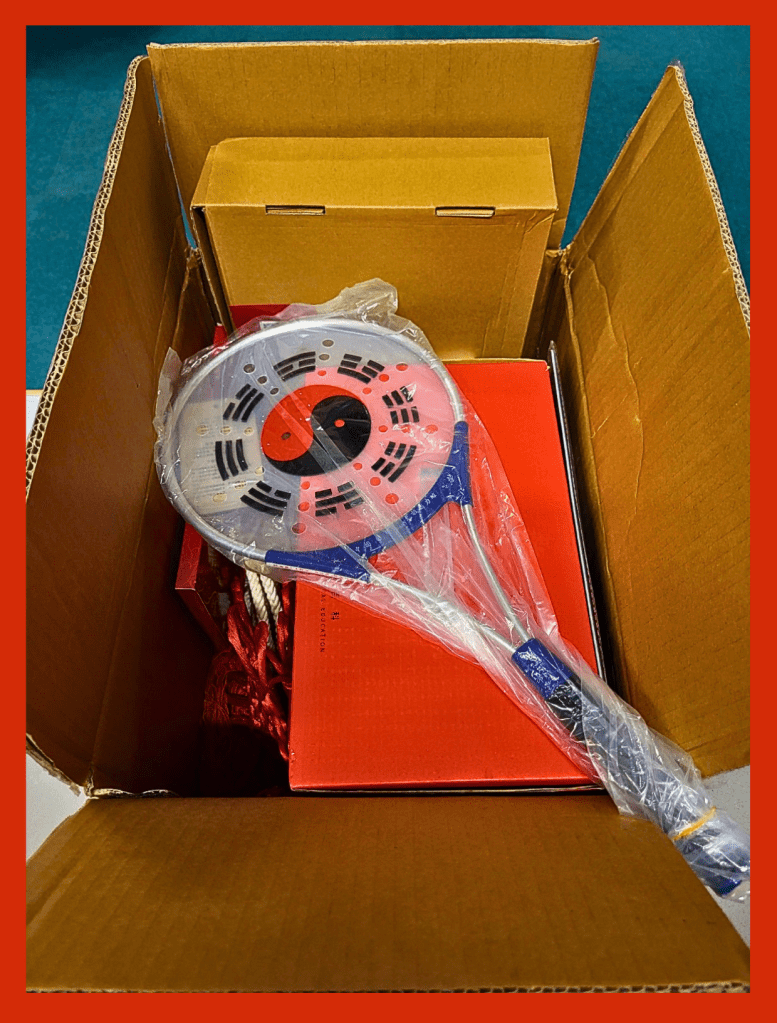
Not exactly library items!

Sophia was managing the Beijing side of the donation itself, so it was also helpful to know her better through the classes, even before the boxes arrived. Attending the classes, alongside signing up for Duolingo, proved to be invaluable in helping the project to even approach feasibility. 

Finally, during the Spring Term 2025, Sophia and I got the chance to properly look through a few of the large donation boxes together. This was the first point that I was able to see what had been donated. What had been initially pitched to me as a hundred-book project was actually around two hundred books, plus some bonus donations that were not library materials at all (including pens, ink, drawing paper, decorations, sports rackets and even a VR Headset)! 

But after some investigation we came up with the following list of library suitable items: 

  • Picture books with Chinese and English text. 
  • Books about Chinese culture (including medicine, music and travel). 
  • Calligraphy books with brushstroke templates. 
  • Chinese masterpieces, in English. 
  • Books for learning Chinese (including textbooks and early reader books). 
  • Books for teaching Chinese (pedagogy). 

We also discussed what Sophia was hoping for from the collection and whether it worked better as its own separate area or to integrate it with the existing library stock. With Tom’s input, we decided that creating a new Chinese Reading Corner would be the way to go. 

The Creation of the Reading Corner 

After deciding to create a discrete section for the donated books, I rearranged our reference area to clear space for the incoming Chinese Reading Corner. I contacted the Head of the Modern Languages department, Nina Geschwendt, who very kindly accepted a large offering of surplus French and German dictionaries. After that, the bulk of the remaining books were reshelved to create a music reference section within the Music Library. What was previously a full reference section was now a Dictionaries section, and four empty shelves for what would become the Chinese Reading Corner. 

With the space cleared, I emailed to say we were ready for the books to be brought over – not realising that I would be brought all six boxes whether they contained books or not! The wonderful evening library assistant, Charlotte Stoddard-Stevenson, went through and sorted the boxes into categories, which we then used as the basis for our final arrangement on the shelves.  

Although the final layout ended up following a genrefication approach, rather than the Dewey classification I had initially planned to use, this was not a huge departure for our current library practice. Most of the music collection is arranged by type rather than classification: String Quartets, Wind + Quintets, Brass Nonets/Dectets, Larger Ensembles, Orchestral Sets, Piano Music, Miniature Scores, etc. 

Our final categories for the Chinese Reading Corner were: 

  • Early Chinese Readers 
  • Full Chinese Readers 
  • Chinese Music 
  • Chinese Picture Books 
  • Chinese Culture 
  • Chinese Classics 
  • Chinese Language 

with a few split categories on the shelves themselves for ease of use. 

While the evening library staff and Duke of Edinburgh volunteers were able to help with the book labelling, covering and processing of the items (a huge task already), it was my sole responsibility to catalogue all two hundred books digitally. 
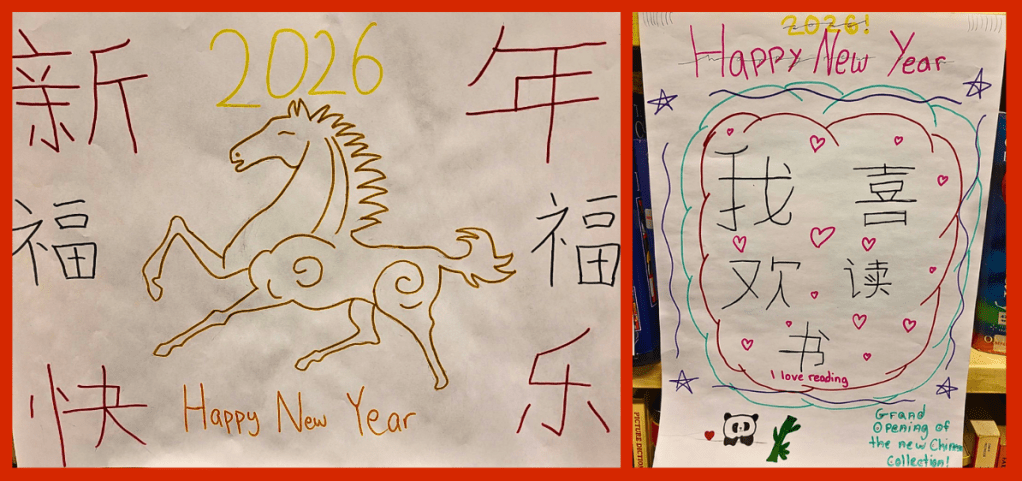
Two of our Duke of Edinburgh volunteers created these posters for the Grand Opening.

As with all items in the school library, it was very important to me that all catalogue users could immediately understand the record they were looking at without needing to go examine the physical item. This was even more important for items in a foreign language. 

While by this point (Summer 2025) I had been learning Chinese for almost a year, I was still a hopeless novice! I had to rely heavily on translation tools, and I also sometimes took questions to Sophia in the Chinese classes. 
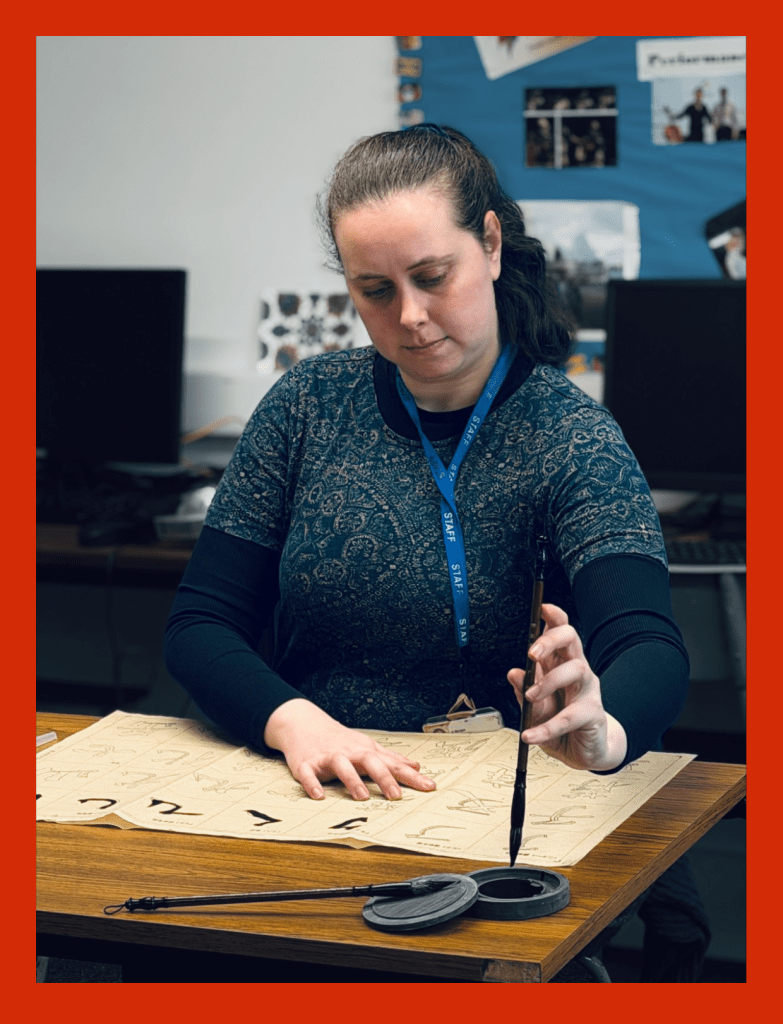
Learning Calligraphy
Photographed by Sophia.

For example, some of the Full Chinese Readers (for older or more fluent students) had texts spanning three volumes, but Google Translate gave me the translations: upper, middle and lower. How was I to tell which meant volume one? 

Well, I asked Sophia! And she not only told me that upper (shàng) meant volume one but, when I found that counterintuitive, she even drew me a diagram to explain why. But please don’t ask me to replicate her explanation! 

Another difficulty I encountered was safeguarding items that I couldn’t read. In hindsight, I had started my cataloguing in the hardest place, with the Full Chinese Readers. These books were entirely in Chinese, with no English translation.  

One particular book gave me pause due to the images inside being potentially frightening for younger students. When I used Google translate to look over the first chapter, the text included gruesome illness, poverty deaths, a child’s coffin and possibly a racial slur. According to Wikipedia, the protagonist is also beaten by his uncle later in the book. The clunky translation changed depending on the angle I held my phone at, which didn’t help parse the actual context of the writing, in the way a language I was more familiar with might have allowed. 

Certainly, texts for older students can include difficult subject matter and even some inappropriate language. To Kill A Mockingbird (which I studied at school in Higher English) has racial slurs and 1984, studied at Chetham’s in the English A-Level, has an entire sequence where the main character is tortured. My worry here was that we have Chinese-speaking children in the school as young as eight years old, so I needed to be careful that any books within the Chinese Corner would not be unsuitable for them to pick up and browse without the staff realising what they were accessing.  

Because I was so unfamiliar with the language, I felt unplaced to make the appropriateness call myself, so my solution was to keep that particular book in the back office rather than on the shelves. It is available if explicitly requested, but there is no danger of younger or more sensitive students accidentally accessing something that might be upsetting. 

After the Full Chinese Readers were completed, the rest of the books were actually considerably easier to catalogue. From a safeguarding perspective, many were geared towards younger readers, and with others, such as the Chinese Music, it was clear what their contents were about. Some of the books I liked most (from a cataloguer and a school librarian perspective) were the ones that had side-by-side Chinese and English. 

For fun, I tried reading one of the early reader texts: The Little Mouse by Lucy Wang. After a year of studying the language, this 28-page story, about a little mouse (lǎoshǔ) who ate so many meatballs (ròuwán) he looked like a pokeball (Pokeball), was surprisingly accessible, and rather cute! 
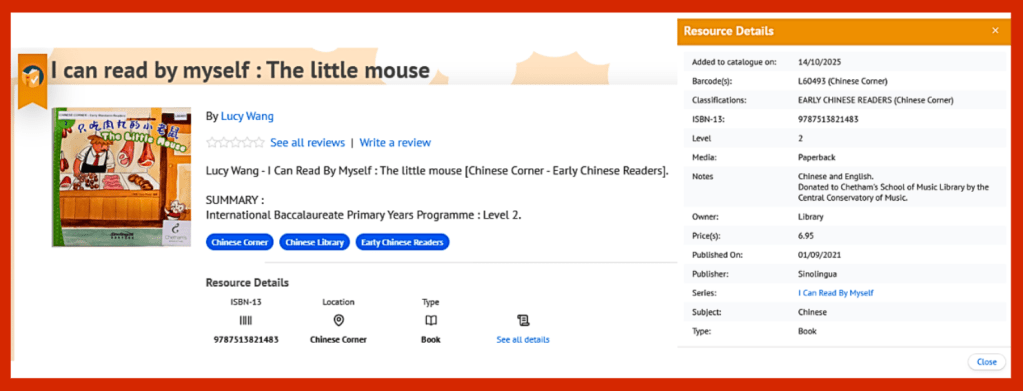
Complete Catalogue Record for The Little Mouse by Lucy Wang

The materials were brought over in April, and the full collection was completed (sorting, processing, cataloguing and all) by the October half term break. The project was put on hold for June, July and August due to end-of-term commitments and the library being closed over the school’s Summer Holiday. So, it effectively only took me and Charlotte about six months to complete the bulk of the work. Alongside running everything else in the library too, that’s something we can be very proud of. 

The Grand Opening 

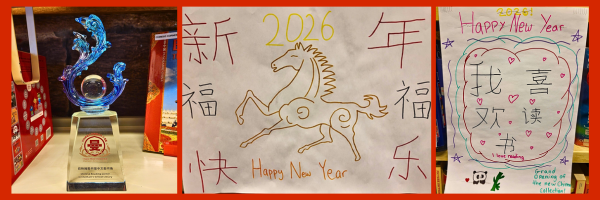
The Reading Corner’s Grand Opening event was fantastic. Two of our Duke of Edinburgh volunteers created posters for Chinese New Year, and the CMC donated a beautiful glass plaque for the Reading Corner. The three staff members from the Chinese Music Classroom set up a traditional Chinese bookmark craft station on our large table, with stickers and paints and ribbons and Chinese characters.
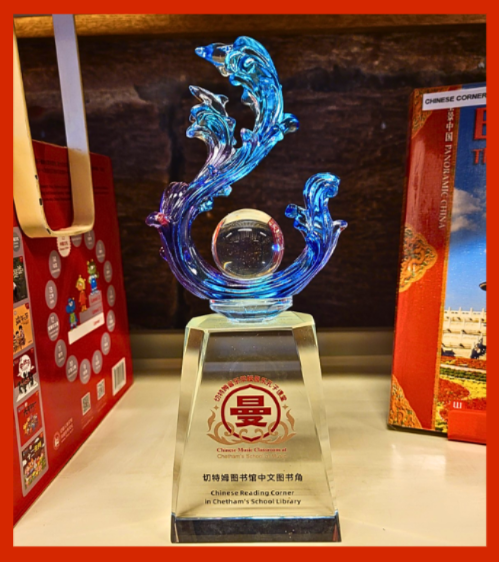
Chinese Reading Corner Plaque
Donated to Chetham’s School of Music Library by the Central Conservatory of Music, Beijing

That break and lunchtime, students came in droves to participate. Although I had to split my focus between helping students at the library desk and the event itself, the three CMC teachers ensured the area was supervised the whole time. (Which was particularly important for keeping the energy high and the paints on the paper!)

A group of about eight juniors kicked it off, and then other students and staff took part as well. A couple of Y13 students, who had been intrigued at morning break, returned that lunchtime to ask whether it was just a Lower School event – and were delighted to be told they could join in too! 

It was also interesting to chat to some Y9s, who I had taught Literacy to when they were in Y7, about all the languages they spoke. One little girl told me that she spoke Cantonese and Spanish at home, alongside knowing English and Mandarin from living in England and China, and now she was also learning French and German in school. And – on top of that – she reads music! 

I even got to know the Chinese teachers better. I knew Sophia, of course, from the Chinese classes, but I hadn’t really spoken to either of the other two. One of them mentioned that, while the others came from Beijing, she was from a small town in China. Sophia hastened to let me know (so I didn’t get the wrong idea) that the “small town” was actually a little larger than Manchester! 
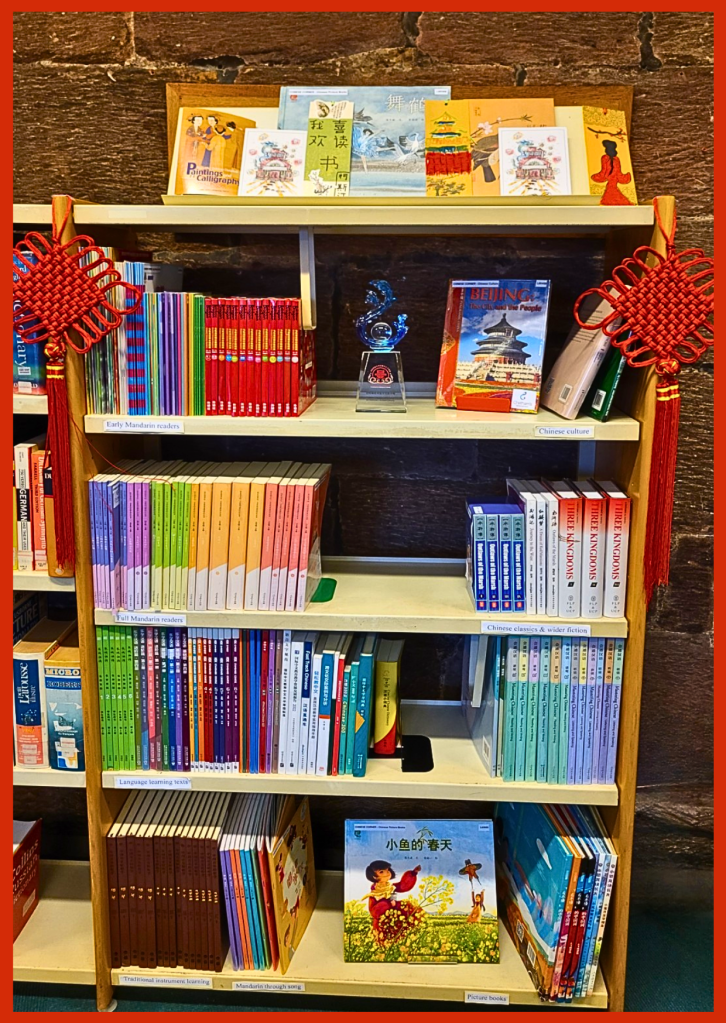
Final Chinese Reading Corner

Projects like this can fly under the radar once they are complete. The year of learning a foreign language, planning, cataloguing, processing, agonising(!) disappears into the shelves and looks like it has always been there. So, it was really gratifying that the final Grand Opening was such an engaging event, and it looked great on social media.

While framing the project through only the final event risks reducing over a year’s work into a single activity day, the effects of the project will hopefully have a long-lasting positive impact in the school library. Already, Chinese students and some students who are learning it in the school, are excited to have a bookshelf of brand-new books in their language.

As an example, even before the Grand Opening, one of the Y7 Literacy students pleaded with me to let her take out the Romance of the Three Kingdoms. Although I was initially reluctant (I hadn’t yet added its record), I relented and created a quick placeholder record that I completed when she returned the book!

Beyond this, the Reading Corner can serve as a future template to upgrade the rest of the language areas of the school library. I’d love to just dive in with an entirely similar scale project for the French and German materials, but unless Chetham’s wants to twin with a Francophone or Germanic donor, we’ll need to be a little more realistic. That being said, while the process will take longer due to budgeting restrictions, I’ve made a start by ordering the French text versions of some popular kids’ novels, in imitation of the Full Chinese Reader section of the Chinese Reading Corner. 

And just this past week, I was told that the school is planning to use the library classroom for some of the Chinese lessons. Having the Chinese Reading Corner just outside the door feels almost perfect. 
World Book Day 2026

I must admit, I frequently feel a bit anxious about arranging library events, and World Book Day is the Behemoth of library event days. For months the School Libraries Association sends out messages about dressing up and World Book Day activities. In the past, I have created Geography displays (world books, geddit?) and told myself ‘Next year, I might actually have the energy to engage in something more exciting’.

But, having worked at Chetham’s for five years now (five!), I finally bit the booklet and got involved properly. Or at least, as properly involved as a school music librarian with a mildly crippling anxiety of overexposure can be expected to be.

It started with a staff email from the Academic Principal, asking several relevant staff members to let the Comms Department know if we were planning anything for World Book Day. That afternoon, the Head of Lower School responded that the younger students would be encouraged to dress up as book characters and there would be a D-E-A-R (Drop Everything And Read) event at 12pm.

After the half term, the English Department also got back to the Comms team to say that the Y7s and Y8s were given free books by the Book Trust and would be doing a blind-date with a book activity. They also suggested KS3 students could join the Drop Everything And Read event.

So far, so nothing from the School Library.

In a brainstorm session with the library assistant, Charlotte Stevenson-Stoddard, she suggested she could make some decorations if we asked for some card from the Art Department. I internally balked at the idea of dipping into another department’s budget, but when I asked the Head of Art, Alison Boothroyd, she was really lovely and let me come over and select a piece of card in every colour she had – and two in white!

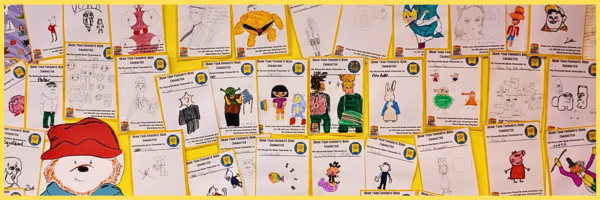
I told the Comms team that the school library’s participation would be a Draw-Your-Favourite-Character station for the full week, and the students’ contributions would be added to the library display. We had also been sent the World Book Day Tokens, so the students were told they could collect these from the library desk.

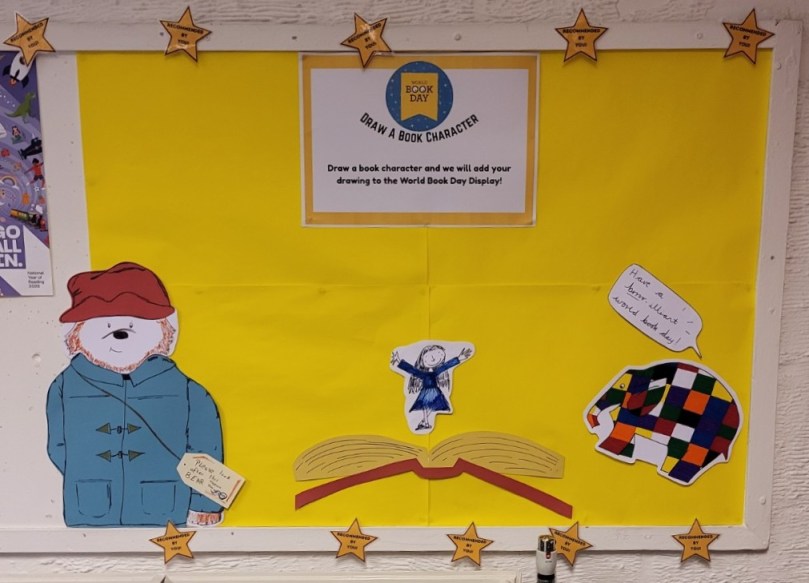
The Monday before World Book Day, I brought in some new colouring pens from home to join the colouring materials the library already had, and I put up the characters that Charlotte had created during her weekend shift: a patchwork Elmer Elephant, a Matilda Wormwood, an open book, a giant Paddington Bear, and a library signpost.

Louise Fogg, the Head of Learning Support, was really supportive of the display, but was correct that the characters sort of faded into the white backboard. She gave me four A3 pieces of yellow paper (coincidentally almost exactly the World Book Day colour!) that I put up to make the display ‘pop’.

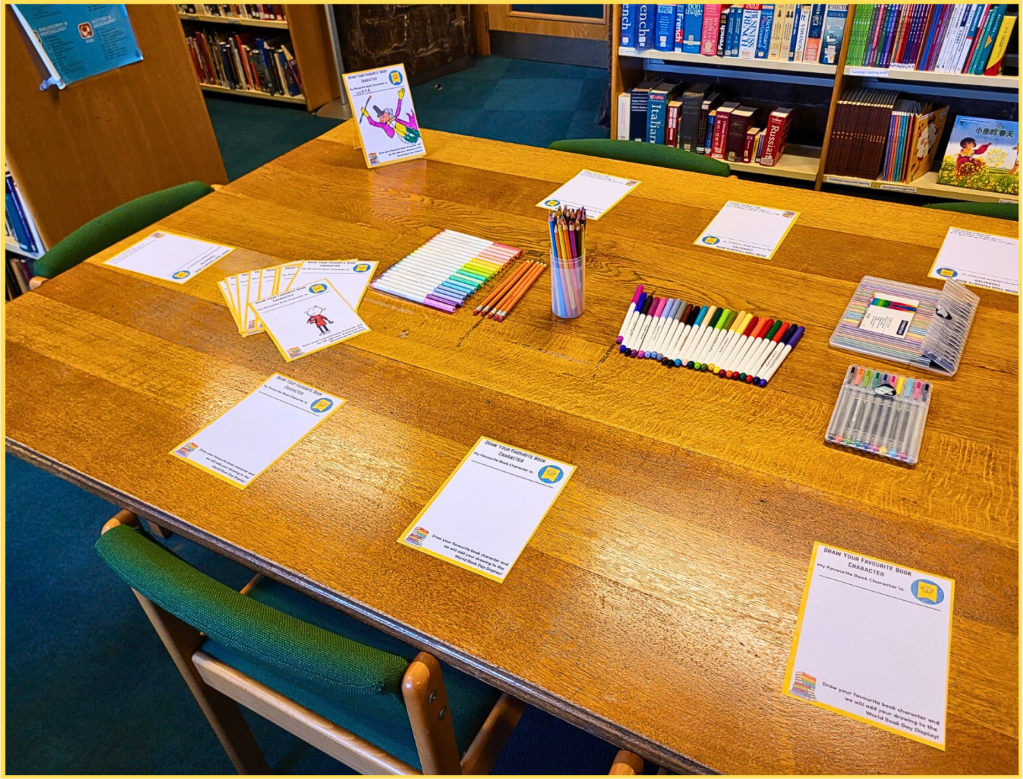
In Canva, I created and printed off about twenty initial Draw Your Favourite Book Character sheets, and I laid out the drawing station on our long wooden study table in the main library. Taking inspiration from the Chinese Reading Corner opening the school library hosted in January, I initially set up along the full table. However, without three staff continuously operating the station, it mostly resembled an austere set of worksheets.

That first Monday morning break, I asked some Juniors who had been very keen during the Reading Corner opening if they wanted to draw a character. But whether it was the uninviting worksheet spread, or simply nerves of being the first one to put themselves out there, once one of them said no, none of the others wanted to do it either.

One child admitted she didn’t know who to draw. Although I offered alternatives – it didn’t need to be a favourite character, and suggested she could copy a picture from a book – my encouragements were still insufficient to slay the dragon of being the first participant.

So, I regrouped.

I tightened the station to occupy just one end of the table, which made it look less sprawling and freed up space for non-participants to still use the table to study at. And I drew a couple of example characters, Willy Wonka and Greg from Wimpy Kid, propping them up on a book display easel. As I was drawing, a Year 8 who happened to be passing said that the table looked nice. That Monday lunchtime (miracle of miracles!) she was back with a group of her friends to draw more Wimpy Kid, Dora the Explorer and Shrek!

After the first few pictures, the display started to take off. One little girl said her favourite character was Coco from Witch Hat Atelier but she didn’t want to draw her. I made her a deal that I would draw her a Coco if she drew any character, so she drew a cowboy with a big hat, and I drew Coco.

Since the display was up for several days, students who had lessons and study sessions in the library sometimes joined in too. This meant that a Year 10 group who come into the library first thing on Tuesdays, the Choristers who get extra library prep sessions, and the Y7 literacy class all had scheduled opportunities to add their contributions.

I also asked the library prefect to create one, and she enlisted her friend’s contributions. So by the end of Wednesday, we had the full gallimaufry from Y4-Y13 – and a range of favourite media from Peppa Pig, through the web comic Lord of the Mysteries to Gregor Samsa from Metamorphosis!

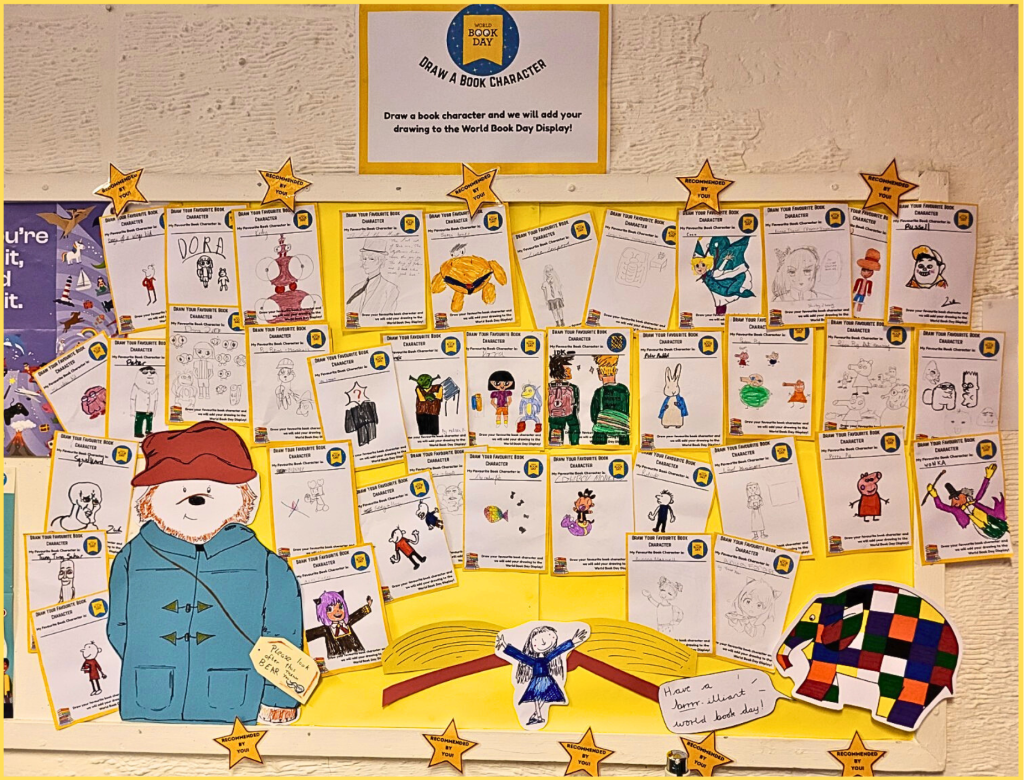
By the time World Book Day itself came around on the Thursday, the board was already a chaotic collage of characters that I had rearranged several times to make room for them all.

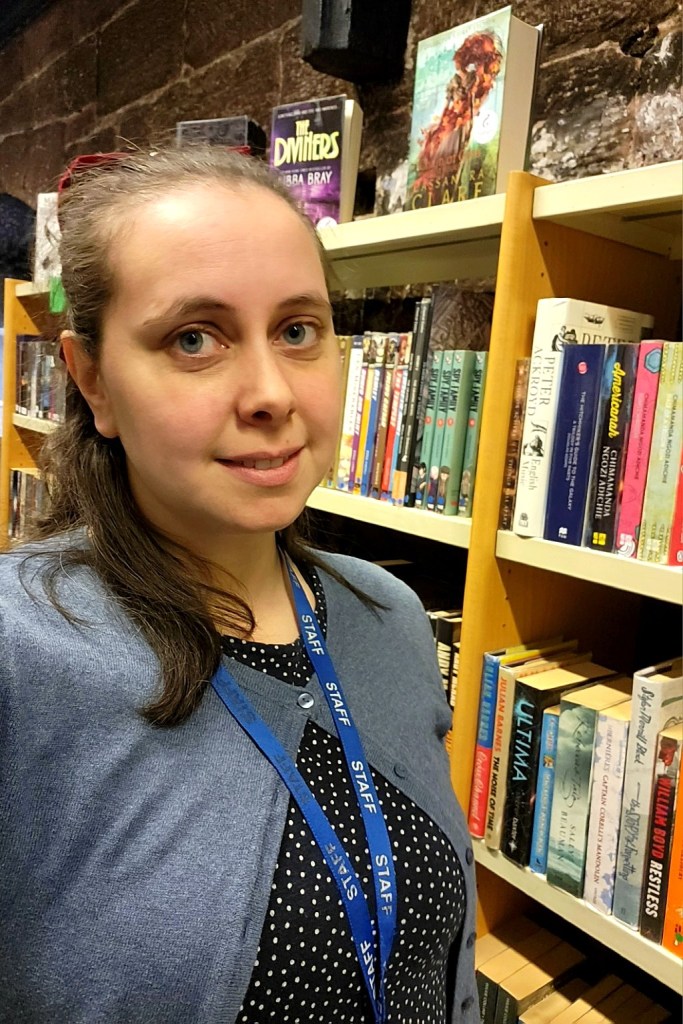
Because I already practically wear the same each day anyway, I dressed as Matilda Wormwood (you can just see the red bow in my hair).

And the additions kept coming. We got Bunny vs Monkey, and Spy x Family and Peter Rabbit and Dork Diaries and the Book Thief and more Peppa Pigs and Doras the Explorers. One child even drew Unc Status, which I think is a meme(?). On the subject of memes, I asked my group of Duke of Edinburgh volunteers to create pictures for the display, and I received a range of submissions from Up to Family Guy’s Peter Griffin to YouTube “Brainrot” characters who I’d never heard of but researched as best I could to check they were school-appropriate.

I was delighted by every single addition, but my favourite was the Heartstopper drawing by one of the Choristers. She is a little self-deprecating, and when I told her I really liked her drawing she corrected me very seriously that, “It isn’t that good.” Nonetheless, there were several comments throughout the week that her drawing was very good, which was wonderful to hear.

Having the station set up throughout the week worked particularly well, allowing for the slow start and refinement to take wheels. I loved to see how excited the students (and some staff) were to see the board. They tried to work out who had drawn what and showed off their contributions to their friends (which sometimes inspired more drawings!)

If there’s anything I learned from the activity, it was mostly just the repeated positive reinforcement that every time the students at Chetham’s are given the opportunity to participate in an activity (whether that’s a Chinese Book Corner opening, a Bookmark Competition, a Reading Challenge, or a World Book Day drawing station) they are significantly more on board (in this case, literally) than I fear they might be during the preparation and planning stages.

Yes, future Kirsty, when you’re reading this back and worrying about whatever next library initiative you’re planning – even that one too!

Our final World Book Day display

Dark Academia Display

In a move that was very much less what-do-I think-my-students-will-enjoy in favour of what-do-I-want-to-make-a-display-about, I decided to create a Dark Academia display for my school library.

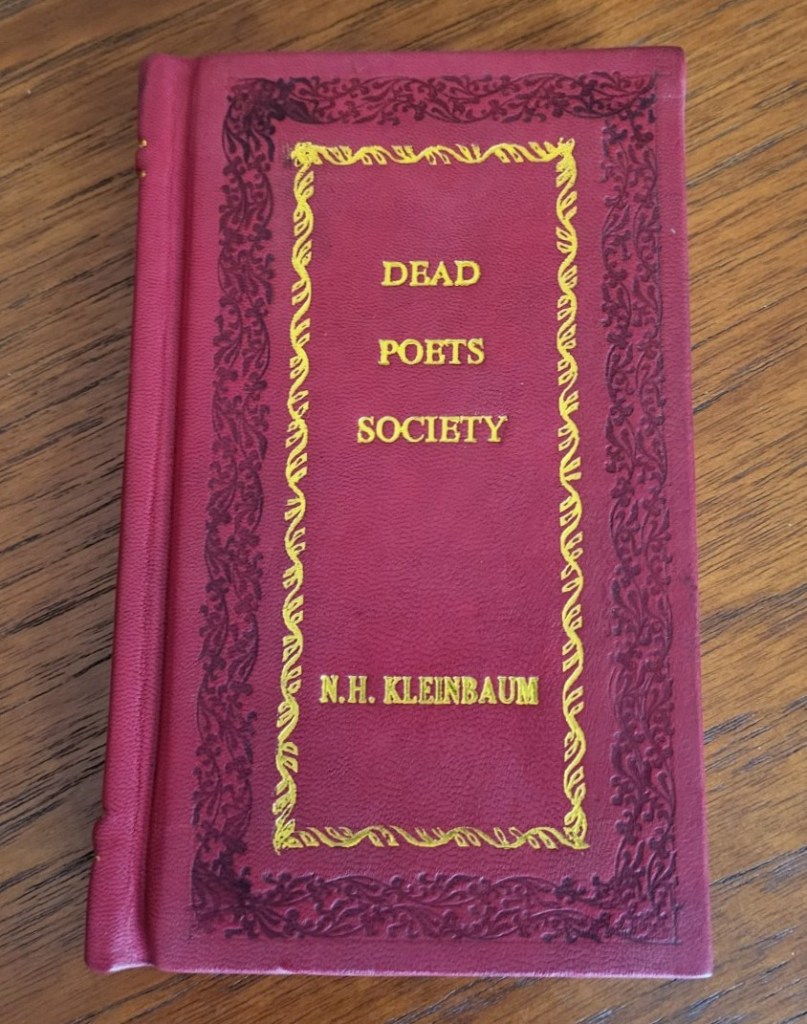
My fancy custom bound copy of
Dead Poets Society
(because I did not want to just have Robin William’s face on my bookshelf).

Ever since I read Donna Tartt’s The Secret History back in April, I have been on what can only be described as something of a Dark Academia fixation. I purchased a series of lectures from Signum University about Dark Academia, which I am still working (gloriously playing?) my way through, and I have been subjecting my poor, beleaguered Calum to every Dark Academia (and Dark Academia-adjacent) movie I could find. Some more enjoyable for him than others.

Bookwise, I’ve been dipping into various Dark Academia titles (If We Were Villains, Babel, the Atlas trilogy) only to stop partway through and move onto the next because I didn’t want any of them to end! I did read Hangsaman by Shirley Jackson and the ridiculous novelisation of The Dead Poets Society by N. H. Kleinbaum in their entireties – but then, I also gave each only two stars on Goodreads, so that maybe tells you something about my reading habits?

Anyway, on the pleasingly symmetrical date of 25/09/25, I finally completed the Dark Academia display I’d been working on since the school returned from the summer holidays. And I am proud enough of it to want to write about it.

Selecting the Books

I started by looking through our collection for existing Dark Academia titles. We already had a few young adult options: Ace of Spades had been nominated for the 2022 Carnegie awards, Atlas Six had been part of a recent donation to the school library, The Secret History and The Invisible Life of Addie La Rue had been purchased at the request of some students a few years ago, and a couple other books had been picked up along the way – often likely without Dark Academia in mind. (I can’t imagine anyone was thinking TikTok aesthetics when The Prime of Miss Jean Brodie was added to the collection back in 2010.)

At the end of last term, I had also cheaply purchased a set of young adult Dark Academia books from Scholastic, which meant we now had plenty of books to attract the older students. But I was still struggling for items that would appeal to our juniors. A Series of Unfortunate Events has The Austere Academy, which I added to my pile, and I was informed online that Lockwood and Co. has Dark Academia vibes (although, judging by the blurb, it reads less Dead Poets Society and more Dead Boy Detectives). To balance things out, I also ordered The Mysterious Benedict Society, which I had not read but enjoyed watching in its semi-recent TV adaption. If anyone has any 8-12-year-old Dark Academia recommendations, I would be very interested to hear them.

Incidentally, when the Scholastic pack arrived, I discovered I had already read one of the books in it. The Library of the Unwritten by A. J. Hackwith is a book that I had not only completed in 2021, but I had even given it five stars on Goodreads. This baffled me because, despite clearly enjoying it at the time, I must admit I hardly remember the book now. However, from what I do remember, although setting largely features a library in Hell, the book otherwise doesn’t seem especially Dark Academia. I wonder if it was perhaps lumped into the pack more because the Dark Academia category is currently selling well than because it actually explores any of the darker aspects of academia.

Perhaps, though, that is a somewhat hypocritical distinction. In scrambling for books to fill my display, I too broadened my scope for what counts as Dark Academia. (Looking at you, Picture of Dorian Gray.)

Designing the Display

The Completed Display

With the books selected, it was time to design the display itself. Across the top shelf, I draped a spiderweb tablecloth that I normally use for Halloween displays, and I piled up some of our oldest-looking tomes from the reserve section in the back office. I also unearthed a plastic compass that I had used for our Talk Like A Pirate Day display a few years ago, and I brought in a small Roman-style bust from home – because no Dark Academia display is complete without a small Roman-style bust.

Charlotte, the school library’s evening library assistant, created some Dark Academia recommendation bookmarks on Canva, which I thought was very cool. Finally, because the lower shelves looked quite bare, I bought some embroidered tapestry ribbon on Amazon to cover them, and I think the effect is quite nice. We can also use the ribbon for Christmas, so it is pleasingly performing double duty!

Reception

The display has proved quite popular, which I was very relieved by. In fact, before I could even get a photograph of the finished project, a sixth-form student had already taken out The Secret History! I also had a really lovely conversation with the head of the Lower School about the books – turns out she likes books about dragons too! – and I came away with several book recommendations, including Jodi Taylor’s The Chronicles of Saint Mary’s, which sounds very much up my street.

I even heard a group of students talking about how my display was ‘like TikTok’, and I still cannot decide whether that was a compliment. I am choosing to take it as confirmation that I am, in fact, ‘Down with the Kids’!

All in all, I was very happy with how the display turned out. And I thought it might interest you to know what books finally ended up on it. So I will leave you with the full booklist.

Booklist

Dark Academia Recommendations Bookmark
(Created by Charlotte Stevenson-Stoddard)

Junior

Shadowhall Academy: the Whispering Walls by Phil Hickes
The Austere Academy by Lemony Snicket
Who Could That Be At This Hour? by Lemony Snicket
The Mysterious Benedict Society by Trenton Lee Stewart
Lockwood & Co : the Screaming Staircase by Jonathan Stroud

Young Adult

Ace of Spades by Faridah Àbíké-Íyímídé
Where Sleeping Girls Lie by Faridah Àbíké-Íyímídé
A Dark Inheritance by H. F. Askwith
The Atlas Six by Olivie Blake
The Devil Makes Three by Tori Bovalino
Infernal Devices by Cassandra Clare
Legendborn by Tracy Deonn
The Library of the Unwritten by A. J. Hackwith
Truly Devious by Maureen Johnson
A Lesson in Vengeance by Victoria Lee
The Raven Boys by Maggie Stiefvater
The Invisible Life of Addie La Rue by V. E. Schwab
A Language of Dragons by S. F. Williamson

Adult

Never Let Me Go by Kazuo Ishiguro
The Historian by Elizabeth Kostova
Babel by R. F. Kuang
If We Were Villains by M. L. Rio
The Prime of Miss Jean Brodie by Muriel Spark
The Secret History by Donna Tartt
The Picture of Dorian Gray by Oscar Wilde